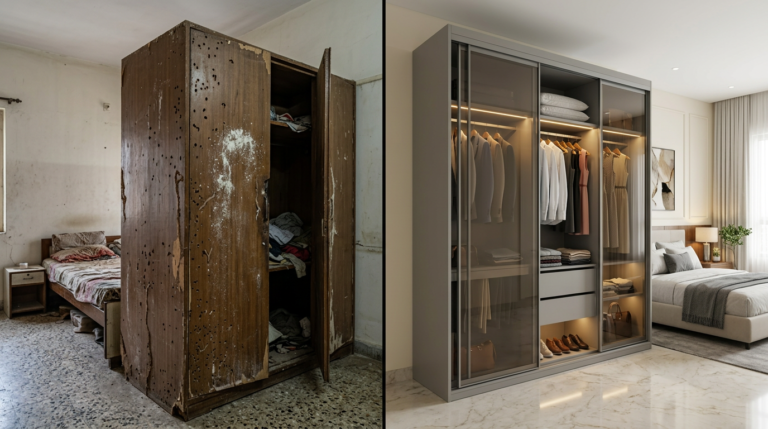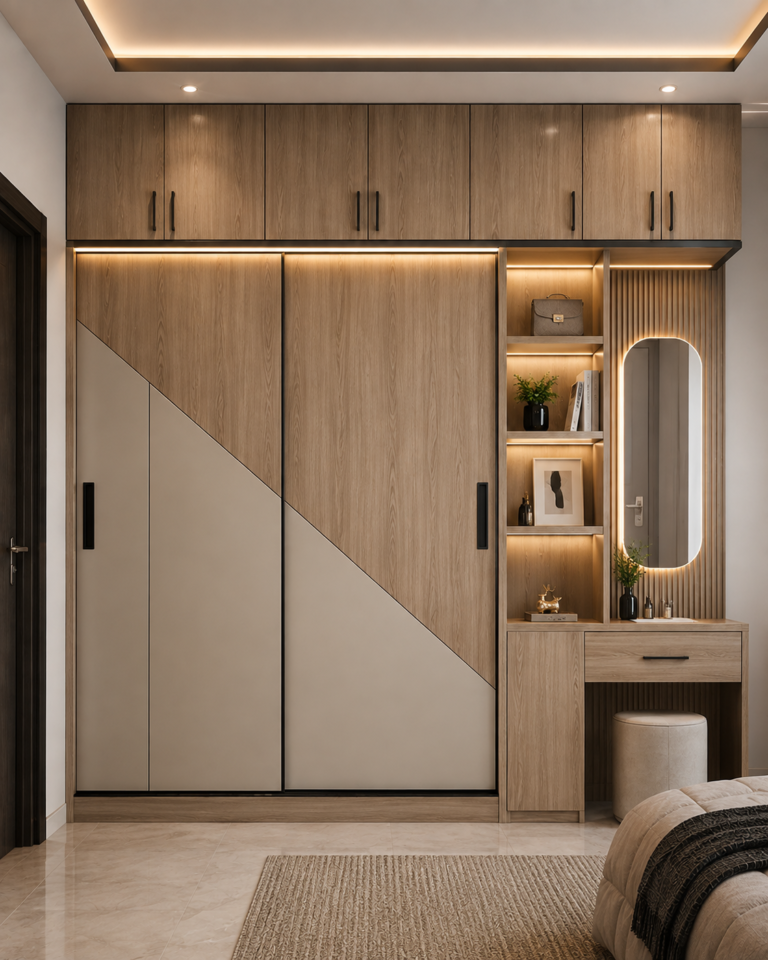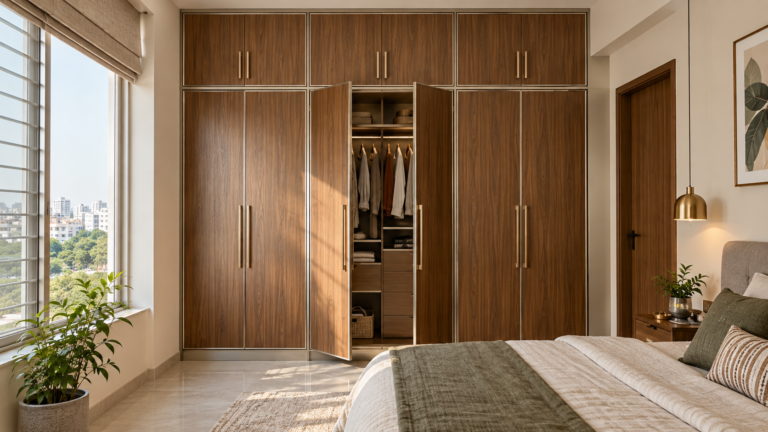
Honeycomb Shutter Doors for Kitchens & Wardrobes
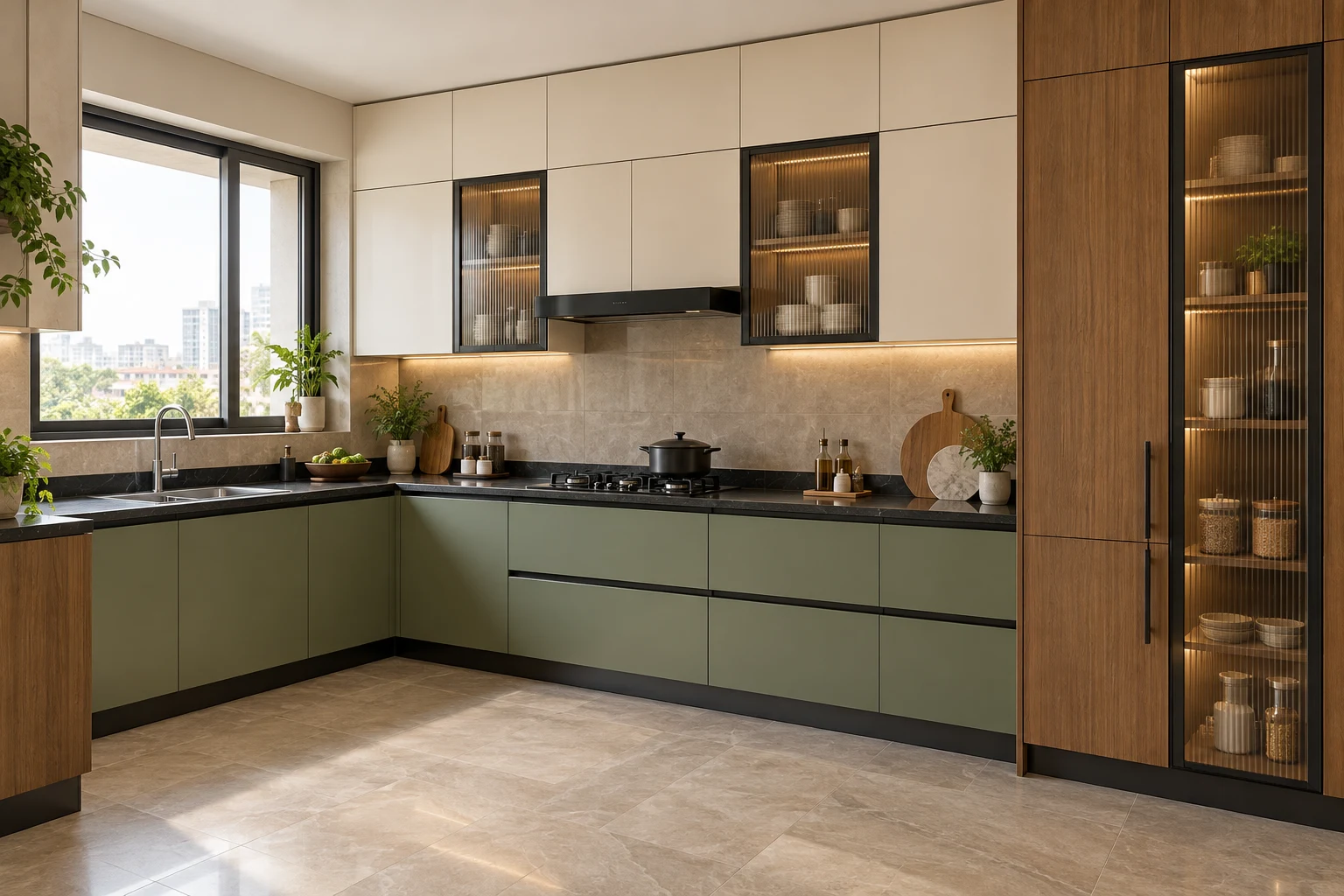
Most homeowners in Hyderabad never know what is inside the box-type aluminium or steel shutters on their modular kitchen and wardrobe. The answer is a honeycomb cardboard core — a structure so well-engineered that it is used in aircraft interior panels, furniture, and premium doors worldwide. Metal & More Interiors explains the full structure, advantages, and why it is the correct choice for modular kitchens and wardrobes in India.
The honeycomb cardboard shutter aluminium kitchen wardrobe India choice is not accidental — it is the result of decades of material engineering applied to the specific problem of building lightweight, rigid, moisture-resistant doors for Indian homes. Walk into any Metal & More Interiors showroom in Hyderabad and knock on one of our aluminium or stainless steel kitchen shutter doors. It will feel solid and rigid — not hollow, not flimsy. But pick it up, and you will be surprised by how light it is for its size. That combination is entirely due to the honeycomb cardboard core inside the door.
This is not a cost-cutting measure or a shortcut. The honeycomb cardboard core in every aluminium kitchen wardrobe shutter is a deliberate, engineered choice used by premium furniture manufacturers worldwide, including in aerospace, automotive, and architectural applications. In this guide, we explain exactly what it is, how it works, and why it is superior to all alternatives in Indian modular kitchens and wardrobes.
What Is a Honeycomb Cardboard Core? The Structure Explained
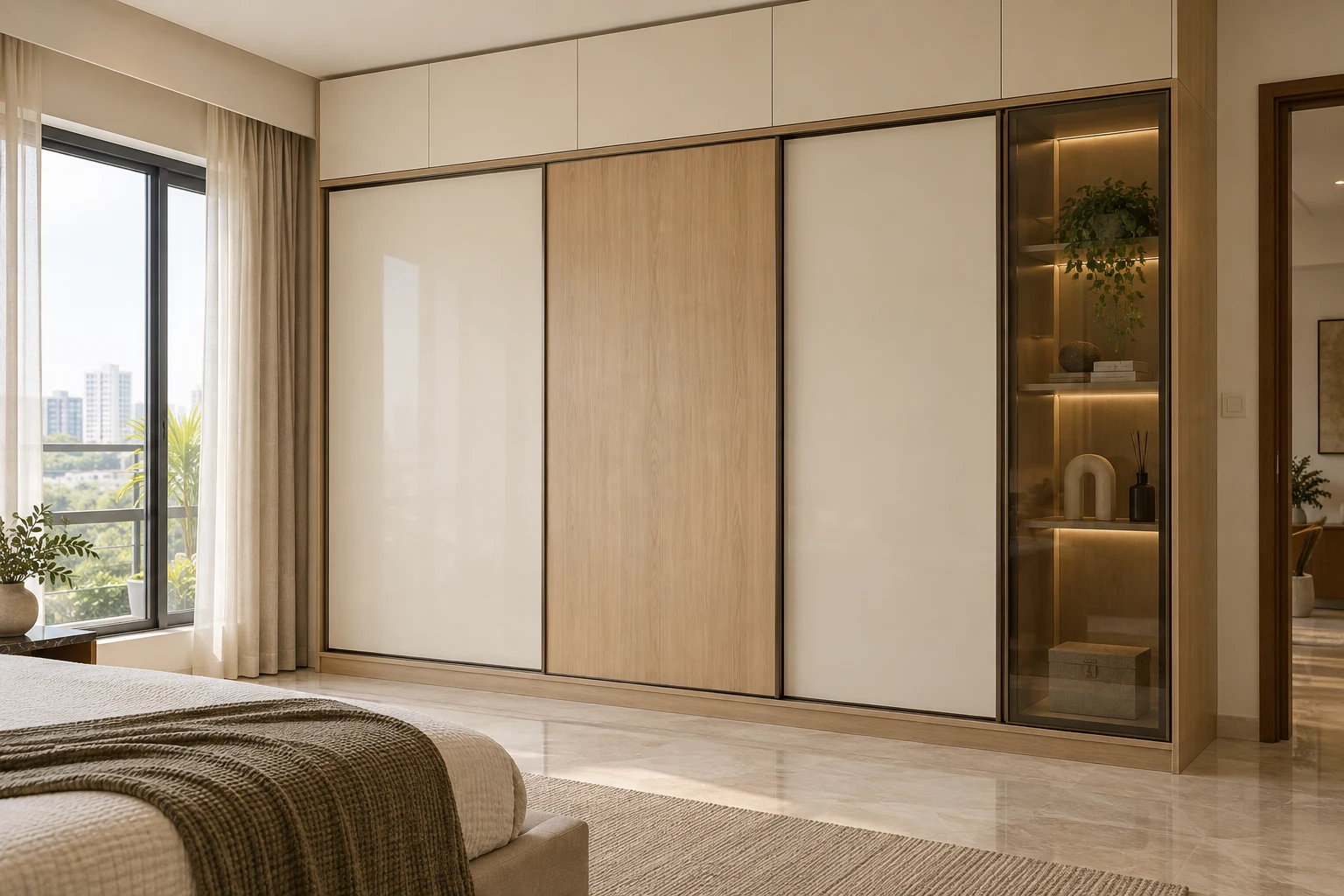
The honeycomb cardboard core used inside box-type kitchen and wardrobe shutters replicates the geometry of a natural honeycomb — hexagonal cells arranged in a continuous grid. This geometry is the most structurally efficient shape known in nature and engineering, allowing maximum load distribution with minimum material.
A honeycomb cardboard shutter aluminium kitchen wardrobe India installation uses a core that is exactly what it sounds like — a layer of cardboard or kraft paper that has been formed into a continuous pattern of hexagonal cells, just like the natural honeycomb structure made by bees. This formed layer is then sandwiched between two flat face sheets and enclosed within the door frame.
The hexagonal cell geometry is not chosen by accident. It is the most structurally efficient closed shape in geometry — meaning it distributes compressive force across the maximum number of contact points with the minimum amount of material. This is why bees use it to store honey, why aircraft manufacturers use it for interior panels, and why premium furniture manufacturers use it for lightweight, rigid doors.
The Four Layers of a Honeycomb Cardboard Shutter Door — Explained
Every honeycomb cardboard shutter used in a box-type aluminium or stainless steel kitchen door or wardrobe panel is built from four distinct layers. Each layer has a specific structural or functional role. Understanding these layers allows you to verify the quality of any kitchen shutter you are considering in Hyderabad.
Why Honeycomb Cardboard Is Stronger Than Solid — The Engineering Explained
The engineering principle behind honeycomb strength is load distribution across an entire cell network simultaneously. When pressure is applied to any point on a honeycomb panel, every cell in the panel resists the load together — unlike solid material where only the point of contact bears the stress. This is why honeycomb performs at levels that seem counterintuitive for a paper-based structure.
Most people find it difficult to believe that a cardboard structure inside a kitchen door can be genuinely strong. The intuition is that cardboard is weak, and therefore a hollow-cardboard door must be weaker than a solid one. This intuition is wrong — and understanding why requires a small lesson in structural engineering.
The Hexagon Principle — Why Geometry Creates Strength
A solid panel bears load in a straight line from the point of application through the material to the support below. A honeycomb panel distributes that same load through every wall of every cell in contact with the loaded area simultaneously. Because each hexagonal cell shares its walls with six adjacent cells, load applied to any one point is immediately shared across a network of interlocking structures. This is what engineers call load distribution — and it is the same principle used in arch bridges, egg shells, and aircraft fuselage skins.
Weight-to-Strength Ratio — The Real Comparison
The correct way to evaluate a door core material is not raw strength — it is strength-to-weight ratio. A solid wood door panel of 600 mm x 800 mm weighs approximately 12–18 kg. An aluminium-framed honeycomb panel of identical size weighs 3–5 kg. Despite being 70–80% lighter, the honeycomb panel resists compressive and bending loads at comparable or superior levels for normal kitchen door use. The lower weight means:
-
Longer hinge life — the single biggest cause of hinge wear in Indian kitchens is door weight. A honeycomb aluminium door weighing 3–5 kg places 60–70% less stress on hinges than an equivalent solid-wood door at 12–18 kg. At Metal & More Interiors, we use Hettich Sensys hinges rated for the correct load — and the lower door weight means the hinge rating is used by only a fraction of its capacity, dramatically extending service life.
-
Easier daily operation — a lighter door requires less effort to open and close. In a modular kitchen accessed 30–50 times per day, this translates to meaningfully easier daily use, especially for children and elderly family members.
-
Less sag over time — heavy solid doors sag at the hinge point over years, causing misalignment. Lighter honeycomb doors maintain their alignment far longer under identical hinge specification.
-
Safer for tall cabinets and overhead units — in overhead kitchen cabinets where the door opens upward on a lift system, lighter doors reduce the force required for the lift mechanism and reduce injury risk if the mechanism fails or is operated unexpectedly.
Does Honeycomb Cardboard Hold Up in Indian Kitchen Conditions? Humidity and Moisture Answered
Indian kitchens present one of the most demanding environments for any furniture material — daily cooking steam, monsoon humidity up to 90% in Hyderabad, proximity to sink splash zones, and decades of thermal cycling. The honeycomb cardboard core, when correctly sealed inside a waterproof aluminium or stainless steel frame, is completely isolated from these conditions and performs without degradation for 15–20 years.
The most common concern homeowners raise about honeycomb cardboard shutters is moisture. “Cardboard gets wet and falls apart — how can this be good for a kitchen?” The answer lies in understanding how the core is protected, not just what it is made from.
In a correctly fabricated box-type honeycomb shutter, the cardboard core is completely enclosed — the aluminium or stainless steel outer frame forms a sealed perimeter around all four edges, the face sheets on front and back are bonded with waterproof adhesive, and the visible outer finish (PVC, ACP, or paint) provides an additional moisture barrier. The cardboard core never comes into contact with kitchen steam, splash water, or cleaning agents at any point in the door’s service life.
Honeycomb Core vs Alternatives — Which Filling Is Best for Kitchen and Wardrobe Shutters India 2026
Comparison of kitchen shutter door filling materials — honeycomb cardboard core versus solid wood, MDF, foam, and hollow (no core). Each option has different weight, strength, moisture resistance, and cost implications for modular kitchens and wardrobes in Hyderabad. Honeycomb cardboard consistently delivers the best combination across all criteria.
| Filling Type | Weight | Strength | Moisture Resistance | Hinge Impact | Cost | Best For |
|---|---|---|---|---|---|---|
| Honeycomb Cardboard | Very Low | High (panel load) | Excellent (when sealed) | Minimal wear | Medium | Kitchens + Wardrobes |
| Solid Wood | Very High | High | Poor — swells/cracks | Heavy wear | High | Avoid in Indian Kitchens |
| MDF Core | High | Medium | Poor — swells fast | Heavy wear | Medium | Not Recommended |
| Foam (PU) Fill | Low | Low — dents easily | Good | Low wear | Low | Budget Only |
| Hollow (no fill) | Very Low | Very Low | N/A | Low wear | Lowest | Not Suitable |
| Aluminium Honeycomb | Very Low | Very High | Excellent | Minimal wear | Very High | Aerospace / Ultra-Premium |
The comparison above makes clear why honeycomb cardboard is the dominant choice for box-type kitchen and wardrobe shutters in India. It is the only option that scores well across all criteria simultaneously — and in Indian conditions particularly, its low weight, sealed moisture resistance, and long hinge life make it structurally ideal for aluminium kitchen shutters, stainless steel kitchen doors, aluminium wardrobes, and stainless steel wardrobes.
Where We Use Honeycomb Cardboard Shutters — Kitchen and Wardrobe Applications in Hyderabad
Aluminium Modular Kitchen Shutters
- All base cabinet doors
- All wall cabinet doors
- Tall-unit pantry doors
- Loft and upper storage shutters
- Appliance housing doors
- Island cabinet shutters
Stainless Steel Kitchen Doors
- SS304 base and wall cabinet doors
- Heavy-duty drawer front panels
- Cooker hood and chimney housing
- Under-sink cabinet shutters
- Corner and carousel unit doors
- Service and utility kitchen shutters
Aluminium Wardrobe Shutters
- Full-height swing door panels
- Sliding wardrobe door infill panels
- Walk-in wardrobe door shutters
- Study and TV unit door panels
- Children’s wardrobe doors
- Guest room wardrobe shutters
Stainless Steel Wardrobe Shutters
- Master bedroom SS wardrobe doors
- Hotel and hospitality wardrobe panels
- Commercial and office cabinet doors
- High-humidity bathroom storage shutters
- Premium residential walk-in wardrobe doors
- Heavy-use storage unit shutters
How Metal and More Interiors Fabricates Honeycomb Cardboard Shutters — Our Exact Process
The quality of a honeycomb cardboard shutter door is entirely determined by the precision of its fabrication — the frame corner joins, the core density, the face sheet bonding, and the edge sealing. At Metal & More Interiors, every shutter undergoes a six-step fabrication process before it reaches your kitchen or wardrobe installation in Hyderabad.
- 1
Frame Cutting and Corner Joining
The aluminium profile or stainless steel section is cut to precise length on a mitre saw with a degree-accurate stop. Corners are joined using purpose-made aluminium corner keys (not just mitre tape) which are pressed and locked into the profile channel. This creates a rigid, gap-free frame perimeter that is essential for edge sealing and structural integrity.
- 2
Honeycomb Core Sizing
The honeycomb cardboard core is cut to fit precisely inside the frame — with zero gap on all four sides. The correct core density is selected based on door size: doors larger than 600 mm in any dimension receive a higher-density core (smaller cell size) to prevent mid-panel flex. Doors for overhead cabinets receive a standard density core given their lower impact load requirement.
- 3
Face Sheet Bonding
The face sheets are bonded to the front and back of the honeycomb core using contact adhesive applied to both surfaces under controlled pressure. The bonded sandwich (face sheet + core + face sheet) is pressed flat until the adhesive sets. This bonding step determines whether the face sheet stays perfectly flat over 15 years or begins to delaminate — at Metal & More Interiors, we use industrial-grade contact cement and allow full cure time before assembly.
- 4
Frame Assembly and Edge Sealing
The bonded core panel is inserted into the aluminium frame. All internal frame joints and the gap between frame and core are sealed with waterproof silicone or self-adhesive foam tape before the second face is closed. This step is the most critical for moisture protection — any unsealed gap is a potential water entry point. We check every frame corner and every edge joint before closure.
- 5
Finish Application
The outer finish — PVC film, ACP sheet, powder coat, or PU paint — is applied to the sealed shutter. For PVC film doors, the film is applied under heat and pressure using a vacuum membrane press to ensure complete bonding without air bubbles. For powder-coated aluminium shutters, the profile is powder-coated before assembly to ensure even coverage on all visible surfaces.
- 6
Quality Check and Hardware Drilling
Every completed shutter is checked for flatness (tolerance: less than 2 mm across the full panel), edge sealing integrity, finish adhesion, and corner rigidity before drilling. Hinge cup holes and handle holes are drilled to precise templates using a jig drill press. No hand drilling — each hole is positioned to within 0.5 mm of the specification template. The completed shutter is then handed to the installation team with hardware pre-fitted.
Honeycomb Cardboard Shutter Price in Hyderabad — 2026 Reference
Below is a reference price range for honeycomb cardboard box-type shutters in Hyderabad as of May 2026. All prices are approximate and depend on aluminium grade, finish type, and hardware specification. Contact us for an exact quote based on your kitchen or wardrobe dimensions.
| Shutter Type | Frame Material | Finish | Price Range (per sq ft) | Best For |
|---|---|---|---|---|
| Standard Aluminium Kitchen Shutter | Aluminium 6063 | PVC Film (Matte / Gloss) | ₹350 – ₹500 | 2BHK kitchen, budget-conscious premium |
| Premium Aluminium Kitchen Shutter | Aluminium 6063 | ACP / Acrylic / Lacquer | ₹500 – ₹750 | 3BHK and villa kitchens, high-gloss finish |
| Stainless Steel Kitchen Shutter | SS304 Formed Section | Hairline / Brushed / Matt PVD | ₹650 – ₹1,100 | Premium and commercial kitchens |
| Aluminium Wardrobe Shutter | Aluminium 6063 | PVC / ACP / Glass Insert | ₹400 – ₹650 | Bedroom wardrobes, sliding and swing |
| Stainless Steel Wardrobe Shutter | SS304 Formed Section | Brushed / Mirror / PVD | ₹700 – ₹1,200 | Master bedroom, hotel, and premium residential |
Our Verdict — Why Every Box-Type Shutter We Make Uses Honeycomb Cardboard
See the Honeycomb Cardboard Shutter Structure at Our Hyderabad Showroom — Free Consultation
Visit Metal & More Interiors at Charlapally, Secunderabad to see and feel cut samples of our actual honeycomb cardboard shutter cross-sections. We show every client the inside structure of the shutters before installation. Free site visit, free measurement, and a full kitchen or wardrobe quote with hardware specification included at no charge.
+91 83286 40392Visit Our Showroom — See Honeycomb Shutter Samples in Person
Jai Jawahar Nagar, Yapral, Telangana 500087
Phone: 8328640392 | 8639067572
Email: dilep763@gmail.com
Hours: Monday – Saturday, 9:00 AM – 7:00 PM
Get Directions on Google Maps
Frequently Asked Questions — Honeycomb Cardboard Shutter Aluminium Kitchen Wardrobe India
Conclusion — The Honeycomb Cardboard Core Is Not a Secret. It Should Be Standard Knowledge for Every Homeowner
When you invest in an aluminium modular kitchen, a stainless steel kitchen, an aluminium wardrobe, or a stainless steel wardrobe, you are not just buying a visible surface. You are buying what is inside the doors — the structure that determines how they feel, how long they last, and how well they hold up through years of daily Indian kitchen and wardrobe use.
The honeycomb cardboard core is not a shortcut or a compromise. It is the engineered answer to the precise challenge of creating lightweight, rigid, moisture-resistant door panels at a practical cost — and it is the material that goes into every box-type shutter that leaves our workshop at Metal & More Interiors.
We believe homeowners deserve to know what is inside their furniture — not just what it looks like on the outside. Visit our showroom in Charlapally, Secunderabad, and we will show you a cut sample of the actual shutter cross-section before you decide. That transparency is part of what we build at Metal & More Interiors. For your full kitchen and wardrobe plan, see our 2BHK interior cost guide or read our honest Hettich vs Häfele vs Ebco hardware comparison to understand what else goes into a well-built kitchen.