SS304 Kitchen
Stainless Steel Kitchen
Starts from₹1.80 lakh
Hygienic, durable and built for everyday Indian cooking.
 Free Design Visit
Compare two metal cabinet systems by weight, protection, profile design and the place each one belongs in a kitchen.
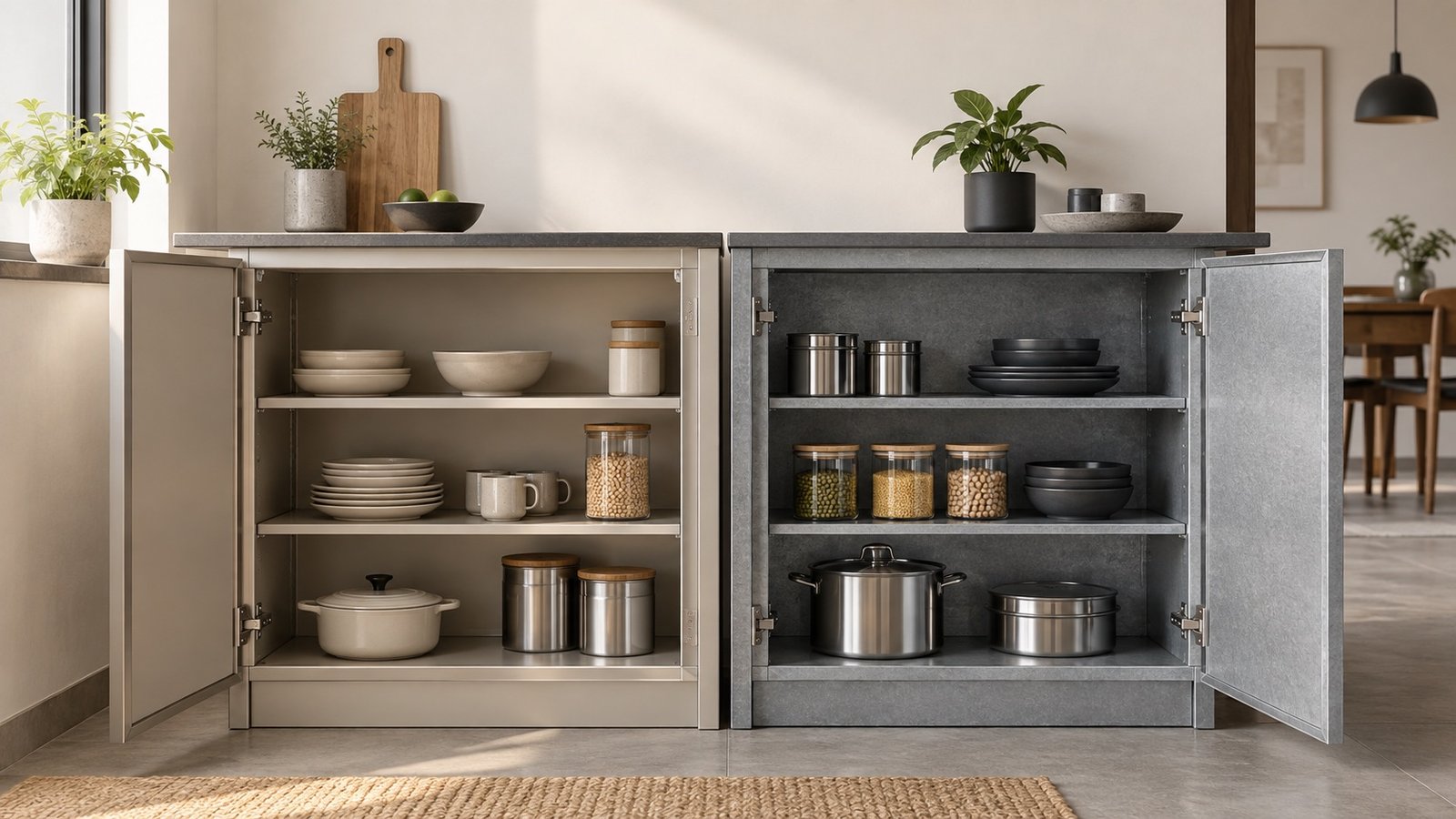
Aluminium is an alloy family that forms a protective oxide surface. GI is steel protected by a zinc-containing coating. Metal & More does not recommend GI for counters, sink bases or other water-use areas. Evaluate GI only for suitable dry storage with the coating and edge detail specified.
Review the alloy or profile, panel support, surface finish and compatibility of fixings. A low-density metal still needs a well-designed cabinet system.
Review zinc coating, cut edges, folds, top finish and service access. Keep the use case away from water-use zones.
Ask for the same dimensions, shutters, shelves, hardware and installation scope on both quotations.
Aluminium vs GI kitchen cabinets is a zone-by-zone decision. Compare the proposed build, not only the metal name.
Aluminium forms a protective oxide surface, but its corrosion behaviour and strength depend on the alloy, temper and finish. GI starts with a steel substrate and relies on zinc coating for barrier and sacrificial protection. Damage, cut edges, wet crevices and the chosen top finish matter. The Aluminum Association standards distinguish alloy and temper specifications; the GalvInfo Center describes zinc coating protection.
| Check | Aluminium | Galvanized steel (GI) |
|---|---|---|
| Base material | Specified aluminium alloy/profile or sheet. | Steel sheet with a specified zinc coating. |
| Corrosion detail | Confirm alloy, surface finish and compatible fixings. | Confirm coating, cut-edge treatment and top finish for dry storage; do not use GI in counters or water-use areas. |
| Weight | Lower-density metal; assembled cabinet weight also depends on profile and infill. | Higher-density base metal; panel thickness and design affect total weight. |
| Stiffness | Profile geometry, bracing and shelf span are critical. | Sheet folds, bracing and shelf span are critical. |
| Visual finish | Ask for a physical sample of the proposed profile and shutter. | Ask for a physical sample of the coated body and shutter. |
| Quote detail | Record alloy/profile, thickness, shutters, hardware and installation. | Record sheet gauge, zinc coating, edge treatment, shutters, hardware and installation. |
A lighter metal does not automatically mean a better overhead cabinet. The wall fixing, module size, hinges, panel span and expected load decide whether the installed system is suitable. Likewise, steel’s material stiffness does not correct weak joints or inaccessible hardware.
These concept views help you discuss cabinetry and finish. The illustrated shutters do not confirm the cabinet body specification; request a written material schedule for your measured kitchen.
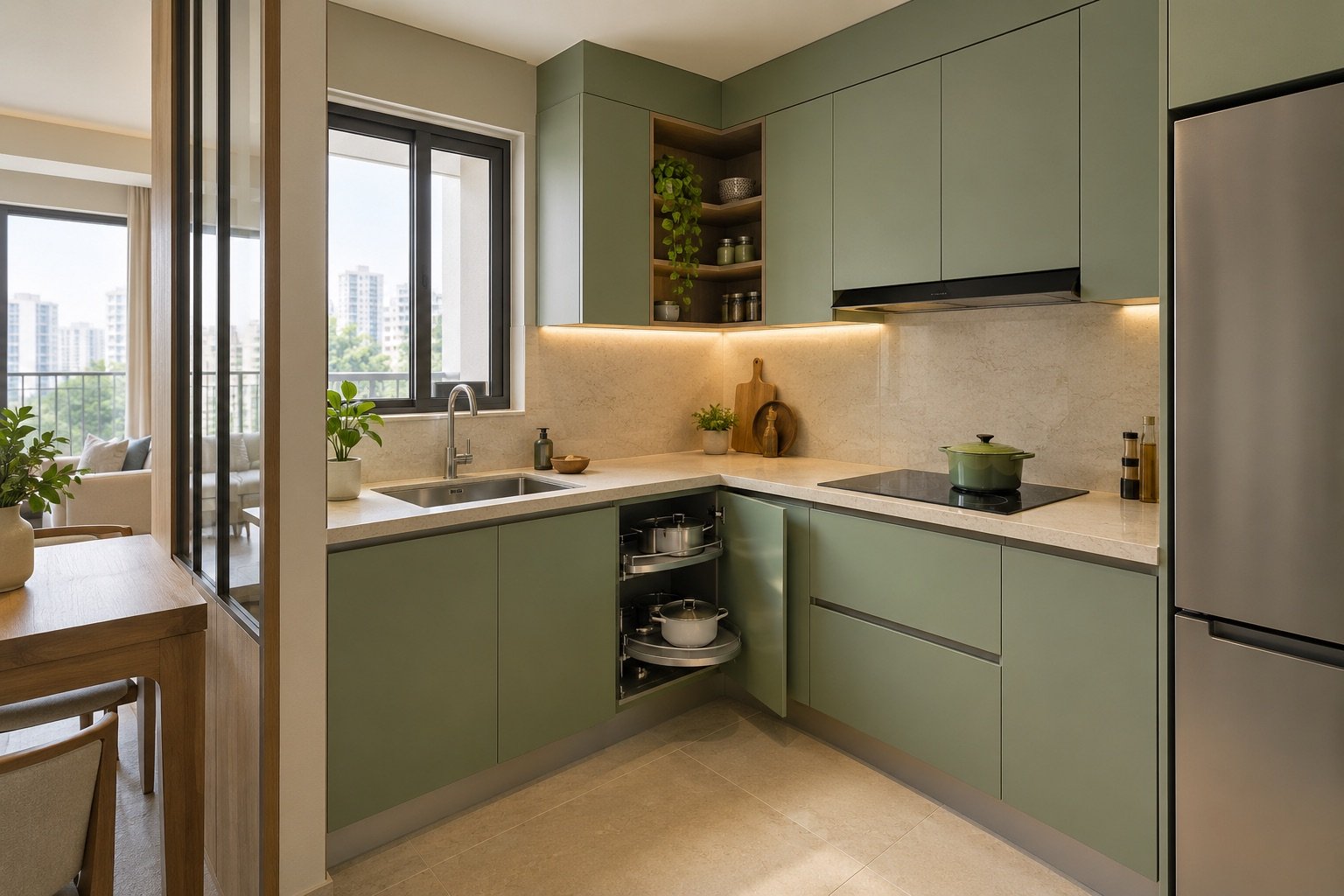
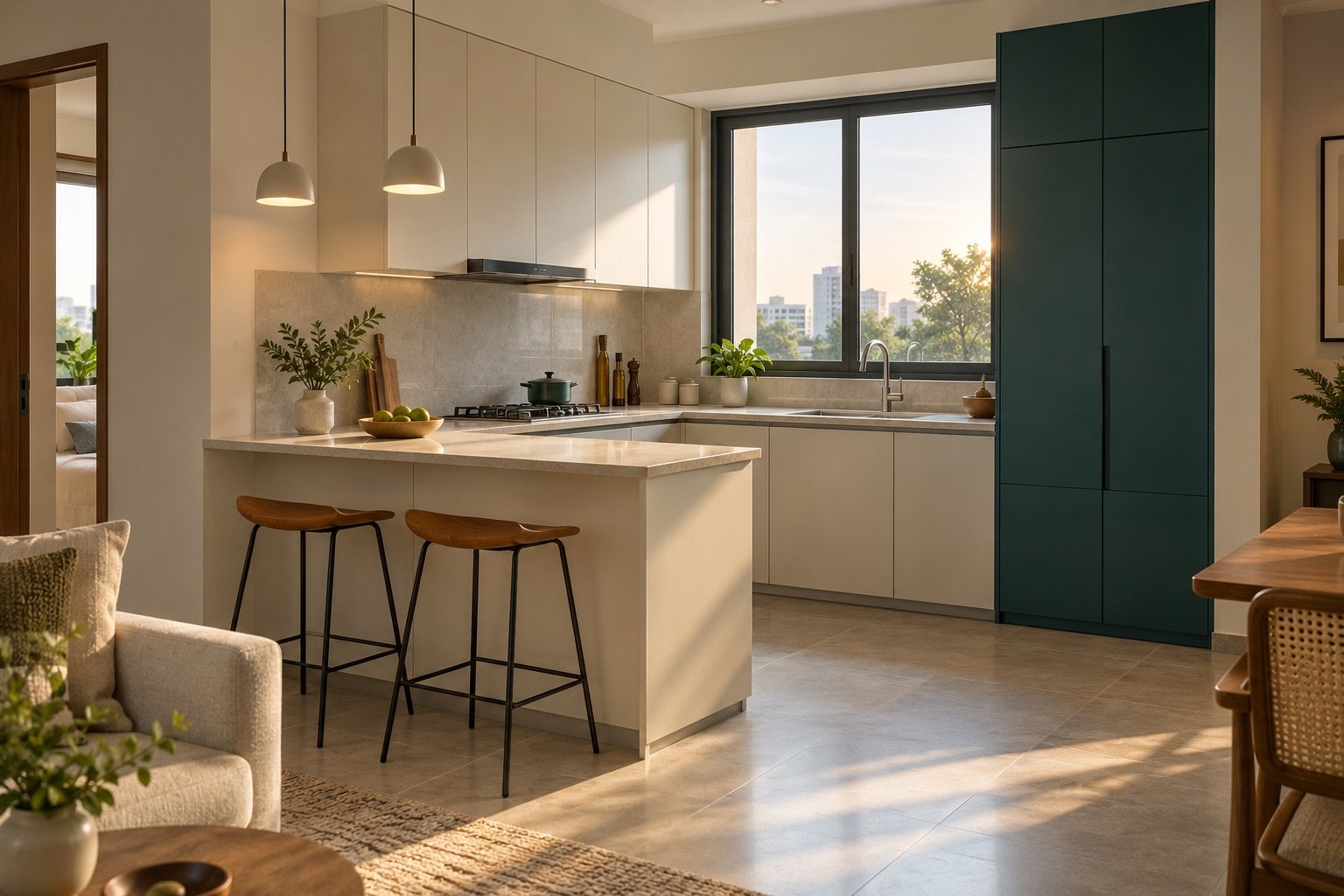
First design access to taps, drain trap, shut-off valves and hoses. Water should be visible and cleanable rather than trapped behind a sealed plinth. Then compare how each proposed cabinet protects joints and fasteners in that space. For aluminium, ask about alloy, finish and dissimilar-metal contact at fixings. Do not specify GI for the sink base or other water-use areas. For GI in dry storage, ask how drilling and cut edges are handled after fabrication. The GalvInfo cut-edge guidance explains why edge geometry deserves inspection.
Inspect a real sample: open the shutter, check hinge fixing, look under the sink base and test whether a shelf can be removed for plumbing service. A cabinet should be judged as a complete module, including finish and hardware, rather than by the metal name alone.
Compare itemised quotations with the same scope: cabinet bodies, shutters, shelves, hardware, accessories, countertop support, transport and fitting. An unmeasured headline rate cannot settle this choice. For another metal pairing, read our stainless steel vs aluminium guide, or browse all material comparisons.
Use the 3D Finish Studio to shortlist colours and layouts, then confirm the final finish with a physical sample. The instant estimator provides an initial planning range; request a measured, itemised proposal before deciding.
For aluminium vs GI kitchen cabinets, open the topics you want to discuss with your kitchen designer. These notes help you review aluminium vs GI kitchen cabinets by profile, coating, storage load and dry versus wet zone.
Aluminium has lower density than steel, yet the total overhead cabinet weight depends on its profile, infill, shutter, hardware and dimensions. Ask how it is fixed to the actual wall, especially if the wall contains a service chase or uses a material that requires special anchors. A lighter frame can be useful, but it does not make a poor wall fixing safe.
Check door height, hinge count, shelf span and expected contents. A wide shutter creates different loads from a short one. The approved drawing should show the mounting points and the cabinet dimensions. Discuss these details before the final finish is selected so the visual design does not hide a structural problem.
A GI cabinet may suit suitable dry storage when the zinc coating, fabricated edges and top finish are defined. Steel can be formed into stiff panels, but the outcome still depends on folds, reinforcement and the way shelves are supported. Ask to see a finished pantry sample and test the door and drawer movement.
Keep GI dry storage separate from the sink base or counter. A pantry near a wet appliance should be reviewed for leaks and cleaning exposure rather than assumed dry because of its label. If the layout changes, revisit the specification.
Aluminium is not one uniform product. Ask the supplier to identify the proposed alloy or profile system and where it is used. A frame, back panel and shutter may have different construction. Confirm the sheet or profile thickness, any reinforcement and the finish for each visible and hidden component.
Ask whether the surface is anodised, powder coated or finished by another specified process. Each choice has a different appearance and care requirement. Review a physical sample in the room’s natural and artificial light. Ensure the quotation records the approved colour and texture.
Look at fixings, fasteners, hinges and hardware. Dissimilar metals can require thoughtful separation or compatible components in damp conditions. Ask how joints will be kept cleanable and accessible, and whether damaged hardware can be adjusted or replaced without dismantling the whole cabinet.
The Aluminum Association standards show why alloy and temper specifications matter. For your kitchen, the written build schedule should translate those labels into actual profiles, panels and components.
Galvanizing adds a zinc-containing protective coating over steel. Ask for the coating specification and how exposed cuts, drilled holes and folded details are handled after fabrication. Inspect a corner and service opening on a sample. A glossy surface on the front does not show the condition of the hidden cut edge.
Check how a top finish interacts with the coated base. Ask for care guidance that matches the exact finish. The protective system is part of a cabinet specification and should be documented in the same way as sheet gauge and hardware.
GI is not recommended by Metal & More for counters, sink bases or other water-use areas. A dry pantry or dry overhead run is a separate design decision. If water points, appliances or cleaning patterns move, re-evaluate whether the proposed cabinet is still truly dry storage.
See GalvInfo coating guidance and the cut-edge note for the underlying material behaviour.
Use the 3D Finish Studio to shortlist cabinet colour combinations, then confirm the proposed finish on a physical sample. The tool helps with appearance; it does not verify an alloy, zinc coating, hardware or site measurement. Keep those items in the written specification.
Mark the sink, drain, water purifier and dishwasher before the cabinet plan is approved. These points need service access and details that let you spot a leak. Discuss the bottom panel, back panel, plinth and fasteners, not only the visible shutter. Metal & More does not recommend GI for a sink base or another water-use zone.
Record the intended contents and likely load. A tall pantry may carry heavy jars on wide shelves; an overhead cabinet may carry dishes close to a wall fixing. Ask for spans, supports and hardware appropriate to those loads. Aluminium and GI can each be engineered in different ways, so the drawing must show the actual construction.
Mark every appliance clearance, ventilation requirement and service connection. If the design adds a washing machine or moves a water line, a formerly dry cabinet may face a different exposure. Revisit the material schedule after those changes rather than applying the first plan automatically.
For an aluminium vs GI kitchen cabinets decision, ask the designer to colour-code the cabinet schedule by material. This makes the dry-storage limits and any material transitions visible before a quotation is signed.
Inspect the hinge position, fixing and the gap around the shutter. Open a wide door several times to see whether the frame remains aligned. A cabinet can use a good metal and still feel poor if the hardware is loose or the panel is unsupported. Ask whether the hinges can be adjusted or replaced after installation.
Pull drawers fully out and check their movement under the expected load. Look at the corners of the drawer box and the finish on the back of the shutter. Confirm that an accessory such as a cutlery insert is included in the quotation if it is shown in the sample.
Inspect a service cut-out, folded corner and the bottom of the cabinet. On aluminium, ask how the profile and panel edges are finished and which fasteners are used. On GI dry storage, ask how a cut through the coated sheet is protected. A smooth visible front does not prove that hidden edges have been handled properly.
Ask how a shelf or access panel can be removed for maintenance. If a pipe or cable will run behind the cabinet, verify that it can be reached without destroying the unit. Photograph the agreed sample and record any change to its construction.
List the profile or sheet used for the carcass, the dimensions, finish and any reinforcement. Identify which parts are aluminium and which are not. The shutter may be a different system from the frame. Note compatible fixings, hinge hardware and care guidance for the finish you approve.
List the steel sheet gauge, zinc coating specification, top finish and treatment of edges created during fabrication. State explicitly which dry-storage cabinets use GI. Exclude counters and water-use areas from that schedule. Ask how the finished surfaces should be cleaned and inspected.
Record shutters, handles, hinges, drawer runners, internal organisers, backing panels, countertop support, transport and fitting. These often explain a price difference more clearly than the name of the body metal. Compare the same dimensions and inclusions before discussing value.
Aluminium vs GI should be reviewed as two complete specifications. A headline material label does not identify the finish, hardware or service access that makes the installed kitchen usable.
Begin with one measured layout and ask both options to quote against it. If the aluminium proposal has a different shutter, handle or drawer system from the GI dry-storage proposal, mark that difference in the comparison. Ask for base units, overheads, pantry units and any tall appliance unit to be itemised separately. A single kitchen total makes it hard to understand where the material choice changes.
Check what is excluded: countertop, sink, appliances, electrical changes, civil work, accessories and site preparation may or may not be part of a given proposal. Ask the supplier to state inclusions rather than assuming them. Transport, installation and final adjustment are also part of a usable kitchen, so they belong in the scope review.
Ask for a written revision when dimensions or finishes change. If the sink location moves or an appliance is added, revisit which cabinet qualifies as dry storage. That is especially important if GI had been proposed for part of the original plan. Keep the revised drawing and quotation together so the material schedule can be checked at installation.
The estimator is an initial planning tool. A final decision needs site measurements and an itemised proposal. You can review an aluminium kitchen service and the GI kitchen service separately before comparing them on a matched scope.
The appearance of aluminium depends on the selected coating or surface treatment. Request care instructions for that finish rather than using a general rule for bare metal. Test the sample under kitchen lighting and note whether it shows fingerprints or cleaning marks. Ask how a scratched shutter or damaged handle would be serviced.
Keep cleaning agents and moisture exposure in mind at joints and fasteners. Corrosion behaviour depends on the alloy, finish and contact with other materials. The specification should describe the installed system, not just call it aluminium.
GI relies on its zinc-containing coating over steel. Ask how a top finish protects the cabinet and how exposed edges are treated. Avoid assuming that a coated dry pantry cabinet is suitable for routine water use. If a leak develops nearby, the cause should be fixed and the cabinet inspected rather than leaving moisture trapped around its joints.
Cleaning guidance should match the specific coating and finish. Record a supplier contact or service route for replacing a shutter, hinge or panel if needed. Serviceability is a practical part of the purchase decision.
Confirm the measured drawing, cabinet-by-cabinet material schedule, shutters, finish samples, hardware, accessories and access panels. Ask for the proposed aluminium profile and GI coating information where those materials are specified. Make sure the sink base is not assigned GI. Review the edge and joint details for dry-storage GI and the fasteners and finish details for aluminium.
Test the relevant sample cabinet. Note any mismatch between sample and drawings before approving production. A finish preview in the 3D Studio can help with colour direction, but a physical sample and written specification decide the final build. Keep those documents with the itemised quotation for later reference.
Aluminium vs GI kitchen cabinets becomes a manageable decision when the material is tied to a real location and a defined cabinet. The result should be a plan that can be measured, quoted, built and serviced rather than a broad promise about one metal always being better.
No. Metal & More does not recommend GI for sink bases, counters or other water-use areas. Specify that wet zone separately.
Not necessarily. The installed weight, wall construction, fixing, span and expected load determine the support needed. Ask for the actual design.
GI may be considered for suitable dry pantry storage when zinc coating, cut edges, finish, load support and service access are specified.
Use the same measured dimensions and list the body material, shutters, hardware, accessories, countertop scope and installation for each option.
For aluminium vs GI kitchen cabinets, start with your layout. Then ask for an itemised schedule showing where aluminium belongs and where GI may suit dry storage. GI is not recommended for counters, sink bases or other water-use areas.
Start with the room that works hardest
SS304 Kitchen
Starts from₹1.80 lakh
Hygienic, durable and built for everyday Indian cooking.
Aluminium Kitchen
Starts from₹1.30 lakh
Light, contemporary and easy to maintain.
Starting prices are indicative and depend on measurements, design, finish, hardware, accessories, site conditions and final inclusions. Contact our team for an itemised quotation.
© 2024 Metal & More Interiors, or metalandmore.in, All Rights Reserved.
Free design consultation
Share two quick details. Our Hyderabad team will call you back.
Thank you! Our design team will call you shortly.