SS304 Kitchen
Stainless Steel Kitchen
Starts from₹1.80 lakh
Hygienic, durable and built for everyday Indian cooking.
 Free Design Visit
Choose the right metal for each cabinet zone. Compare corrosion protection, wet-area suitability, construction details and the questions to ask before approving a quotation.
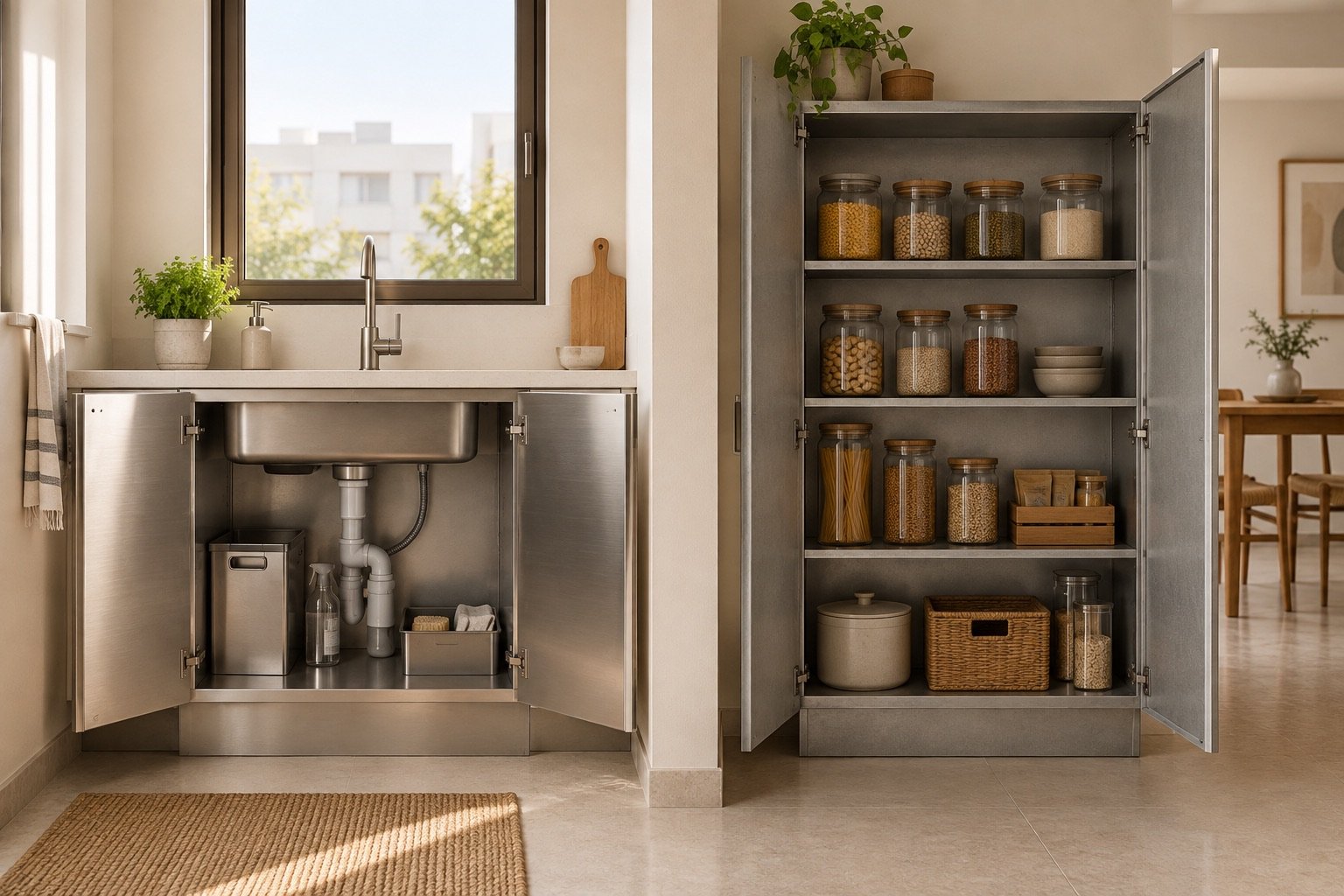
SS304 stainless steel uses a chromium-rich passive surface. GI is steel protected by a zinc coating. We do not recommend GI in counters, sink bases or other water-use areas. A GI cabinet may be considered for appropriate dry storage when coating, cut edges, joints and finish are specified.
Consider a properly detailed SS304 cabinet. Keep plumbing reachable and confirm grade, fabrication and cleaning guidance.
GI can be considered for a pantry or dry storage run. Confirm zinc coating, protection of fabricated edges and the planned finish.
Use different materials by zone only when every module and inclusion is shown clearly in the drawing and quotation.
| Decision | SS304 stainless steel | Galvanized steel (GI) |
|---|---|---|
| 1. Surface protection | Chromium-rich passive film on the alloy. | Zinc-containing coating over steel. |
| 2. Water-use areas | Consider with suitable grade, joints and cleaning details. | Not recommended for counters or water-use areas. |
| 3. Dry storage | Suitable where specified for the intended cabinet. | May suit dry storage with appropriate coating and finish. |
| 4. Fabricated edges | Inspect welds, finish and crevices. | Inspect cuts, folds and coating continuity. |
| 5. Cabinet stiffness | Depends on folds, supports and span. | Depends on sheet, folds, supports and span. |
| 6. Appearance | Metal body with selected shutter finish. | Protected body with selected shutter finish. |
| 7. Quotation detail | Ask for grade, sheet/profile and fabrication. | Ask for gauge, zinc coating and edge detail. |
This stainless steel vs GI kitchen cabinets comparison is a specification checklist, not a fixed price or service-life promise. Read the steel cabinet rust guide for the practical maintenance questions.
These two compact kitchen concepts show how layout affects cabinet planning. Visible shutters and colours are illustrative; confirm SS304 and any suitable dry-storage GI in the written cabinet schedule.
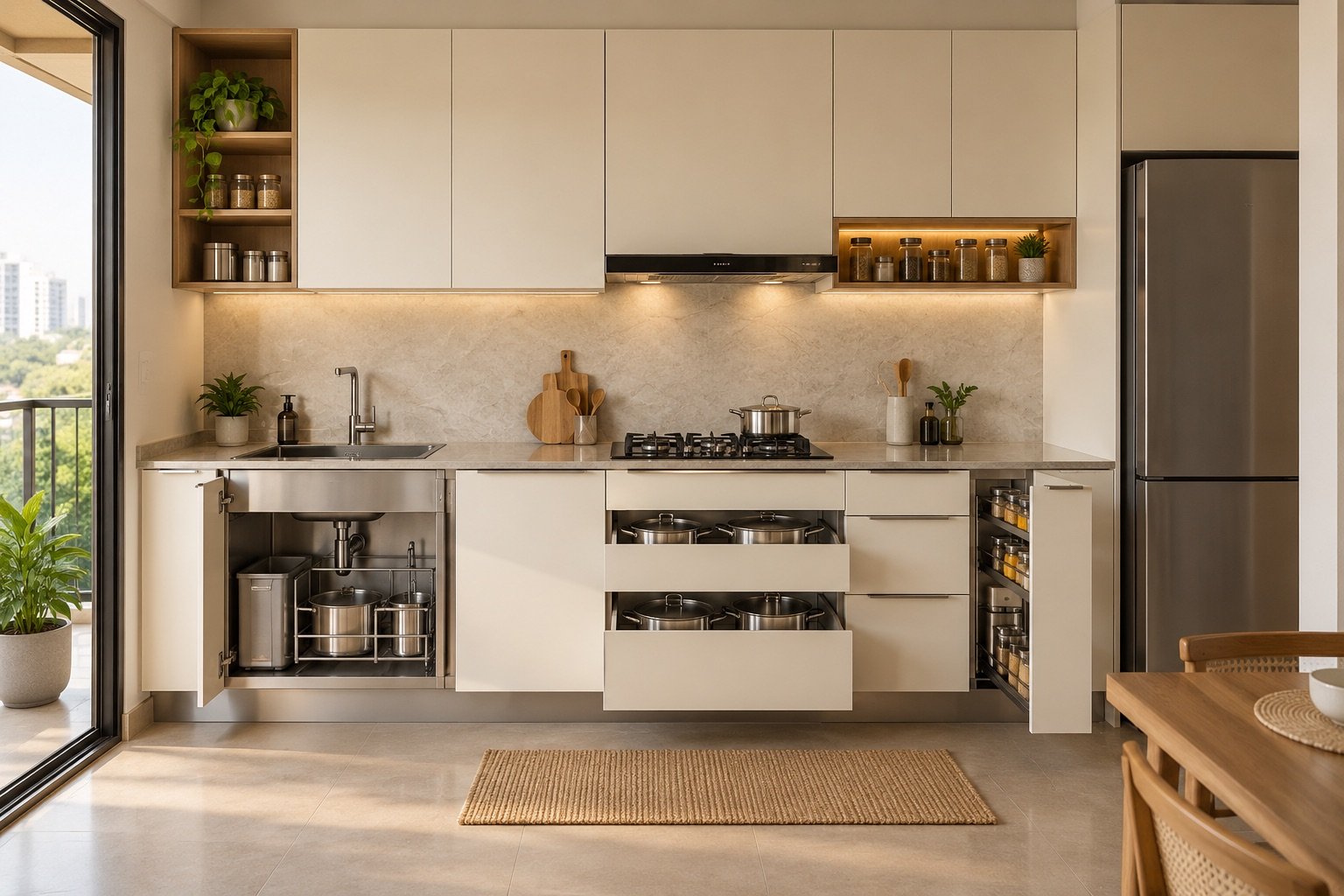
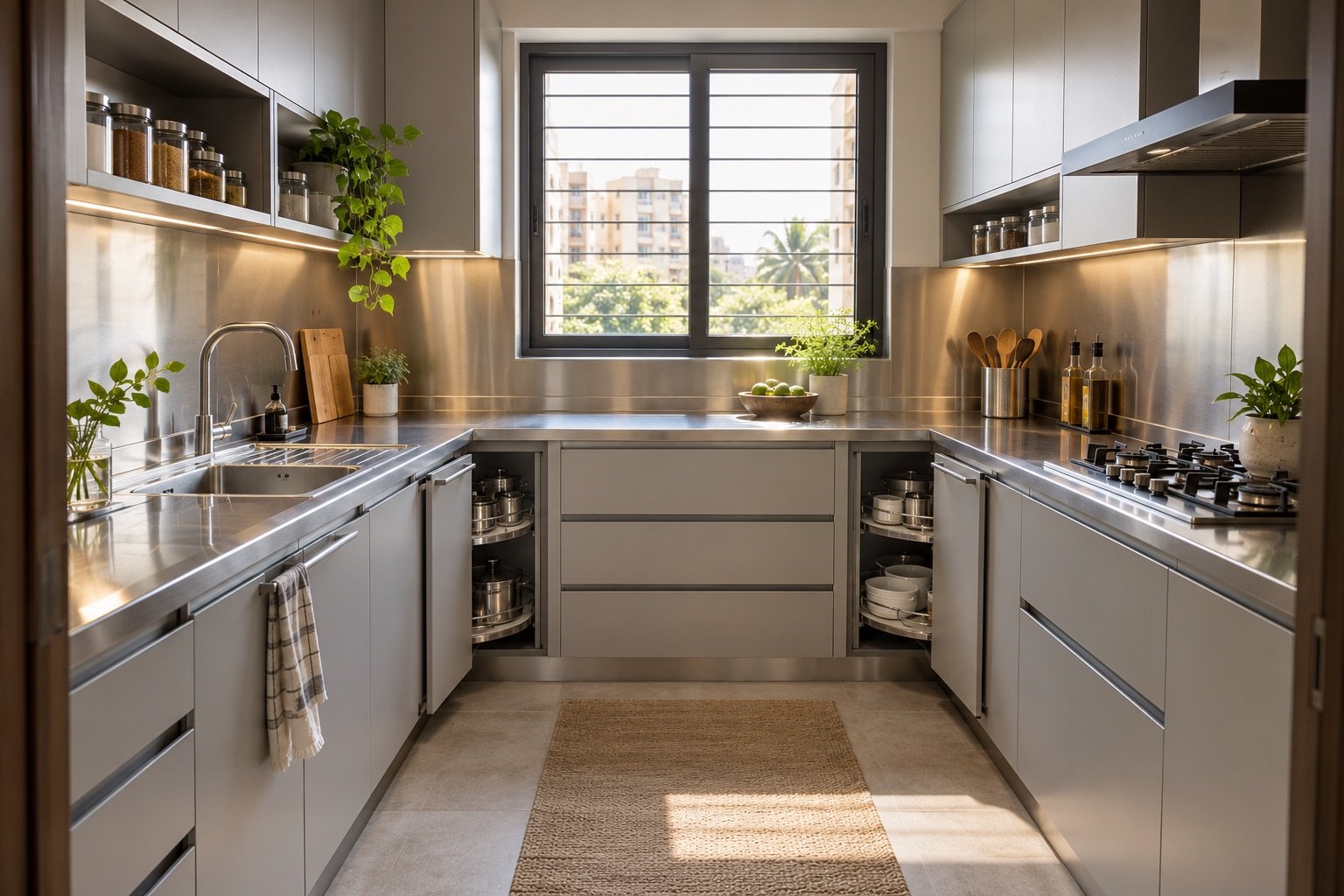
The sink cabinet faces splashes, cleaning agents and possible slow leaks. Make the trap, hoses and shut-off valves reachable. Avoid details that hide standing water against a wall or plinth. Compare the carcass, bottom panel, joints, fasteners and finish in this exact zone.
SS304 resists corrosion through a naturally formed chromium-rich film, though chlorides and poor detailing can still cause problems. GI relies on a zinc-containing coating whose performance depends on environment, coating mass and fabricated edges.
Technical background: worldstainless corrosion guidance and GalvInfo coating guidance.
Open a wide shutter, inspect hinge fixing, test drawer travel and check shelf support for the expected load.
Inspect panel edges, folds, fastener points and the finish around plumbing or appliance openings.
Compare base and overhead units, tall units, shutters, hardware, accessories, transport and installation line by line.
For GI dry storage, ask how sheet cuts and drilled holes are protected after fabrication. For SS304, confirm grade and cleaning guidance. The GalvInfo cut-edge note explains why edge details matter.
Use the 3D Finish Studio to shortlist colour combinations, then check physical samples before final approval. Explore the GI kitchen service for suitable dry-storage applications or return to our material comparison guides.
These stainless steel vs GI kitchen cabinet notes help you review SS304 grades, GI coatings, loads, wet zones and the written material schedule.
When comparing stainless steel vs GI, start with a cabinet-by-cabinet zone map.
Mark the sink, dishwasher, drinking-water point and any location where routine washing or spills are likely. Give those areas a separate material decision from dry pantry cabinets. A drawing should also show where plumbing access panels, service gaps and cabinet backs sit. This makes it easier to review the real water exposure rather than treating the entire kitchen as one uniform environment.
Check the countertop support and any appliance cut-out. In a stainless steel vs GI review, the name of the carcass metal does not tell you how a wide span is supported or how a cut edge is finished. Ask for the supporting member, panel fold and fixing method to be identified in the specification.
Inspect a finished corner and a visible cut-out, then look at the back of a shutter and the inside of a drawer. Check that moving parts can be adjusted or replaced. For SS304, ask which components are actually stainless steel and whether any mixed-metal fasteners are used. For GI dry storage, ask how exposed edges and holes are protected after fabrication and how the finished surface can be cleaned.
Surface appearance alone cannot confirm a steel grade or a zinc-coating specification. Request those details in writing when they are material to your decision.
Mark the sink, water purifier, dishwasher and cleaning point on your plan. Note where splashes are routine and where a small leak could remain unseen. A cabinet near these points needs practical access as well as a suitable material. Discuss the panel below the sink, the back of the unit and the plinth detail separately from the rest of the kitchen.
List heavy cookware, pantry jars and tall appliances before choosing shelves and spans. The material name cannot tell you whether a wide shelf will feel solid. Ask how the panel is folded or reinforced, where supports are fixed and what happens when a drawer is fully loaded. Test a sample unit with the hardware you intend to specify.
Plumbing and electrical connections should be reachable for maintenance. Ask how a plumber would access a trap or valve without damaging the cabinet. Make sure appliance ventilation and service clearances are shown in the final drawings. A neatly finished front is less useful if the equipment behind it cannot be inspected.
For a stainless steel vs GI kitchen cabinets decision, the drawings should name the material for each module rather than applying one label to an entire kitchen. This is especially important when a quotation proposes a mixed build. Review any change in material at the boundary between a wet zone and dry pantry storage, including the way panels and fixings meet.
Ask for the specified stainless grade and identify which parts of the unit use it. A kitchen cabinet may include a metal body, separate shutter material, drawer hardware and fasteners from different suppliers. The finish can also affect how visible fingerprints and cleaning marks are. Request care instructions that match the actual grade and finish, and avoid assuming every cleaner is suitable for stainless steel.
Inspect welds and corners where cleaning residue might collect. Even corrosion-resistant stainless steel can be affected by harsh chemicals, salt-rich exposure or trapped deposits. Good detailing and suitable upkeep remain part of the decision.
If GI is proposed for a dry pantry cabinet, ask for the coating specification and how cut edges, holes and folds are handled. Inspect the finish on the inside as well as the visible face. The zinc coating is the protective system over the steel substrate; a chipped or poorly treated area can change how the cabinet performs.
Do not transfer a dry-storage recommendation to a sink base or a water-use counter. The environment and maintenance needs are different. If a design changes after plumbing or appliances are confirmed, revisit the material schedule before approving manufacture.
Start with wall lengths, ceiling height, doors, windows and appliance sizes. Mark water, drainage and electrical points. A first estimate can be useful for planning, but the measured scope should control the final cabinet drawings. Note any uneven wall, column or service shaft that affects depth or access.
Decide where base cabinets, overheads, drawers and tall units belong. Check door swings, corner access, working clearance and the route for installation. Identify wet-zone cabinets before selecting the material for dry storage. If a proposed layout moves the sink or appliance, revisit the cabinet material schedule.
Request elevations, module dimensions and a written specification for bodies, shutters, finishes and hardware. Confirm the edge and joint treatment for the chosen material. Approve a physical finish sample where possible. An image in the 3D Studio is useful for direction, but a sample helps decide the final appearance.
Use the kitchen estimator as a starting point and the design consultation for a measured specification. Keep the material schedule with the quote so changes remain visible during design review.
Ask each supplier to list the body material by unit, the sheet or profile specification, the finish and the method of fabrication. For a mixed kitchen, a single sentence saying “metal cabinets” does not identify which modules are SS304 and which are GI. The schedule should be specific enough that you can mark the sink base, dry pantry and overheads separately.
Include the backing panel, bottom panel and plinth treatment in the review. Those pieces often receive less attention than a visible shutter but affect maintenance and access. If a part is omitted from the quotation, ask whether it is excluded or covered elsewhere.
List hinges, drawer runners, handles, corner accessories and any internal organisers separately. Confirm the shutter finish and its substrate. Installation scope should clarify transport, fitting, alignment, site preparation and responsibility for connections. A lower total can be misleading if major components are excluded.
Ask how an adjustment or replacement would be handled after installation. Serviceability depends on accessible hardware, standard components and clear drawings. These questions are useful regardless of which metal is selected.
Look at the inside of the cabinet, not only the show face. Check for sharp edges, loose panels, uneven gaps, exposed cuts and fastener access. Open and close the shutter several times. Pull a drawer to its full extension and check whether it feels supported. Ask for a sample of the finish that will actually be installed, rather than relying only on a screen image.
At a corner, inspect how adjoining panels are joined and whether moisture or cleaning residue could remain trapped. At a service opening, check how the cut surface is finished. Ask whether a panel can be removed to reach a pipe or cable. A good sample review can reveal practical differences that a material label does not show.
Keep a short written record of what you approved: metal grade or coating specification, finish, edge detail, shutter, hardware and any exception by cabinet. This is more reliable than trying to remember a verbal comparison after several meetings.
A uniform material schedule can simplify discussion, but it should still be tested against each cabinet’s exposure. The sink base, a dry pantry and a tall appliance housing have different duties. Stainless steel vs GI kitchen cabinets is therefore a zone decision as much as a material decision. If one material is proposed throughout, ask for the reasoning at the wet and dry extremes.
Two finished shutters can look similar while the cabinet bodies behind them are different. Ask to see the inside face, the back panel and the edge of a service opening. The surface colour is a design choice; the metal, coating, fabricated edge and hardware are specification choices. Record both in your approval notes.
A change in cabinet dimensions, hardware, finish or zone material can alter the quotation. Ask for an itemised revision with the affected units highlighted. Avoid approving a new total without knowing whether the sink-base material or dry-storage specification has changed. This keeps the comparison clear from first estimate through final drawings.
There is no single material answer for every home. Site conditions, cleaning habits, storage needs and the intended finish all matter. A useful proposal explains where the specified system will be installed and what a homeowner must do to maintain it. The focus should be on a cabinet that can be inspected, cleaned and serviced in its actual location.
When weighing stainless steel vs GI, treat uncertain statements as questions for the supplier. Request the grade or coating specification, ask to see a sample of the proposed construction and confirm any limitations in writing. This is more useful than a broad claim that one metal is always maintenance-free or that a quoted price guarantees the same build quality across different scopes.
After reviewing the proposal, save a copy of the measured plan and mark the metal used in each cabinet. Add the shutter finish, hinge and drawer specification, cut-edge treatment, countertop support and access panels. Photograph the approved samples in natural and indoor light so the selected finish is easier to identify later. Make sure the written quotation uses the same cabinet names as the drawings.
Before manufacture, review any revised appliance dimensions or plumbing positions. Even a small move can change which cabinet is exposed to water and which details need attention. If a material substitution is proposed, ask for a revised schedule and confirm the reason. An approval record does not replace a contract or warranty document; it simply makes the agreed specification easier for both sides to follow.
No. Metal & More does not recommend GI for sink bases, counters or other water-use areas. Ask for a specified SS304 solution where wet-zone performance is needed.
GI may be considered for appropriate dry storage. Confirm coating, cut-edge treatment, finish, ventilation and service access for the proposed cabinet.
No material is immune to every condition. Confirm grade, weld details and cleaning guidance, especially where chlorides or harsh chemicals may be present.
Compare measured scope and itemised materials, shutters, hardware, accessories and installation. A headline material label alone is not enough.
For stainless steel vs GI kitchen cabinets, begin with your measured layout, then request an itemised SS304 and GI cabinet schedule. GI is not recommended for counters, sink bases or other water-use areas.
Start with the room that works hardest
SS304 Kitchen
Starts from₹1.80 lakh
Hygienic, durable and built for everyday Indian cooking.
Aluminium Kitchen
Starts from₹1.30 lakh
Light, contemporary and easy to maintain.
Starting prices are indicative and depend on measurements, design, finish, hardware, accessories, site conditions and final inclusions. Contact our team for an itemised quotation.
© 2024 Metal & More Interiors, or metalandmore.in, All Rights Reserved.
Free design consultation
Share two quick details. Our Hyderabad team will call you back.
Thank you! Our design team will call you shortly.