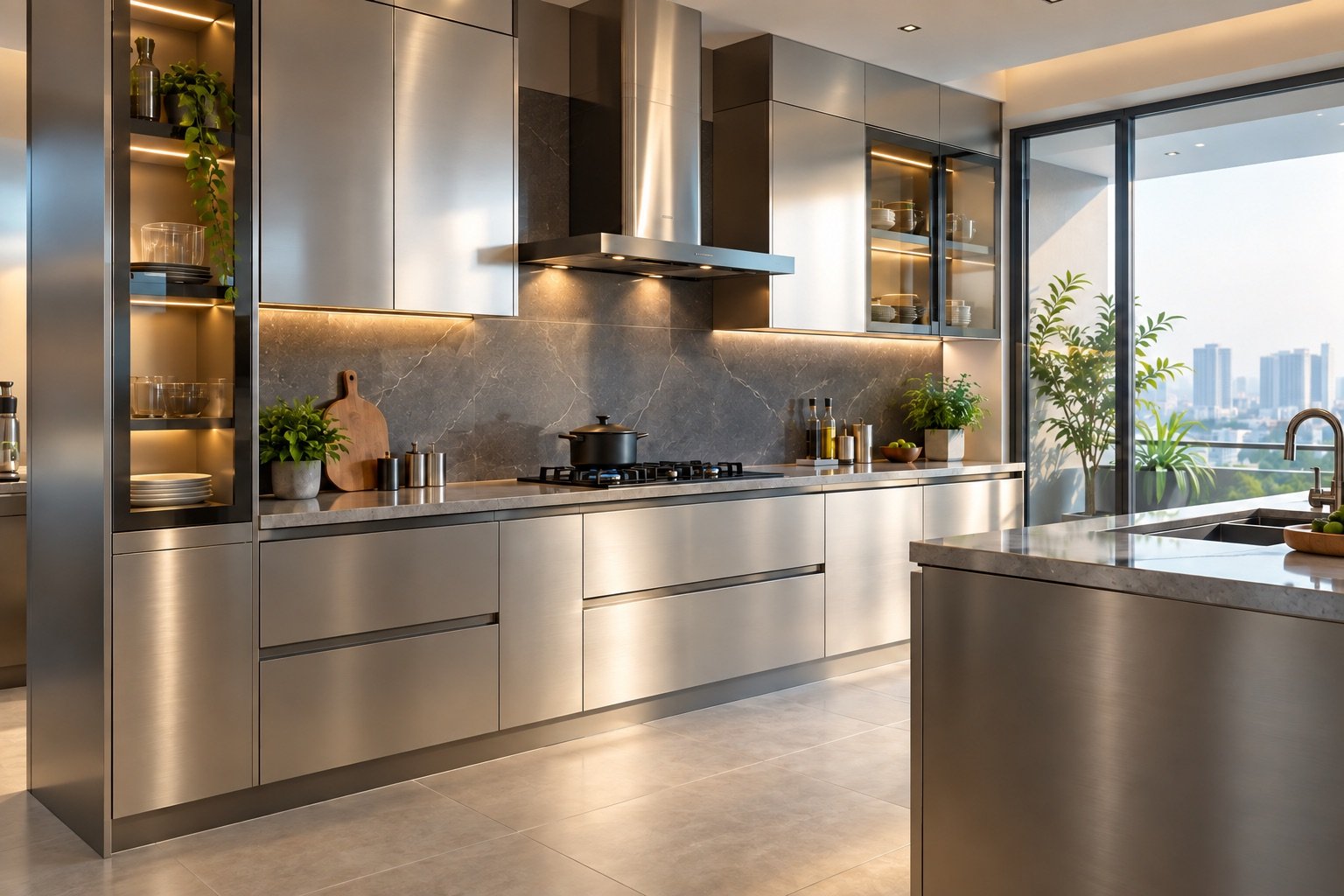
Fire-resistant describes a material that resists ignition and does not readily add fuel to a fire under ordinary conditions. It is a property of the material, not a certificate for a finished kitchen. A safe kitchen still depends on appliance clearances, sound wiring, ventilation and tested products wherever a formal rating is legally required.
Most people reach this question one of three ways: they are planning a kitchen and want to know how a cabinet behaves beside a hob, they have read a page of conflicting marketing and suspect the words are being stretched, or they have seen how quickly a badly placed appliance can scorch whatever surrounds it. In every case the useful answer is the same. Separate what a material genuinely does from what a sales line implies, then plan the room around the appliances rather than around a glossy front elevation.
This guide explains fire-resistant kitchen cabinets in plain terms for Hyderabad homes and apartments. It sets out what the phrase can and cannot mean, how to read a specification without being misled, how to plan the heat zones around a hob, oven and chimney, and where a metal carcass fits into that picture. Metal & More Interiors designs and manufactures metal interiors in-house from its factory at B.N. Reddy, Charlapally, with its office at Jai Jawahar Nagar, Yapral Ammuguda Road, Secunderabad.
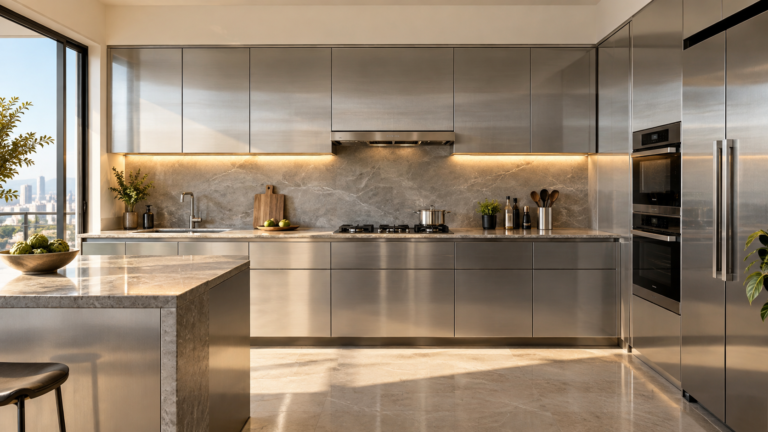
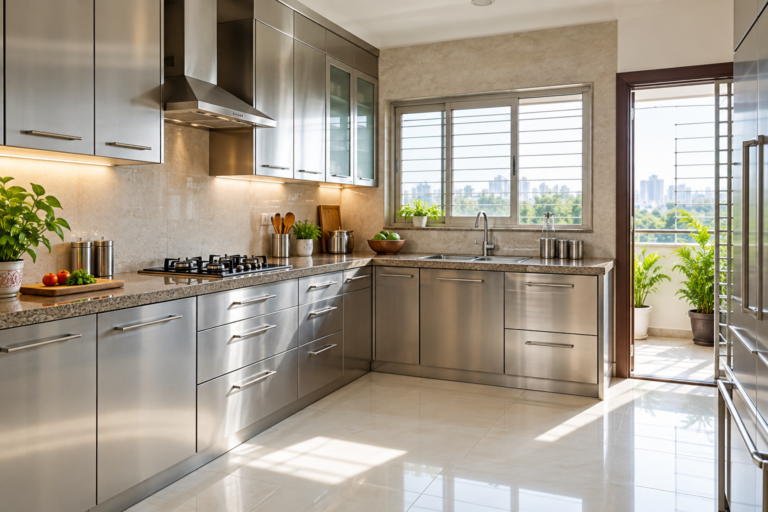
A Hyderabad homeowner searching for a steel kitchen or a stainless steel modular kitchen in Hyderabad is usually comparing safety, moisture resistance and long-term serviceability together. The useful specification names the carcass material, heat-zone clearances, finish, hardware and service access instead of relying on one broad slogan. That makes competing modular-kitchen quotations easier to compare on construction quality, not appearance alone.
Quick answer
Fire-resistant is a description of how a material behaves when it meets heat or flame. The material resists catching fire, and it does not itself feed a fire the way an organic board can. Stainless steel, aluminium and galvanised steel are non-combustible, so a metal carcass adds very little fuel to a kitchen. That is a real and useful property, and it is the property Metal & More Interiors means when it uses the term.
What the phrase does not mean is that a finished cabinet has passed a fire test or will hold back a fire for a stated number of minutes. Language that suggests a measured rating, a guaranteed duration or complete immunity belongs to tested, certified systems such as fire doors, shafts and rated partitions. Ordinary residential cabinetry is not certified in that way, and a supplier who implies otherwise is promising more than the product can deliver.
The honest value of a fire-resistant cabinet is narrower. It does not add wood, resin or adhesive to the fuel already present in a room, and it is not the item that ignites first. The rest of the safety picture — hob clearances, electrical protection, gas connections, ventilation and alarms — sits with the room and its appliances. Cabinet material supports that picture; it does not replace it.
Unsure how your hob, chimney and cabinet clearances should work together? Discuss the actual room before finalising the material schedule.
What the term fire-resistant really means
Several words are used almost interchangeably in kitchen showrooms and mean quite different things. Understanding the difference is the whole point of this guide, because that difference is where honesty lives. A reader who can tell the three apart will never be misled by a brochure again.
Fire-resistant
A fire-resistant material does not readily ignite and does not sustain combustion on its own. Steel, aluminium, stone and glass are everyday examples. A fire-resistant material can still be damaged by heat, can still conduct heat to whatever it touches, and can still sit next to something combustible — but it is not fuel in the way that timber and polymer boards are. This is a descriptive, testable statement about the material itself.
A measured rating
A measured rating is a result, not an adjective. It comes from a standard test applied to a complete assembly — a door, a wall, a duct, a service shaft — under defined conditions, and it is confirmed by a certificate that states a duration and the criteria met. That certificate belongs to the tested system, not to a generic material and certainly not to a residential cabinet carcass. When someone offers a “rated” kitchen cabinet, the fair questions are: rated by whom, in which test, for how long, on which complete assembly, and where is the certificate?
Total immunity
The strongest of the three words promises that nothing will ever burn. Very little in a working kitchen meets that standard. Enough heat changes almost any material: coatings discolour, seals soften, composites char and fixings lose their grip. Avoiding the strongest word is not modesty for its own sake; it keeps the conversation focused on what can actually be planned and maintained.
The practical lesson is simple. Use fire-resistant for materials that genuinely resist ignition, and treat any stronger language as a claim that must be evidenced in writing before you rely on it. Metal & More Interiors uses the accurate term and does not present ordinary residential cabinetry as a certified fire barrier.
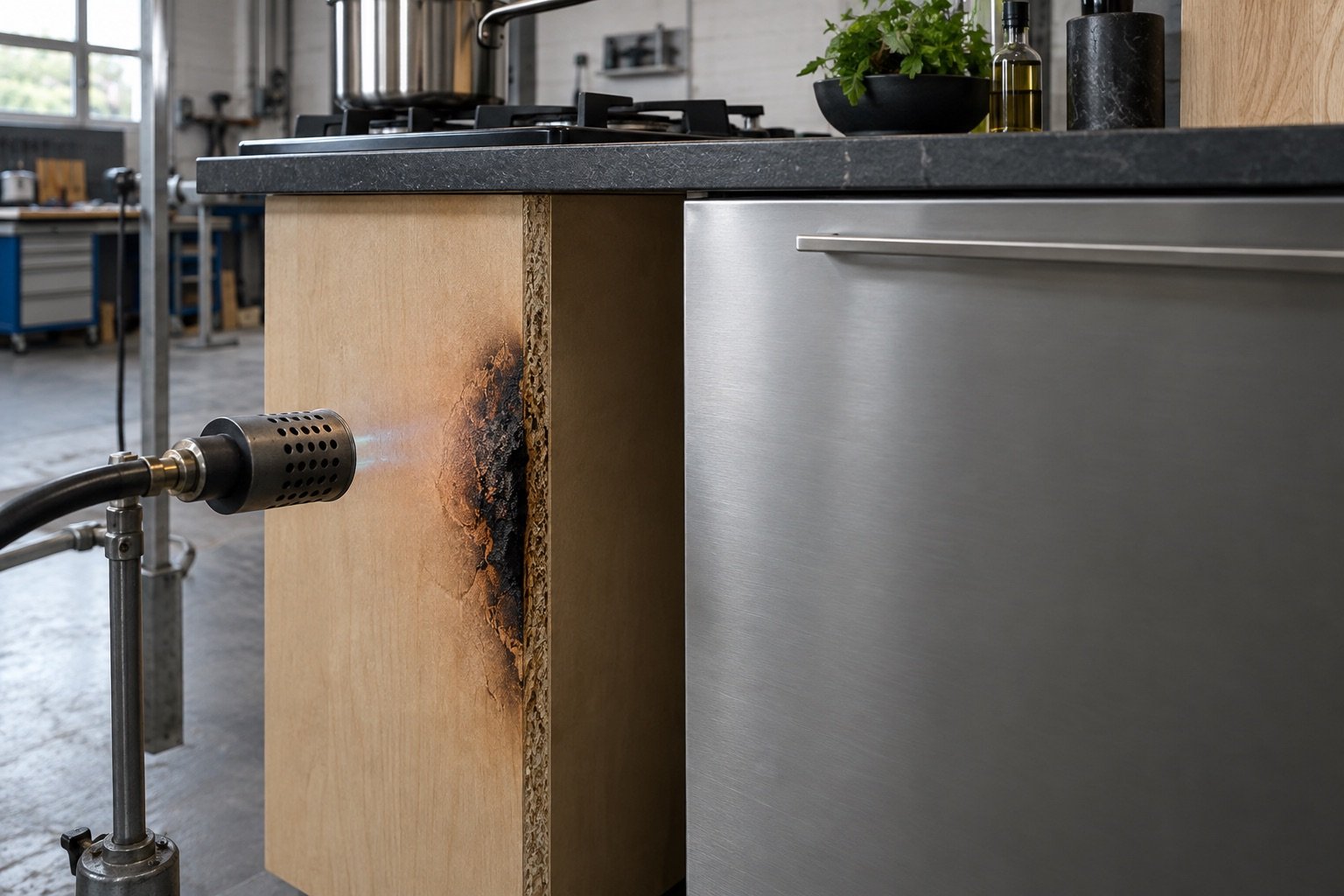
How kitchen fires actually start
A kitchen fire is rarely caused by the cabinet. It is caused by something that reaches ignition temperature while sitting close to something that will burn. The cabinet matters because it is one of the things nearby, and because its material decides whether it joins the fire or simply stands there.
The ignition source
The common triggers are ordinary and well known: unattended oil reaching its flash point in a pan, a gas leak finding a flame, an overheated appliance, a damaged cord or overloaded socket, a cloth left on a hot hob, or a blocked cooling vent. None of these is a cabinet fault. All of them are foreseeable, and most are preventable with clearances, good habits and sound electrical work.
The fuel
Once a small flame exists, what decides whether it stays small is the fuel available to it. Wood-based boards, veneers, laminates, adhesives, edge tapes and the contents of the cupboard are all fuel. A cabinet built from fibre board close to a heat source gives a young fire something to grow into. A cabinet built from steel gives it almost nothing; the same flame has to find its fuel elsewhere.
The cabinet’s real role
This is why the material of the carcass matters, and it is the only sense in which a cabinet is “fire-resistant”. A metal body does not smoulder, does not char into fuel and does not spread flame along a panel. It can become hot, and it can transfer that heat to whatever it stores or touches, so clearance and ventilation still matter. But it removes the cabinet itself from the list of things feeding the fire.
How to judge a fire-resistance claim
When a quote or a brochure makes a heat-related promise, test it with specific questions. Vague reassurance is easy to write and hard to verify; concrete answers are harder to fake. The table below contrasts the two, and it applies equally to wood-based board, metal or a mixed build.
| Question to ask | What a vague answer sounds like | What a specific answer includes |
|---|---|---|
| What is the cabinet body made of? | “It is a premium fire-resistant kitchen.” | A named material — SS304, aluminium, GI or a specified board — recorded module by module. |
| How does it behave near a hob? | “Metal never burns, so it is safe anywhere.” | Stated clearances, shielding and airflow that follow the appliance manual. |
| What protects edges and cut-outs? | “The finish is fully sealed.” | Edge treatment, cut-out protection and the method used at service openings. |
| How are hinges and channels fixed? | “Only the best hardware is used.” | A described fixing system, such as threaded inserts, with load and adjustment in mind. |
| Is any rating claimed? | “It is fully protected and cannot burn.” | A test reference, a certificate and the exact assembly it applies to — or an honest “no rating applies”. |
| What does the warranty cover? | “A lifetime guarantee on everything.” | Coverage tied to the chosen material and written into the project terms. |
Two of those rows matter more than the rest. The first is the material, because everything else follows from it. The second is the rating question, because it is the one most often answered loosely. If a supplier cannot name the material or cite a certificate, the strongest possible response is to ask for both in writing before you commit.
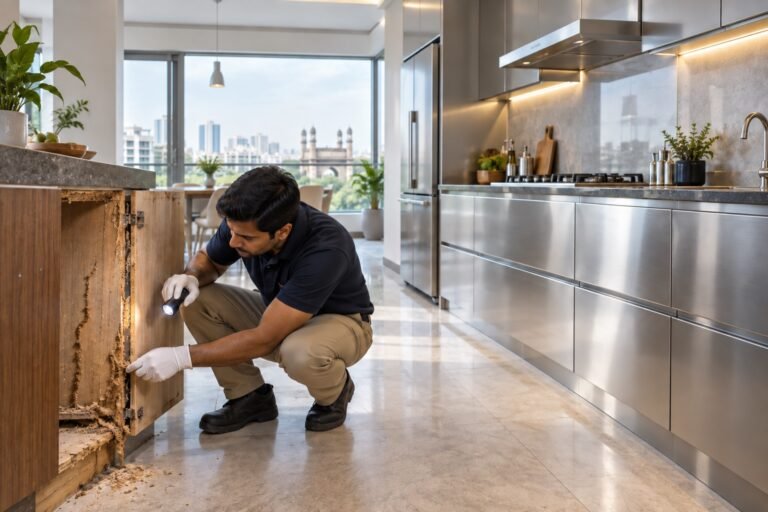
A useful habit is to request the specification as a written schedule rather than a conversation. Ask which module uses which material, how the sink base, tall pantry, loft and wardrobe differ, and how each heat-adjacent unit will be detailed. A supplier who designs in-house can answer this from shop drawings; a supplier who resells a single panel cannot.
Which materials resist heat and ignition
Fire-resistance is not one property but a set of behaviours observed under heat. What matters for a cabinet is whether the material ignites, whether it sustains combustion, whether it releases anything harmful, and how it deforms or transfers heat. The comparison below keeps the framing at the level of material behaviour, without attaching numbers that would need test data to justify.
| Property | Wood-based board | Metal carcass (SS304, aluminium, GI) |
|---|---|---|
| Combustibility | Organic; will ignite and burn given enough heat and oxygen. | Non-combustible; does not sustain combustion on its own. |
| Fuel contribution | Board, resin, veneer and adhesive all add fuel to a fire. | Structural body adds almost no fuel to the fire. |
| Response to heat | Chars, smoulders, swells and loses strength; finishes blister. | Conducts heat and can discolour or distort at very high temperature; coating may be affected. |
| Smoke and odour | Can produce significant smoke and odour while burning. | Does not burn; coatings and stored contents are the usual smoke sources. |
| Reaction to water used on a fire | Absorbs water; swells and weakens further. | Unaffected by water; grade and finish kept in good order. |
| Rating | No residential board carries a fire rating by itself. | No residential carcass carries a fire rating by itself; wording stays descriptive. |
The table is not an argument that metal is the only sensible choice. It is an argument that the material should be named and its behaviour understood. A kitchen with generous clearances, sensible wiring and careful habits is safe in almost any well-built carcass. Where the cabinet sits very close to a heat source, though, removing the fuel from the body is a genuine advantage.
SS304 stainless steel
SS304 is a non-combustible steel with a non-porous, hygienic surface and strong corrosion resistance under normal domestic care. Near cooking zones it offers the dual benefit of not burning and of tolerating the moisture and cleaning that comes with a working kitchen. Confirm the grade, keep the surface clean, and avoid harsh chloride-rich cleaners or steel wool that can contaminate the finish.
Aluminium
Aluminium is light, corrosion resistant and non-combustible, and it suits kitchens, wardrobes and general storage. It conducts heat readily, so it will feel warm if placed beside a heat source, and its performance still depends on profile, alloy, reinforcement and how hardware is fixed. It can be finished to look calm and residential rather than industrial.
Galvanised steel (GI)
Galvanised steel carries a zinc protective layer over a steel core and is normally finished with a coating. Like the other metals it does not burn and does not feed a flame. Check coating continuity and fabricated edges, and follow the stated care routine. Metal & More Interiors provides a 15-year warranty on GI under the written project terms.
Powder-coat and other finishes
A finish sits on the metal; it does not change the fact that the body is non-combustible. Powder-coat, PU paint and laminate surfaces are chosen for colour, texture and durability, and they must be kept in good repair. A powder-coat finish for metal interiors gives a hard, washable surface that stands up to daily kitchen use while the steel underneath continues to resist ignition.
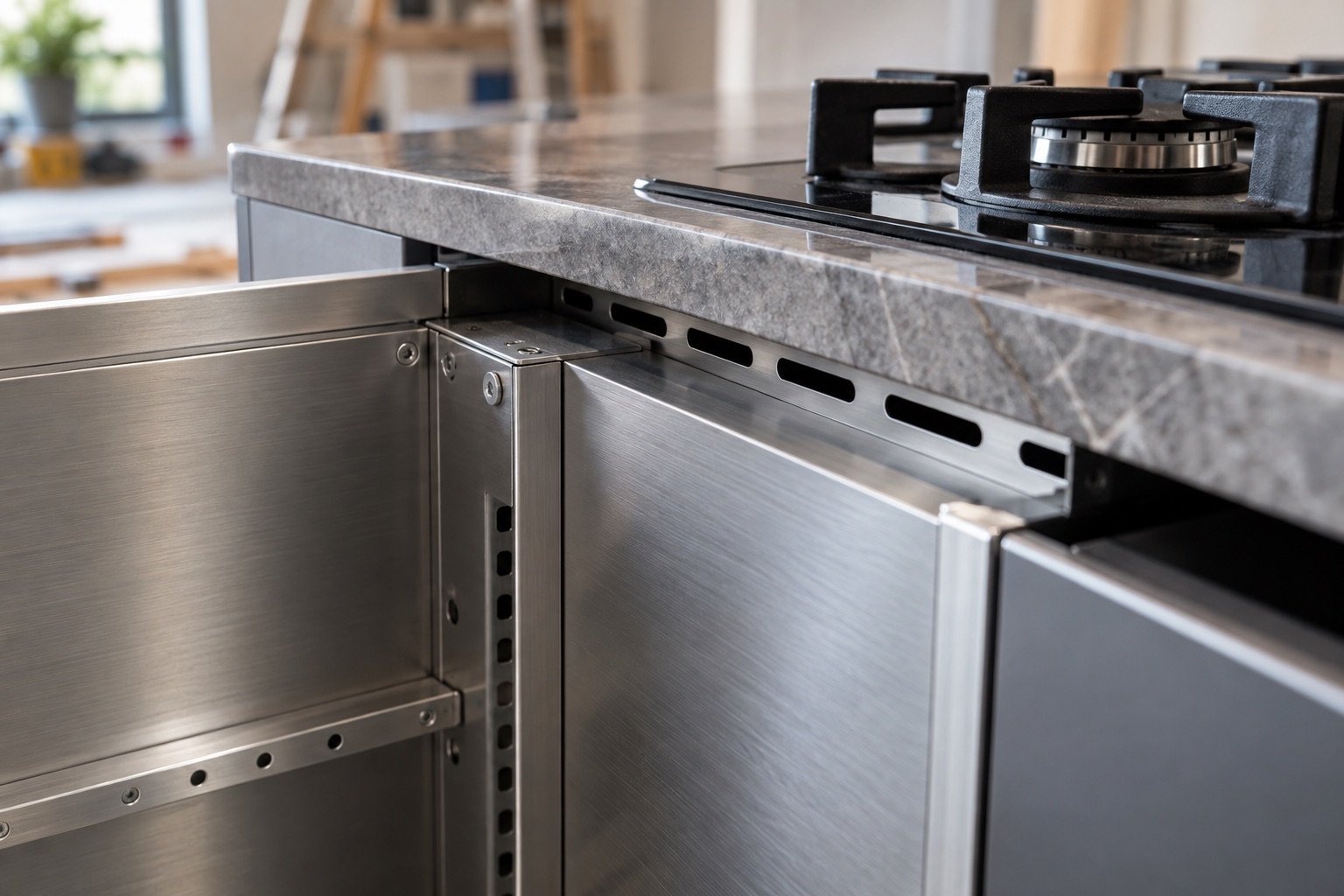
Planning the heat zones
Fire-resistance is only half the task. The other half is layout: where the hot things sit, and what surrounds them. A material that does not burn can still be a poor neighbour to a hob if it is too close, and the appliance manual — not the showroom — is the authority on clearances.
Hob and chimney
Leave the clearances the hob manufacturer specifies between the burner edges and any side panel, wall or overhead unit, and let the chimney extract properly. Do not site a tall unit so that its side face receives direct flame from a burner. Where the wall behind the hob is combustible, use a non-combustible backsplash or a specified heat shield. Metal side panels help here, but the gap and the shielding still do the real work.
Ovens and built-in appliances
Built-in ovens, microwaves and dishwashers come with their own ventilation and clearance requirements, usually stated in millimetres in the manual. Follow them exactly. An appliance bay needs airflow around the unit and a route for warm air to escape; sealing it tightly into a cupboard defeats the design. Confirm the housing dimensions before fabrication rather than cutting metal afterwards.
Talls, lofts, refrigerators and gas lines
Tall units beside an oven, lofts above a chimney, and cabinets next to a refrigerator all sit in warmer microclimates. Plan the gas connection with an accessible shut-off, keep flexible hoses away from hot surfaces, and route electrical cables clear of heat. A kitchen rack in Hyderabad or an open shelf above a hob should be positioned to the same clearance rules as an enclosed unit.
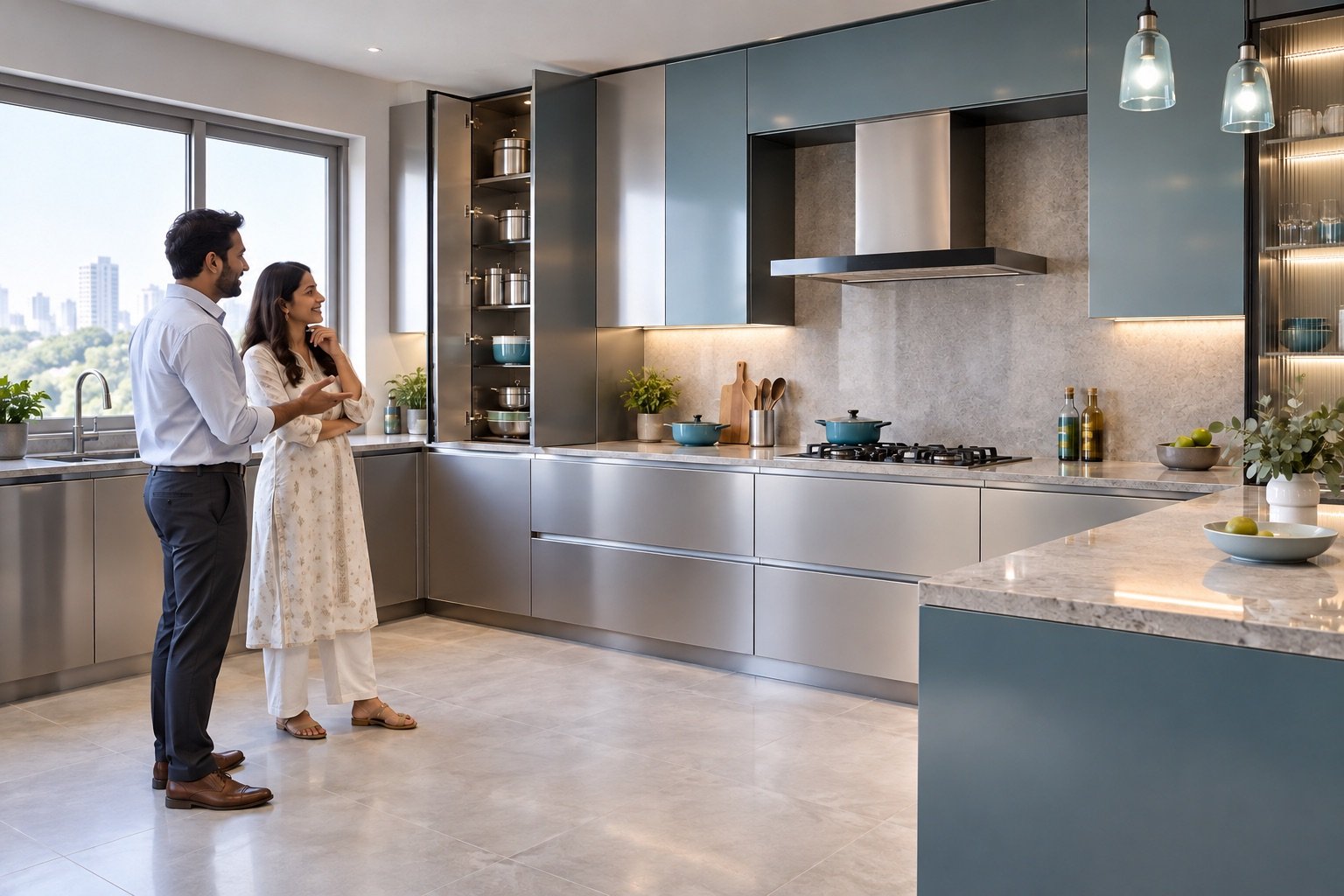
How Metal & More Interiors builds differently
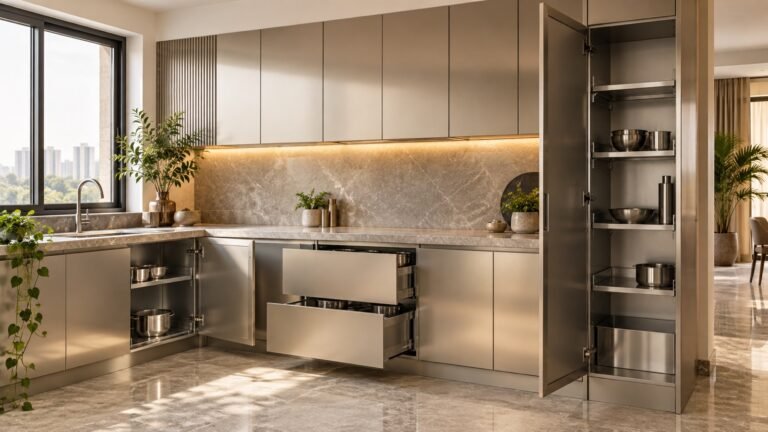
Metal & More Interiors designs and manufactures metal interiors in Hyderabad, with SS304, aluminium and GI cabinetry fabricated in-house. The meaningful difference is control: the same team measures the room, produces the shop drawings, fabricates the modules, checks them and installs them, so the material named on the quote is the material delivered to site.
The selected carcass and shutters are metal unless a customer deliberately approves a documented mixed-material configuration. Typical kitchen and wardrobe depth is planned around 2 feet where applicable, adjusted for the wall, countertop, appliances, services and room circulation. Modules use an Insert Nut Fastening System, where a threaded insert creates a controlled fixing point in the metal build — a connection that can be released and refitted during future service rather than a screw driven once into a substrate.
Because the body is non-combustible, the cabinet adds almost nothing to the fuel load of a kitchen, and because the body is metal it is also termite-proof, waterproof and rust-resistant as a material when the correct grade and finish are used. Coatings, sealants, hardware and stored contents still deserve care; the accurate safety description remains fire-resistant, not a certified rating. Warranty follows the chosen material: lifetime on stainless steel and aluminium, and 15 years on GI, subject to the written project terms. Hettich hardware can be specified where selected; it is not claimed automatically for every fitting.
Myths and mistakes
A handful of beliefs cause most of the confusion around this topic. Clearing them up makes the whole decision simpler.
- “Fire-resistant means it cannot catch fire.” It means the material resists ignition and does not readily add fuel. Heat and flame can still damage coatings, seals and fixings, and can still travel to what the panel touches.
- “A metal kitchen is therefore a completely safe kitchen.” No single material makes a room safe. Clearances, wiring, gas safety, ventilation, alarms and habits decide the outcome.
- “The front shutter matters most.” The carcass, edge treatment and fixing points matter at least as much. A fire-resistant shutter on a board body is only half a decision.
- “A thick metal desk means a better cabinet.” Shape, folds, reinforcement and fixing method do more for rigidity and heat behaviour than raw thickness alone.
- “A brochure word is enough.” Ask for the material name and any test reference in writing. A claim you cannot verify is a claim you cannot rely on.
The most expensive mistake is not choosing the wrong material but leaving the specification vague. Two kitchens can look identical in a rendering while using different carcasses, edges and fixing systems. The clearer the written schedule, the easier it is to compare quotes honestly and the less chance there is of discovering a misunderstanding after installation.
Habits that cut real fire risk
Material choice is a passive safeguard. The active safeguards sit with how the kitchen is used, and they matter more than any panel spec. A metal carcass does not excuse a neglected hob or a tangle of extension leads.
Keep a working smoke alarm within hearing of the kitchen and test it on a schedule. Store a suitable extinguisher or fire blanket where it can be reached without crossing the hob, and know how to isolate the gas and electricity. Clean grease from the hob, chimney filter and surrounding surfaces so that deposits cannot catch. Never leave hot oil unattended, keep cloths and packaging away from burners, and give appliances the airflow their manuals require. Repair damaged cords and overloaded sockets promptly, and keep the area around a cylinder or piped connection clear.
In the cabinet itself, keep the finish intact — a chipped or peeling coating should be repaired before moisture and heat can work on the metal beneath. Keep service openings clear so a small problem can be inspected before it grows. These habits do not depend on whether the shutter is wood or steel, which is exactly why they belong in every kitchen plan. For readers reviewing the whole home rather than one room, the same logic extends across a set of full-home metal interiors.
10 safety checks for fire-resistant kitchen cabinets
Use this list before approving a quotation for a heat-conscious kitchen.
- Record the hob, chimney and oven clearances from the appliance manuals.
- Confirm the carcass, shutter and finish material for every module in writing.
- Detail heat shields and non-combustible back surfaces where required.
- Plan electrical routing, isolation and socket positions away from heat.
- Locate the gas connection with an accessible shut-off and short, protected hoses.
- Keep a smoke alarm, extinguisher or blanket reachable without crossing the hob.
- Confirm edge treatment and protection at every cut-out and service opening.
- Approve internal dimensions, depth and clearances after site measurement.
- Check the fixing system, hardware and future service access.
- Record warranty coverage and exclusions in the project terms.
Frequently asked questions
What does fire-resistant mean for a kitchen cabinet?
It describes a material that resists ignition and does not feed a fire the way an organic board can. A metal carcass is non-combustible, so it adds almost no fuel to a kitchen. It is a material property, not a certificate, and it does not make the whole room safe on its own.
Does a metal cabinet carry a certified fire rating?
No. A measured rating comes from a standard test on a complete, certified assembly such as a fire door or shaft, and it is confirmed by a certificate. An ordinary residential carcass is not tested that way, and Metal & More Interiors does not present its cabinetry as a rated system.
Can cabinets touch a hob or oven?
Follow the appliance manufacturer’s clearance and ventilation instructions. Cabinet material does not remove the need for safe gaps, shielding and airflow. Treat those manual figures as the minimum, not a target to shave.
What can a fire-resistant carcass actually contribute?
It removes the cabinet from the fuel available to a fire and resists ignition itself. That is a genuine benefit beside a heat source, but coatings, hardware and stored contents can still be damaged, so clearances and habits remain essential.
Which metal is used near cooking and wet zones?
SS304 is commonly selected for demanding cooking and wet zones because it resists corrosion and is non-combustible. Aluminium and GI may suit other positions after the layout, finish and exposure are reviewed. In every case the grade and finish should be recorded.
How can I reduce fire risk in my own kitchen?
Keep clearances, maintain the smoke alarm, store an extinguisher or blanket within reach, clean grease, give appliances airflow, repair damaged wiring and never leave hot oil unattended. These steps work alongside good material choices rather than replacing them.
Final decision
Treat fire-resistant kitchen cabinets as a precise, modest claim rather than a slogan. The material genuinely resists ignition and does not feed a fire; it does not carry a measured rating and it cannot make a room safe by itself. Build the decision from three parts: name the material, plan the heat zones around each appliance, and keep the everyday safety habits that do most of the real work.
Metal is compelling where the priority is a cabinet that will not become fuel, will not swell with water and will not be eaten by termites. It still has to be designed, fabricated and installed correctly, with clearances and service access planned from the start. Metal & More Interiors can measure the room, review the heat and wet zones, and recommend SS304, aluminium, GI or a documented mixed-metal configuration. The office is at Jai Jawahar Nagar, Yapral Ammuguda Road, Secunderabad, and manufacturing is at B.N. Reddy, Charlapally. To ask a specific question first, speak to the team, or compare the wider material range in the stainless steel modular kitchens service.