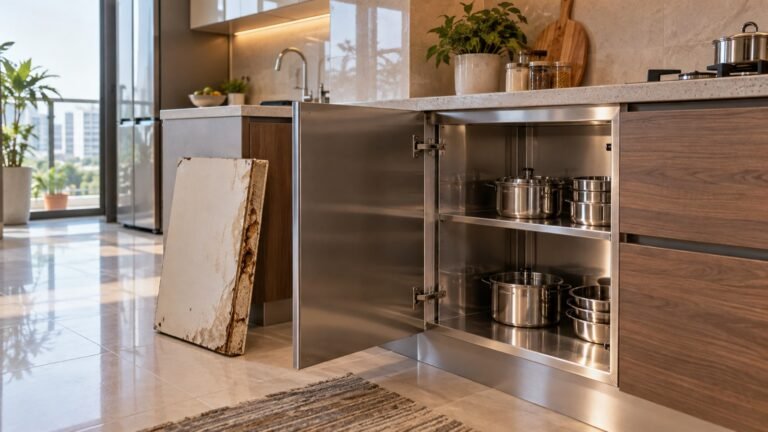

Termites in plywood kitchen cabinets are a colony problem, not a cabinet problem. The insects usually arrive through soil, wall cracks, service ducts and connected woodwork, so treatment must reach the colony and its route as well as the damaged module. Rebuilding the failed cabinet in metal removes the food source from that module, but it does not replace building-level pest control.
Homeowners usually meet this subject at the worst possible moment: a shelf sags, a shutter sticks, a soft patch appears near the sink base, or a fine trail of debris is found behind a kickboard. By then a colony may have been working quietly for months inside a wall, plinth or adjacent door frame, and the cabinet is simply where the damage finally becomes visible. Hurried purchases — a tin of spray, a new cabinet, a coat of paint over a hollow panel — tend to treat the symptom and leave the route untouched.
This guide explains termites in plywood kitchen cabinets in practical terms for Hyderabad homes and apartments. It separates what can be saved from what should be replaced, sets out the warning signs worth photographing, looks at what professional treatment actually does, and explains how a metal cabinet body changes the long-term picture. Metal & More Interiors designs and manufactures metal interiors in-house from its factory at B.N. Reddy, Charlapally, with its office at Jai Jawahar Nagar, Yapral Ammuguda Road, Secunderabad.
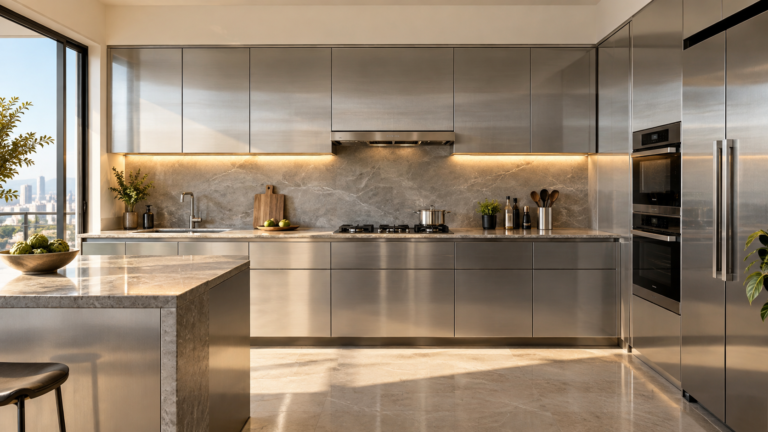
Homeowners searching for termite-proof kitchen cabinets or termite-resistant kitchen cabinets are usually trying to prevent a repeat failure, not simply change the finish. A steel kitchen or stainless steel modular kitchen in Hyderabad removes wood-based food from the cabinet body, but the building still needs professional colony treatment, leak correction and a dry service zone. Quotations should therefore separate pest treatment from the new cabinet specification.
Quick answer
Termites are a colony animal. The visible cabinet is the symptom; the colony and the route by which it reached the cabinet are the cause. A surface spray applied to the outside of a shutter rarely reaches insects living inside a wall cavity or beneath a plinth, and disturbing a mud tube without treating the access path can simply push the activity to another part of the house. Any real solution therefore has two halves: professional pest control that addresses the colony, and a decision about the cabinet itself once the moisture and pest problems are under control.
Plywood is a wood-derived product. Its veneers and the adhesive between them are cellulose and resin, which offer food and shelter to a termite colony once the board is damp enough to work easily. A metal cabinet body — stainless steel, aluminium or galvanised steel — is not a termite food source and does not hold moisture the way a fibre board does, so it takes those modules off the menu. What metal cannot do is stop a colony living in the soil, the wall or neighbouring woodwork from travelling behind the cabinet on its way somewhere else. Building-level pest control and a dry, well-detailed cabinet remain the foundation; the material choice then decides how the cabinet behaves over the following decade.
How termites reach a plywood kitchen
Found mud tubes, hollow panels or loose hinge points? Record the evidence first, then plan treatment and cabinet replacement as separate decisions.
Subterranean termites, the type responsible for most damage in Indian homes, live in the soil and build protected tunnels to reach food. Drywood and dampwood species behave differently, but the practical result is the same: once a colony has a route into a building, it explores the wood and wood-based materials it can reach while staying out of the light. A plywood kitchen sits in the middle of that search, because it combines cellulose, warmth, darkness and — near a sink or a damp wall — the moisture the insects need.
Why plywood attracts them
Plywood is made from thin veneers glued in crossed layers. That construction makes it stable and strong for its weight, which is why it remains a popular cabinet material, but it is still organic. Under dry, well-sealed conditions a plywood cabinet can last well. Under chronic moisture — a slow leak under the sink, a damp external wall, a poorly ventilated utility corner — the board softens, the edges open and the exposed core becomes far easier to tunnel through. Termites rarely attack a sound, dry, sealed panel first; they usually appear where the plywood has already been weakened by damp.
The same logic explains why a swollen or water-damaged cabinet deserves attention even before any insect is seen. If you have already noticed board swelling, the companion guide on why plywood kitchen cabinets swell traces the moisture routes that make a cabinet both weaker and more attractive to pests.
The common entry routes
- Soil in contact with the plinth, skirting or a ground-floor cabinet line.
- Hairline cracks in walls, expansion joints and the gap around a window frame.
- Service ducts, plumbing penetrations and the sleeve where a drain or water line enters the room.
- Skirting boards and door frames that sit against the same wall as the kitchen.
- Damp plaster or a leaking wall behind the sink and the utility corner.
- Cardboard, paper, packing debris and offcuts left inside service voids after construction.
- Connected furniture — a wooden wardrobe, cupboard or partition sharing the same structure.
Because these routes are hidden, the first cabinet to show damage is often not the point of entry. A colony living behind a skirting can travel several metres through a wall cavity before it reaches the kitchen, and it may leave a second, quieter trail running behind a run of base units. That is why an inspection has to look beyond the damaged module to the walls, the floor line and the adjacent joinery.
Why kitchens are especially vulnerable
Nowhere else in a home concentrates moisture, warmth and stored starch the way a kitchen does. The sink base handles daily water; the dishwasher bay adds warm damp air; the base units sit low, close to the cool floor and the plinth; and the cupboards hold grain, flour and packaged food that keep the microclimate stable. Add a poorly ventilated corner or a slow drip that nobody has noticed, and the conditions a colony prefers are met almost exactly.
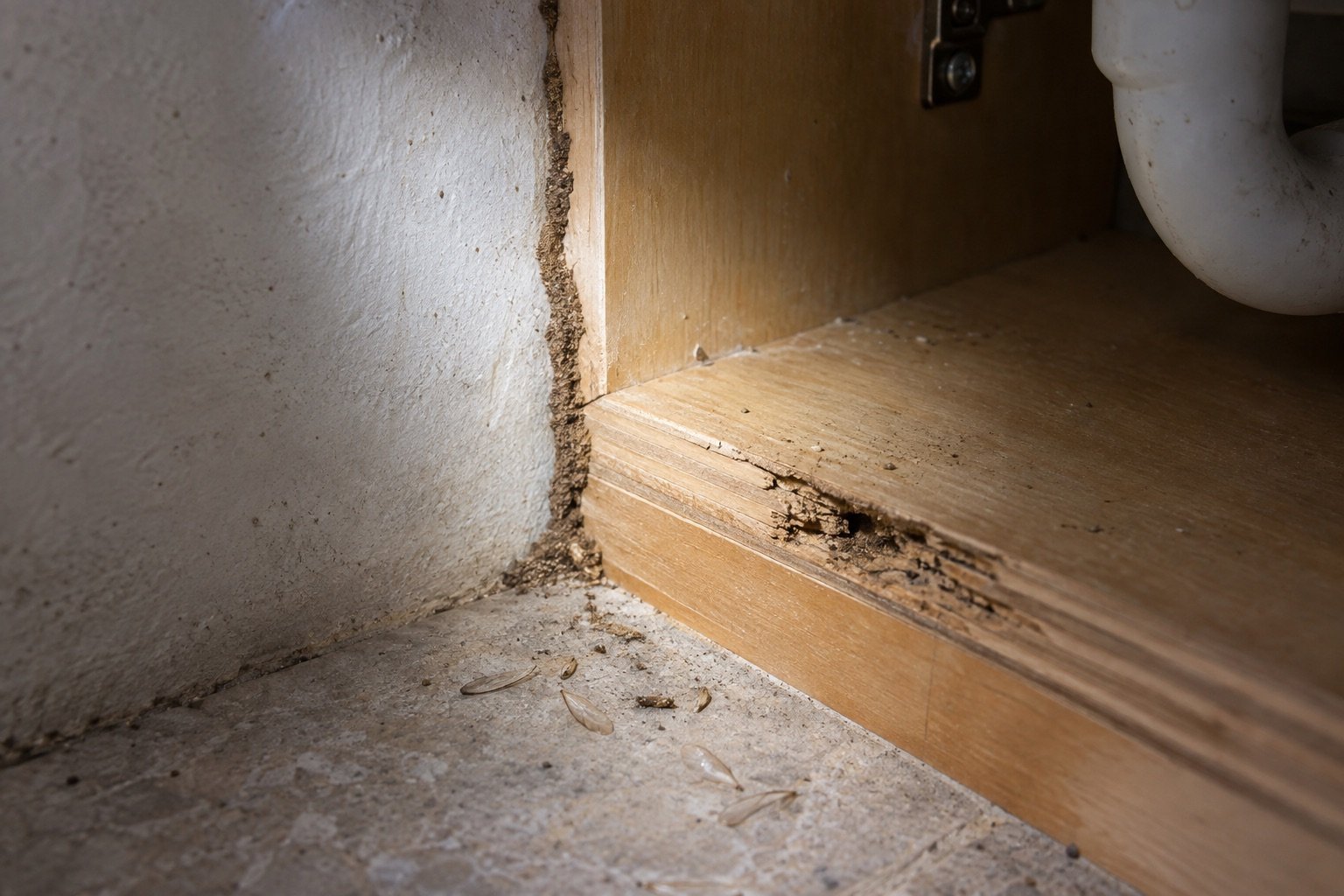
9 warning signs of termites in plywood kitchen cabinets
Termite activity is usually discovered late because the insects stay inside the structure and cover their tracks. Early detection depends on recognising the handful of signs worth acting on, and on checking the quiet places — under the sink, behind the kickboard, along the back of a base unit, inside a loft — rather than only the parts of the kitchen you see while cooking.
| Sign | What it usually indicates | Sensible next step |
|---|---|---|
| Mud tubes on walls, plinth or cabinet back | An active, protected termite route between soil and food. | Photograph the tube, do not break it, and book a professional inspection. |
| Hollow or papery sound when a panel is tapped | The interior of the board has been tunnelled and eaten away. | Mark the panel, probe gently at an edge and check the modules beside it. |
| Fine granular debris below a shelf or joint | Frass or droppings falling from activity inside the panel. | Collect a small sample in a sealed bag and show it to the inspector. |
| Blistered, rippled or lifting surface | Moisture damage or insect activity pushing beneath the finish. | Check for a leak first, then have the panel assessed for structural loss. |
| Doors and drawers that stick or drop | The carcass or the fixing zone has lost shape or strength. | Test the hinge plate and shelf support; a loose fixing often signals deeper damage. |
| Discarded wings near a window or light | A swarm, often the start of a new colony nearby. | Note the date and location and arrange an inspection promptly. |
| Faint rustling or clicking inside a panel | Soldiers tapping, or a large and established colony. | Treat as urgent; avoid disturbing the area by cutting or spraying. |
Read the signs together rather than one at a time. A single sticking door is usually just a hinge problem. A sticking door beside a hollow panel, a mud tube and a damp wall is a pattern, and the pattern is what tells you the cabinet is part of something larger. If several of these signs appear in the same run of units, assume there is activity you cannot yet see and call in an inspector before spending money on new shutters or handles.
How to confirm an infestation before you spend money
The aim of an inspection is to answer three questions: is there an active colony, where is it coming from, and how much of the cabinet has actually lost strength. Those questions are separate from whether the kitchen merely looks tired, and keeping them separate prevents the two most common mistakes — replacing a cabinet that only needed treatment, and treating a cabinet that is no longer structurally safe.
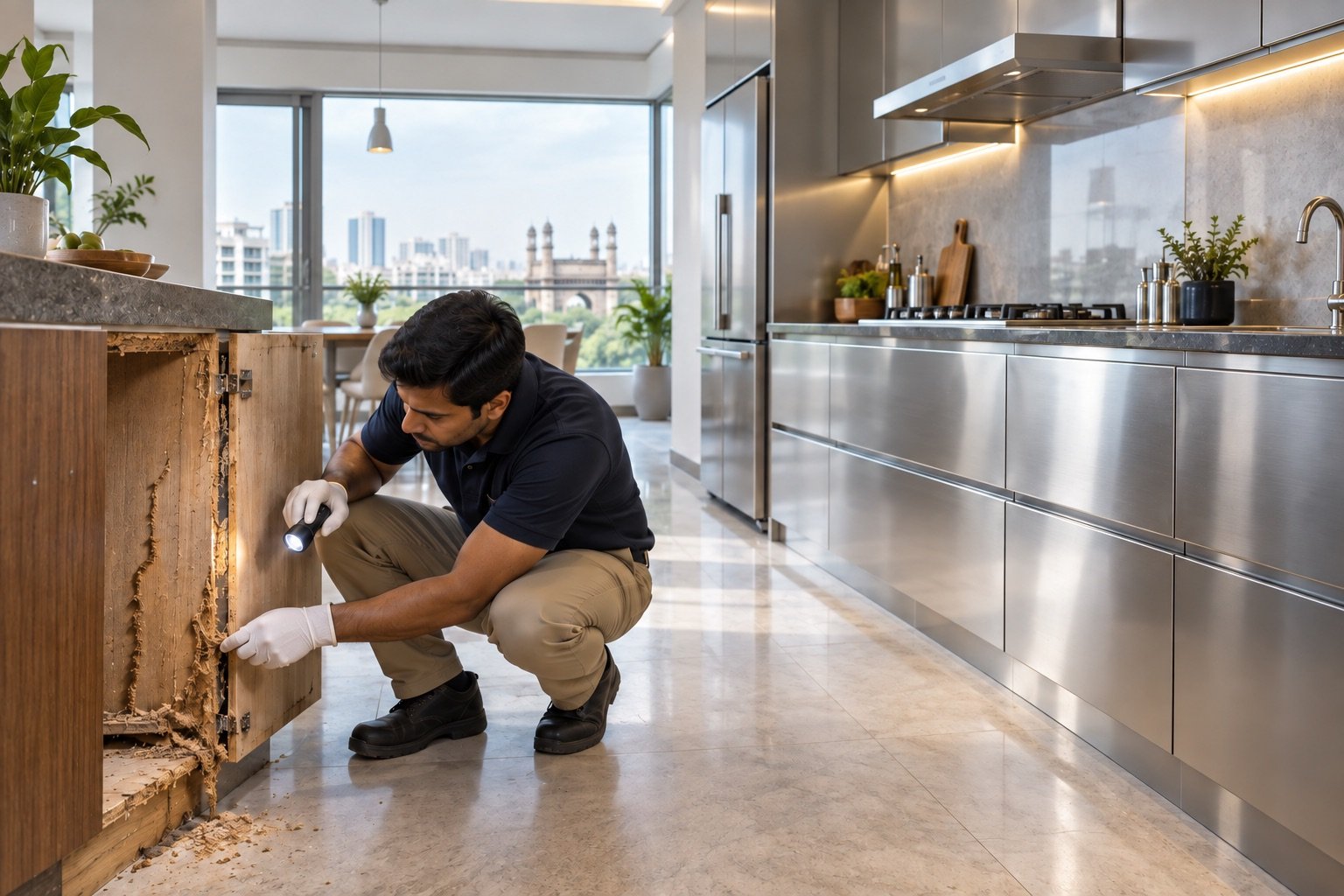
A methodical look begins with the room as a whole. Check the wall behind and beside the kitchen for tubes and cracks, follow the floor line and skirting, and inspect the service points where pipes and waste lines enter. Inside the cabinets, tap each panel and listen for the change in pitch between a solid sheet and a tunnelled one, inspect the underside of shelves and the back of the carcass, and look closely at the joints where moisture gathers. A torch and a thin probe reveal more than a glance, and a moisture reading near the sink base gives useful early warning.
Document everything as you go. Photographs with a date, notes of where each sign was found and a simple sketch of the affected run will help the inspector and will later show what has changed. Do not dismantle cabinets or break open mud tubes before that inspection; disturbing the visible route can move activity elsewhere and make the problem harder to trace. Where the kitchen shares a wall with a wooden wardrobe or a partition, the same review should extend to that woodwork, because treating only the kitchen of a larger route rarely holds.
Treat or replace: choosing the right response
Once an inspector has confirmed the colony and the route, the cabinet decision becomes more straightforward. The question is not “wood or metal” but “how much of this module is still sound”. Termite damage is often uneven: a carcass can lose its core in one corner while the surrounding panels keep most of their strength. Decisions should follow structural condition, not the age of the kitchen or the size of the repair bill.
| Condition found | What it means | Reasonable action |
|---|---|---|
| Active colony, panel still solid | Insects present, but the structure is not yet weakened. | Treat the colony and route first; keep the module under observation. |
| Surface damage only | Finish blistered or stained; the core is intact. | Fix the moisture source, then repair or refinish after treatment. |
| Hollow core, fixing still holds | Partial loss of material; hardware still secure. | Assess load-bearing panels and replace the weakest boards, not the whole run. |
| Sagging shelf or loose hinge zone | The panel can no longer carry its intended load safely. | Replace the affected module once treatment is complete. |
| Soft, crumbling or open edges | Structural loss worsened by moisture. | Replace the module and repair the plumbing or damp wall at the same time. |
| Colony in the wall, not the cabinet | The cabinet is a waypoint on a larger route. | Treat the building; review the cabinet only after the route is closed. |
Two points are worth holding on to. First, treatment always comes before replacement. Installing a new cabinet against an untreated wall leaves the new module in the same vulnerable position, and a fresh plywood body is simply fresh food. Second, replacing only the damaged module is often enough; a whole kitchen need not be sacrificed because one sink base failed. What matters is that the replacement is built from a material that will not repeat the failure — and that the moisture and pest problems behind it have genuinely been solved.
What professional termite treatment involves
Termite control is a specialist service, and the details matter because the wrong method can simply move the problem. A qualified technician works in a defined order, and a good provider is willing to explain each step before starting.
Identifying the species and the route
The first task is to confirm which termite is present, because subterranean, drywood and dampwood species need different approaches. The technician then traces the route — the soil contact, the crack, the duct or the damp wall — and works out how the insects are reaching the kitchen. Jumping straight to a spray without this step is the most common reason a treatment fails within a season.
Treating the soil and the structure
For subterranean termites, treatment usually combines a chemical or bait barrier in the soil with targeted work inside the building. Injection through drilled holes into walls and along the plinth, and sometimes bait stations placed around the property, are common methods. The goal is to break the connection between the colony and the building rather than to kill only the insects that happen to be in the cabinet today. Access to the soil line, the service voids and the damp wall is therefore part of the job, which is why treatment and repair planning often need to happen together.
Aftercare and what a guarantee really covers
Treatment is not a one-time event that ends when the technician leaves. Follow the provider’s guidance on inspection intervals, keep the treated zone dry, and report any new activity promptly. A guarantee is only as useful as its wording, so read it carefully and record what it actually promises.
| What to check | Why it matters |
|---|---|
| Scope of the guarantee | Confirm whether it covers re-treatment, fresh infestation or only the original application. |
| Duration and conditions | Coverage often depends on the building staying dry and on scheduled inspections being carried out. |
| Products and method | Ask which chemicals or bait systems are used and whether the treatment is suitable for a working kitchen. |
| Access and safety | Food, water and utensils must be protected; ventilation and re-entry guidance should be given in writing. |
| What is excluded | Structural damage, damp problems and connected woodwork are frequently outside the guarantee. |
The cost of treatment varies with the size of the property, the extent of the route, the method chosen and the guarantee offered, so it is worth obtaining a written scope rather than a single figure. Whatever the amount, the logic is unchanged: fix the moisture and the route, treat the colony properly, and only then decide which cabinet modules deserve to be rebuilt in a material that will not feed the next colony.
How Metal & More builds differently
Metal & More Interiors designs and manufactures metal interiors in Hyderabad, with SS304 stainless steel, aluminium and GI cabinetry fabricated in-house. The practical difference is control: the same team measures the room, prepares the shop drawings, fabricates the modules, checks them against the drawing and installs them, so the material named on the schedule is the material that reaches the site.
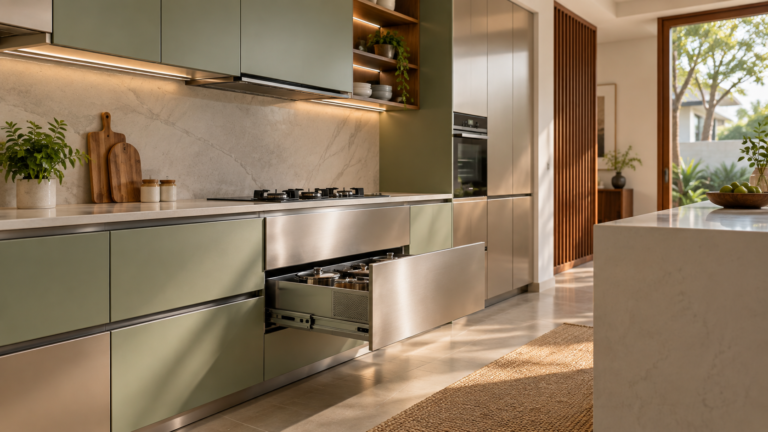
The selected carcass and shutters are metal unless a customer deliberately approves a documented mixed-material configuration. Typical kitchen and wardrobe depth is planned around 2 feet where applicable, then adjusted for the wall, countertop, appliances, services and room circulation. Because the body is not a wood-derived product, it is not a termite food source, and because it does not absorb water the way a fibre board does, it removes two of the conditions a colony needs inside the cabinet itself.
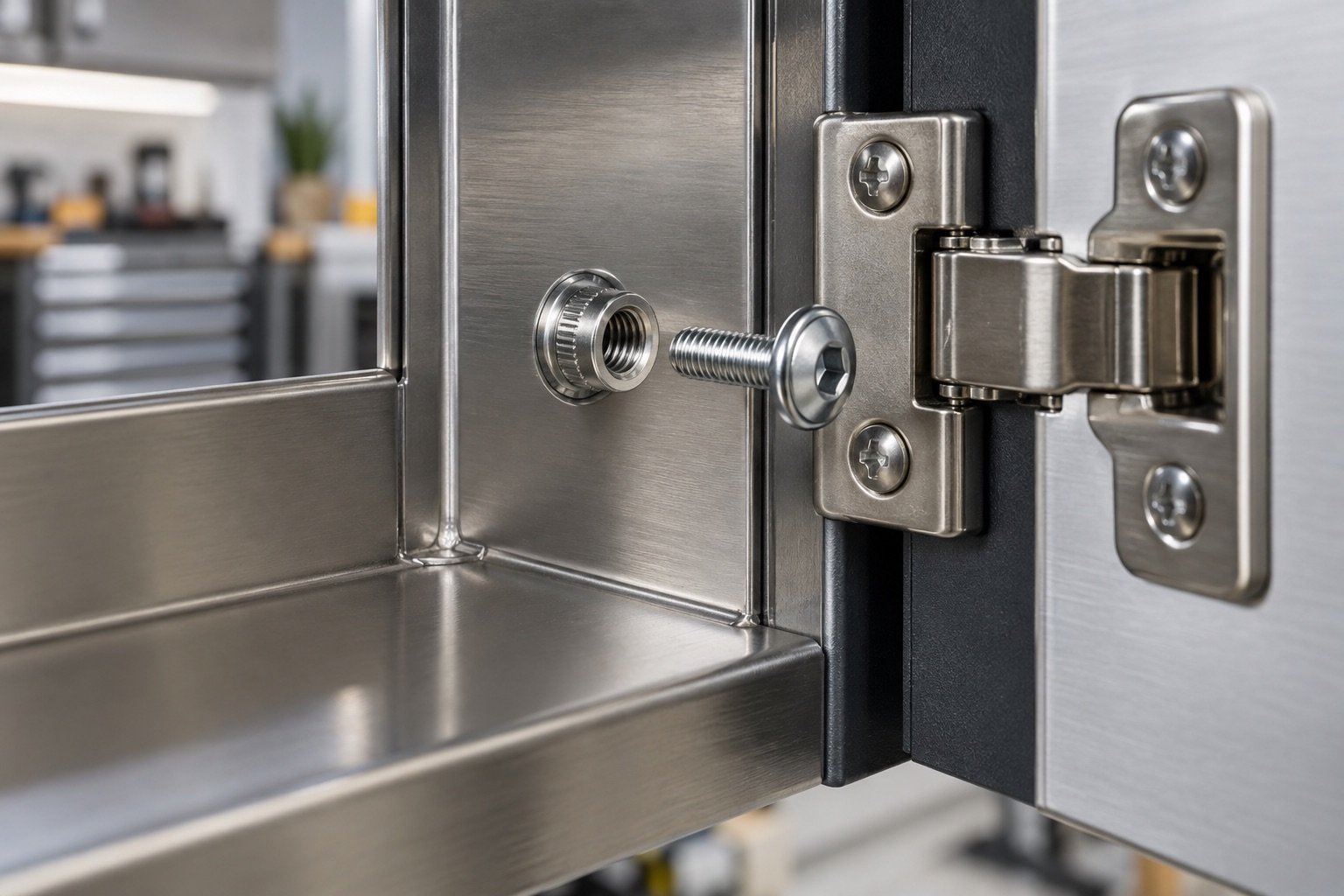
Modules use an Insert Nut Fastening System. A threaded insert forms a controlled fixing point in the metal construction, so hardware can be loosened and re-fitted during future service instead of a screw being driven once into a substrate that may later weaken. After a pest failure, that serviceability matters: a damaged door or shelf can be replaced without disturbing the modules around it, and access points can be reopened rather than cut. Warranty follows the chosen material — lifetime on stainless steel and aluminium, and 15 years on GI, subject to the written project terms. Hettich hardware can be specified where selected; it is not claimed automatically for every fitting.

Choosing SS304, aluminium or GI
All three metals are non-organic and therefore not a termite food source, but they differ in strength, weight, finish and corrosion behaviour, so the choice should follow the module and the room. A pest-driven rebuild is a good moment to match the material to each zone rather than applying one grade everywhere.
SS304 stainless steel
SS304 is the premium choice for demanding kitchen and wet-zone use. Its non-porous surface is hygienic, easy to wipe down and highly corrosion resistant under normal residential care. It suits sink bases, dishwasher bays and heavy-use base units where moisture and cleaning are constant. Confirm the grade, keep the surface clean, and avoid harsh chloride-rich cleaners or steel wool that can contaminate the finish.
Aluminium
Aluminium is light, corrosion resistant and well suited to kitchens, wardrobes and general storage. Panel profile, alloy, reinforcement and hardware fixing still decide performance, and it can carry a calm residential finish rather than a commercial look. It is a practical choice where weight and clean lines matter more than maximum rigidity.
Galvanised steel (GI)
Galvanised steel carries a zinc protective layer over a steel core and is normally finished with a coating. It offers a cost-conscious non-organic body with good stiffness. Check coating continuity and fabricated edges, keep the finish in good repair, and follow the stated care routine. Metal & More Interiors provides a 15-year warranty on GI under the written project terms.
Homeowners weighing a pest-resistant rebuild against another board product can compare the options directly in the metal vs WPC kitchen guide, then review the workshop detail on the stainless steel modular kitchens service page.
Planning checklist before you approve a quotation
Whether you are treating an existing kitchen or rebuilding one module in metal, a short checklist keeps the project focused on the cause rather than the symptom.
- Confirm the species and the route with a qualified pest-control provider.
- Fix the moisture source — plumbing, damp wall or ventilation — before any new module is fitted.
- Photograph every sign of activity and keep the record with the treatment report.
- Decide module by module whether to treat, repair or replace, based on structural condition.
- Name the carcass, shutter, finish and hardware material for every unit in writing.
- Confirm the warranty period, its scope and its exclusions in the project terms.
- Keep service points — valves, traps and purifier connections — genuinely accessible.
- Approve internal dimensions after site measurement, not just the front elevation.
- Operate a finished sample and inspect the inside construction before you commit.
A clear quotation makes comparison easier, not harder. Two kitchens can look identical in a rendering while using very different cabinet bodies, joint systems and fixing methods, and the differences only surface years later. Ask for enough detail to understand the long-term structure, and treat vagueness about the material as a warning rather than a small detail.
Frequently asked questions
Can termites eat stainless steel or aluminium cabinets?
No. Stainless steel, aluminium and galvanised steel are not a food source for termites, so a metal cabinet body cannot be eaten. The insects can still travel behind such a cabinet to reach woodwork elsewhere in the building, which is why metal removes the food source from the cabinetry but does not replace building-level pest control.
Should I spray the cabinet myself?
A surface spray is unlikely to reach a concealed colony inside a wall, plinth or duct, and it may disturb the visible route without solving it. A qualified pest-control professional can identify the species and the access path and choose a treatment that reaches the colony rather than only the insects you can see.
Does anti-termite treatment last forever?
No treatment lasts forever on its own. How long protection continues depends on the product and method used, the building’s condition, future moisture and any disturbance of treated areas. Keep the treatment documentation, follow the provider’s inspection schedule and act quickly if new activity appears.
When should damaged cabinets be replaced rather than treated?
Replace a module when the board has lost strength, when a shelf sags, when an edge is soft or crumbling, or when a hinge or channel can no longer be fixed safely. Treat first, then replace only the modules that are structurally unsound; a sound cabinet can usually be retained and kept under observation.
Will termites come back after the colony is treated?
A correctly treated building is far less vulnerable, but re-infestation is always possible if soil contact, cracking or damp returns. Keeping the treated zone dry, repairing leaks and maintaining the barrier or bait system are what keep the risk low over the long term.
Is plywood always a bad choice for a kitchen?
Not necessarily. A sound plywood cabinet in a dry, well-sealed and well-ventilated spot can serve for years. The risk rises sharply where moisture is chronic — under the sink, against a damp wall or beside a leaking appliance — and those are exactly the positions where a non-organic metal body is worth considering.
Final decision
Treat termites in plywood kitchen cabinets as two problems with two solutions: a colony that needs professional treatment at its source, and a cabinet that needs to be judged on its remaining strength. Fix the moisture and the route first, record what the inspector finds, and then decide module by module whether to treat, repair or rebuild. Metal is compelling in the modules that failed because it cannot be eaten and does not absorb water, but it still has to be designed, fabricated and installed correctly.
Metal & More Interiors can measure the room, review the failure point and recommend SS304, aluminium, GI or a documented mixed-metal configuration across modular kitchens in Hyderabad. The office is at Jai Jawahar Nagar, Yapral Ammuguda Road, Secunderabad, and manufacturing is at B.N. Reddy, Charlapally. To ask a specific question before booking a visit, talk to us.