

How long does a plywood kitchen last?
A practical lifespan guide for Indian homes—covering plywood grade, moisture, hardware, workmanship, warning signs, repair decisions and durable alternatives.
How long does a plywood kitchen last? In a dry, well-ventilated home, a properly built plywood modular kitchen can often deliver roughly 10 to 15 years of useful service. Premium marine-grade plywood, sealed edges, reliable hardware and disciplined leak control may extend that period. Persistent seepage, steam, unsealed cut-outs, poor-quality boards or weak installation can reduce a plywood kitchen lifespan to five to eight years—and localised under-sink failure may appear much sooner.
How long does a plywood kitchen last in Hyderabad?
The useful life of a cabinet is the period during which the carcass stays structurally sound, shutters remain aligned, drawers travel correctly and the interior remains hygienic. A kitchen does not suddenly “expire” on a particular date. It normally loses serviceability in stages: hinges need adjustment, exposed edges darken, the sink cabinet softens, shelves bow and laminate begins lifting. Good maintenance can correct early wear, but deterioration inside a wet board is difficult to reverse.
For many Hyderabad apartments, 10 to 15 years is a realistic planning range for a competently built plywood kitchen. Dry upper cabinets may remain usable for longer, while the sink base and cabinets touching damp walls may fail first. Homes with hard daily use, frequent wet cleaning, inadequate exhaust or unnoticed plumbing leaks should budget for earlier repair. A lightly used kitchen with careful housekeeping may outperform the average.
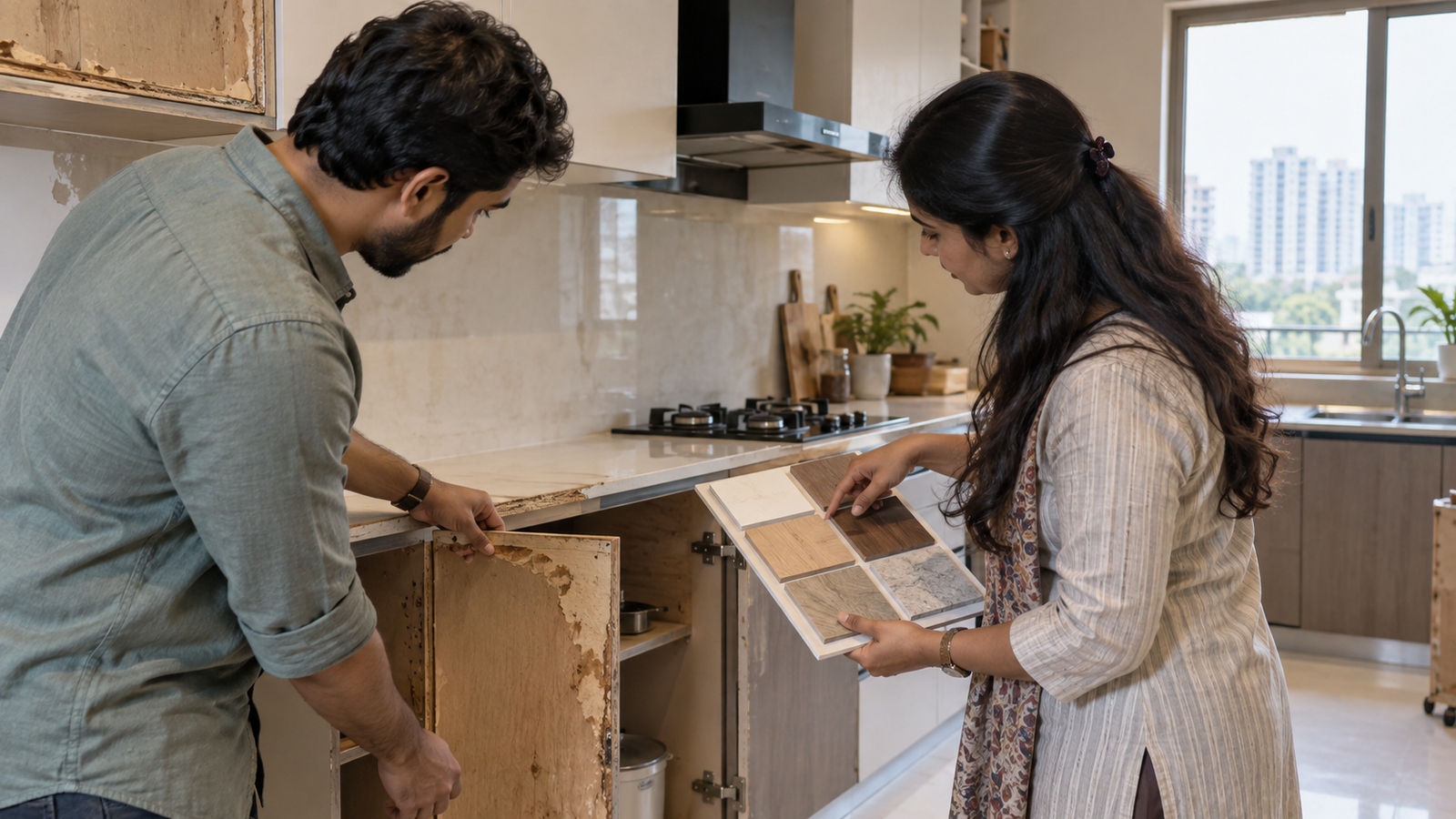
The important distinction is between cosmetic age and structural failure. Faded laminate, scratches or an outdated colour can be refreshed without replacing the carcass. Swollen panels, crumbling screw points, persistent mould odour and repeated hinge pull-out indicate that the core material has changed. That is when a simple facelift stops being economical.
9 factors that decide plywood kitchen lifespan
1. Plywood grade
Board composition and bonding quality determine how well a cabinet tolerates moisture cycles. The label alone is not enough; obtain the manufacturer, thickness and grade in writing.
2. Water exposure
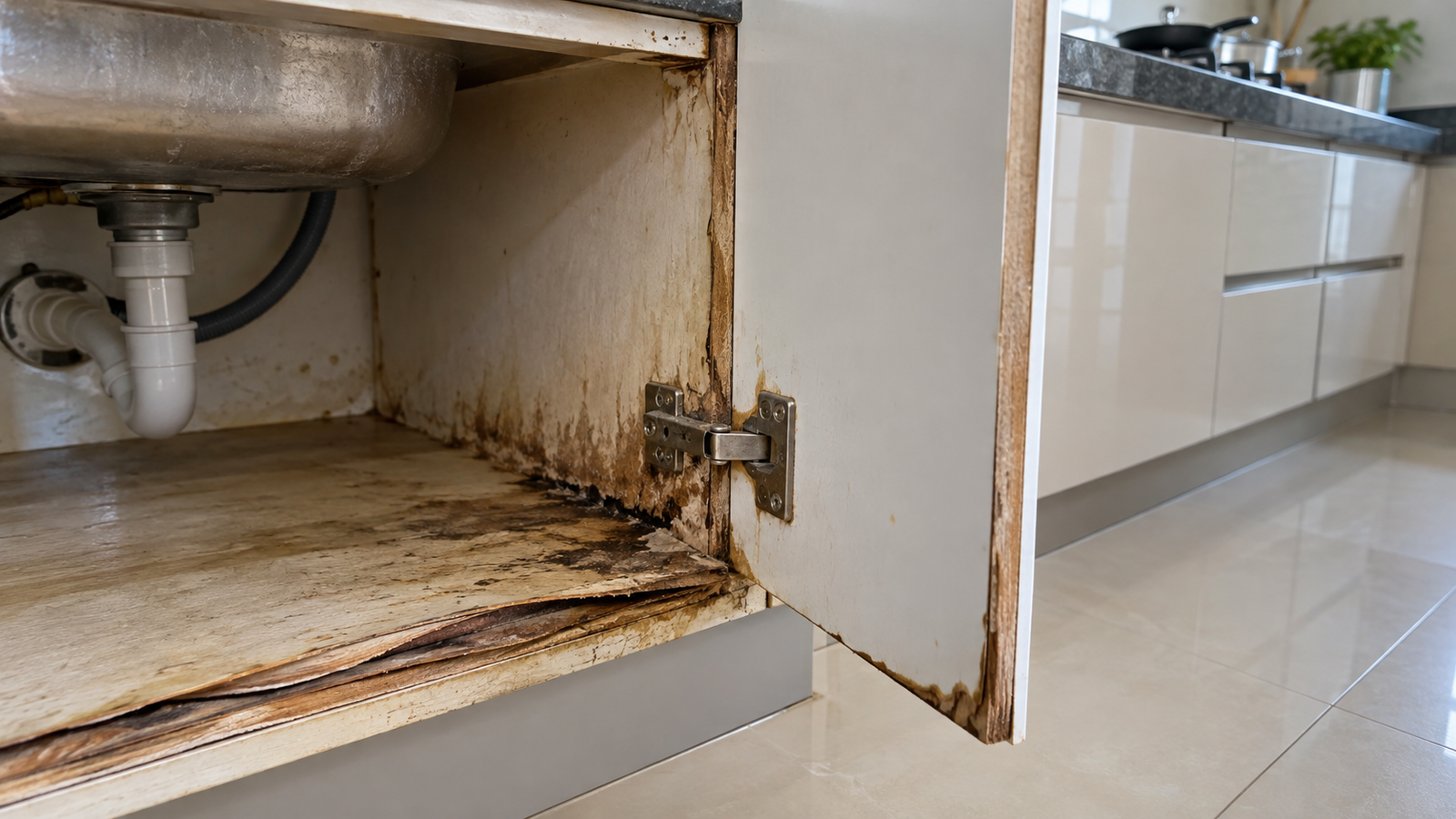
A slow sink leak can cause more damage than an occasional spill because the board remains damp for weeks. Plumbing access and early detection matter enormously.
3. Edge sealing
Every cut edge, screw hole and service opening is a potential entry point. Factory edge banding and sealed sink cut-outs reduce absorption.
4. Hardware quality
Reliable hinges and channels spread loads correctly. Weak fittings loosen, enlarge screw holes and make shutters sag even when the board is still usable.
5. Cabinet design
Ventilation, adjustable legs, skirting details and separation from damp walls protect the carcass. Thoughtful design removes avoidable stress.
6. Installation
Square carcasses, proper levelling, the right fasteners and accurate cut-outs prevent premature movement. Good material cannot compensate for careless assembly.
7. Heat and steam
Uncontrolled steam affects adhesive, laminate and edges. A correctly sized chimney and adequate clearances reduce repeated heat-and-moisture loading.
8. Cleaning habits
Standing water and aggressive chemicals shorten cabinet life. A damp cloth followed by drying is safer than flooding the floor or cabinet surfaces.
9. Usage intensity
A large family cooking three meals daily puts more cycles on shutters and drawers than an occasional-use kitchen. Hardware must match the load.
Does plywood grade change cabinet durability?
Yes, but grade should be considered together with detailing. Moisture-resistant plywood may suit dry bedroom furniture, yet a kitchen includes a sink, plumbing penetrations, steam and wet cleaning. Boiling-water-resistant or marine-grade products are generally chosen for higher-risk locations, especially sink bases and utility areas. Ask the supplier to state the applicable standard, brand and thickness instead of accepting a broad term such as “waterproof ply.” The Bureau of Indian Standards is a useful starting point for understanding Indian material standards and certification.
Even good plywood remains an engineered wood product. Its veneers and adhesive bond can tolerate more moisture than low-grade board, but exposed edges still deserve protection. A premium sheet with an unsealed plumbing cut-out may deteriorate faster than a modest sheet that is carefully sealed and kept dry. For a meaningful quotation, compare the carcass, shutter, back panel and sink unit separately; they do not always use the same specification.
Thickness and back panels matter
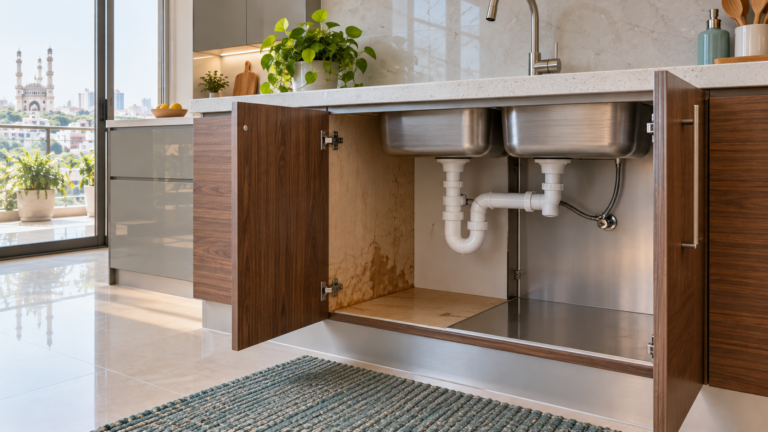
Cabinet sides and shelves need adequate thickness for their span and load. Very wide shelves can sag even when the board is sound. Thin back panels may absorb wall dampness and develop odour before the visible carcass does. Confirm whether the back is full height, how it is fixed and whether a service gap separates it from the wall. These small construction decisions influence kitchen cabinet lifespan more than a decorative finish.
Why water and humidity shorten a plywood kitchen’s life
Plywood changes dimension as it absorbs and releases moisture. Repeated cycles stress the adhesive, laminate and edge banding. Water usually enters through raw edges, drilled holes, the base of a cabinet or a damaged laminate joint. Once trapped, it can soften veneers and reduce the holding power of screws. That is why the first visible symptom may be a hinge that repeatedly comes loose rather than an obvious puddle.
Hyderabad is not uniformly humid all year, but monsoon conditions, closed apartments and wet utility zones can keep cabinet interiors damp. Steam from cooking raises local humidity, while a wall shared with a bathroom can introduce hidden moisture. A chimney helps with cooking vapour; it cannot solve a plumbing leak or damp wall. Look for the source before paying for cosmetic repairs.
Our detailed guide to why plywood kitchen cabinets swell explains the failure mechanism and immediate steps. If damage is concentrated under the sink, also review this kitchen cabinet water-damage guide. Early intervention can sometimes preserve adjacent units.
Hardware, workmanship and daily use
A cabinet is a system, not just a sheet material. Hinges, drawer channels, connectors, legs, fasteners and shutters transfer force into the carcass every day. When a shutter is oversized or a drawer is overloaded, each cycle pulls on the same screw points. Soft-close hardware improves the experience and reduces impact, but only when it is genuine, correctly rated and accurately installed.
Installation begins with a level base. If the run is twisted, shutters never align consistently and channels work under side load. Plumbing cut-outs should be neat and sealed; rough oversized openings expose more core. Countertop joints must shed water away from the cabinet. A small silicone detail may prevent years of seepage, but sealant is not a substitute for sound plumbing.
During handover, open every shutter and drawer, check gaps, load shelves normally and inspect around the sink in bright light. Request hardware model details and warranty terms. Maintenance access is also important: a plumber should be able to reach valves without breaking a panel. Serviceable design generally lasts longer because faults are easier to detect and correct.
When to replace kitchen cabinets: 10 warning signs
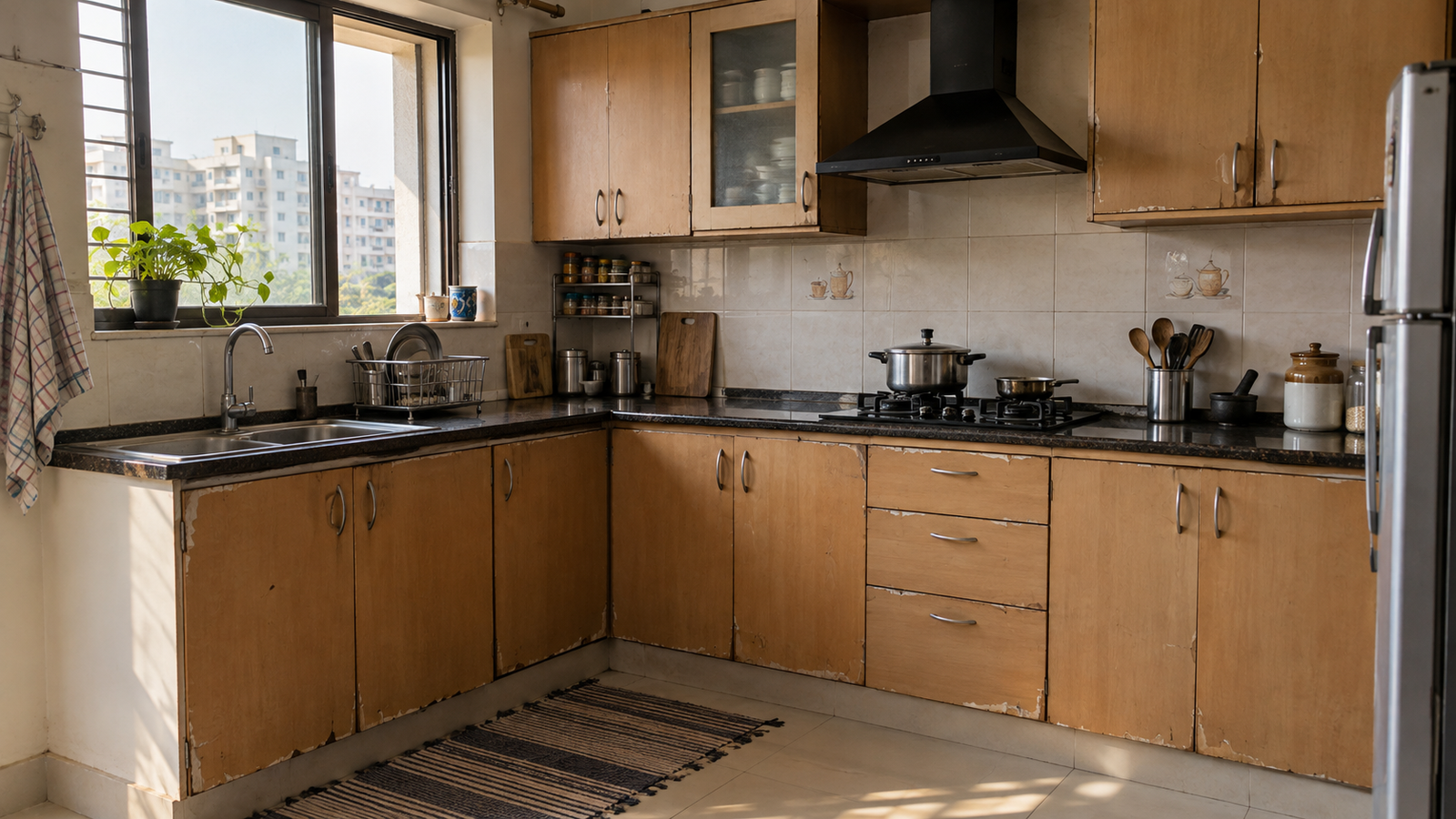
- Swelling that does not reduce after drying. A permanently thickened edge indicates damage inside the board.
- Laminate repeatedly lifting. Re-gluing may fail when the substrate has become uneven or powdery.
- Hinges pulling out again. Larger screws are only temporary when the core no longer holds a fixing.
- Persistent mould or musty odour. Hidden damp material is difficult to clean thoroughly and can affect stored items.
- Soft or sagging shelves. Deflection under ordinary load suggests inadequate span, thickness or moisture damage.
- Dark staining near plumbing. Trace the leak immediately; staining may extend beyond what is visible.
- Cracked sink-base floor. The wettest cabinet is often the first unit that needs replacement.
- Multiple misaligned shutters. One hinge can be adjusted, but widespread movement may indicate a distorted carcass.
- Pest activity. Tunnels, powder and hollow-sounding panels require inspection; see our guide to termites in plywood kitchen cabinets.
- Repair costs keep returning. Repeated labour and hardware replacement can exceed the value of a planned upgrade.
Do not wait for every sign. One severe plumbing-related failure may justify replacing a unit, while several small cosmetic problems may still be repairable. The right decision depends on whether the carcass is sound and the cause has been eliminated.
Repair, reface or replace?
| Condition | Best response | Reason |
|---|---|---|
| Surface scratches, faded colour, sound carcass | Reface or replace shutters | Cosmetic work preserves usable structure. |
| Loose hinge, firm screw area | Adjust or replace hardware | A fitting issue does not require a new kitchen. |
| Local sink-base swelling, other units dry | Replace affected module after fixing leak | Targeted work can be economical if adjoining panels are sound. |
| Widespread swelling, mould or crumbling core | Plan replacement | Decorative repair will not restore structural integrity. |
| Layout no longer supports appliances or workflow | Redesign | A new plan can improve storage, safety and daily efficiency. |
A professional survey should separate the cost of plumbing correction, cabinet work, countertop removal, hardware and finishes. Ask whether the countertop can be safely retained. In some kitchens, dismantling weak cabinets damages adjacent laminate or stone support; a phased solution is not always practical.
How to extend a plywood modular kitchen’s service life
- Repair drips, failed sink seals and damp walls immediately.
- Wipe spills promptly and dry cabinet bases after cleaning.
- Use a chimney and ventilation to control steam and heat.
- Keep wet cloths and leaking cleaning bottles out of cabinets.
- Inspect the sink base, plumbing valves and dishwasher connections monthly.
- Avoid overloading wide shelves and deep drawers.
- Adjust hinges when misalignment first appears instead of forcing shutters.
- Keep edge banding intact and reseal vulnerable service cut-outs.
- Use removable trays under cleaning products to catch small leaks.
- Schedule a hardware and plumbing check when the kitchen reaches five years.
These habits are simple, but they work because damage is strongly related to exposure time. A spill wiped within minutes is different from a leak that remains trapped for a month. Preventive checks protect the plywood cabinet durability you paid for.
Not sure whether your kitchen needs repair or replacement?
Share a few photos of the sink base, damaged edges and overall layout. Metal & More Interiors can help you identify the likely failure zone and compare a targeted repair with a long-life metal kitchen plan for your Hyderabad home.
Plywood kitchen lifespan vs metal kitchen lifespan
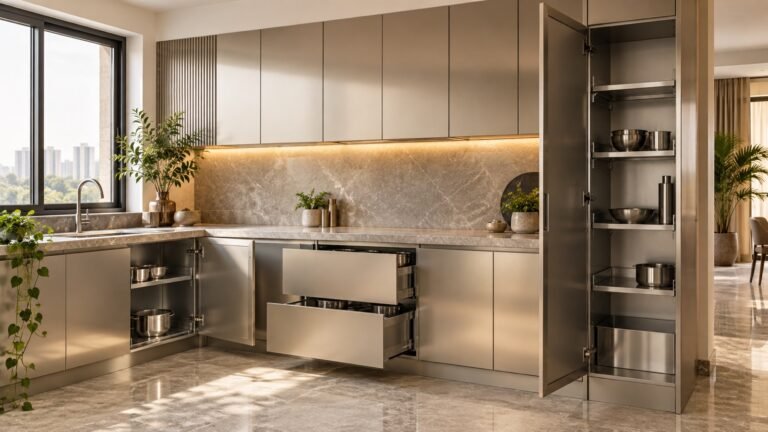
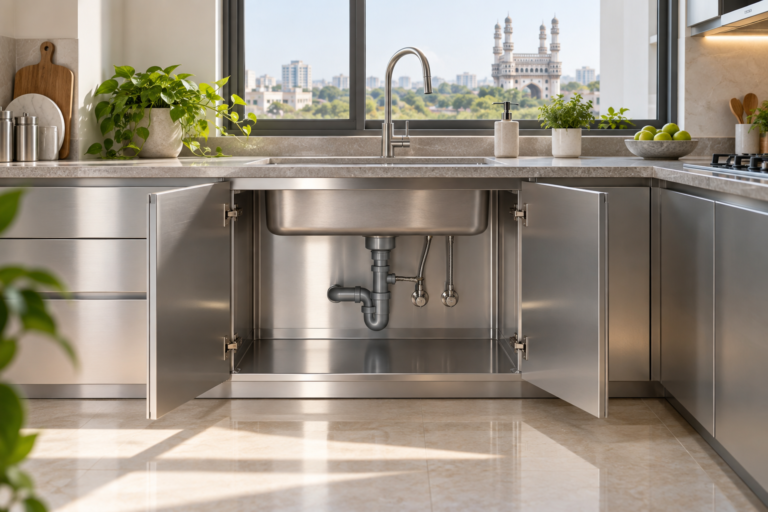
Plywood remains popular because it supports many finishes and familiar fabrication methods. Its key vulnerability is that long-term water entry can affect the core. Metal cabinet systems do not swell like engineered wood. Aluminium is naturally resistant to rust, while properly specified stainless steel—especially SS304 for suitable residential applications—offers strong moisture, hygiene and durability advantages. Coated steel also performs well when material, pretreatment and finishing are appropriate.
No material is maintenance-free. Metal kitchens still require good hardware, correct fabrication, safe edges, thoughtful acoustics and suitable cleaning. Low-grade stainless, damaged coatings or poorly protected mild steel can corrode. The meaningful comparison is a complete system from a named manufacturer, not simply “wood versus steel.” Read our detailed steel vs wood vs aluminium kitchen comparison, explore SS304 stainless-steel modular kitchens in Hyderabad, or compare aluminium modular kitchens.
| Decision factor | Plywood | SS304 stainless steel | Aluminium |
|---|---|---|---|
| Moisture response | Depends on grade and edge protection; may swell after prolonged ingress | Does not swell; corrosion resistance depends on grade, fabrication and environment | Does not swell and does not rust like ferrous steel |
| Termite risk | Needs material and site protection | Not a food source | Not a food source |
| Finish flexibility | Very broad | Brushed, powder-coated or combined finishes | Powder-coated and other system finishes |
| Typical planning horizon | Often 10–15 years under favourable conditions | Long-life option when correctly specified and maintained | Long-life moisture-resistant option |
| Best fit | Dry, controlled conditions and buyers who prioritise wood-based finish options | Wet zones, hygiene-focused homes and premium durability | Moisture resistance with lighter construction |
Service life varies with specification, use, environment and maintenance. Request written material details and warranties for the exact system quoted.
Buying checklist for a longer-lasting kitchen
Before approving a quotation, request a line-by-line material schedule. It should identify carcass material, grade, thickness, back panels, shutters, finish, hardware brand and model, sink-base treatment, leg and skirting system, countertop support and warranty. Ask how plumbing cut-outs will be sealed, how the back will be separated from a damp wall and how future service access will work.
Inspect a completed project that has been in use—not only a new showroom sample. Open heavy drawers, check corner access and look below the sink. Ask who will handle installation and after-sales adjustments. A kitchen with replaceable modules and accessible hardware is easier to maintain over its life.
Finally, compare lifetime value rather than only the opening price. A cheaper cabinet that needs repeated repairs can cost more and create disruption. Our 10-year stainless-steel kitchen cost guide explains how to consider maintenance and replacement cycles. For a cooking zone, also review stainless-steel kitchen safety.
Frequently asked questions
How long does a plywood kitchen last on average?
A sound planning range is about 10 to 15 years for good material and workmanship in a well-maintained, dry kitchen. Recurring leaks, exposed edges and weak hardware can shorten the useful life significantly.
Can a plywood kitchen last 20 years?
Some do, particularly in dry conditions with premium plywood, sealed detailing and careful use. It should be viewed as a possible result, not a universal expectation or guarantee.
Which plywood is best for kitchen cabinets?
Higher moisture-resistant grades are usually preferred in kitchens, especially around sinks and utilities. Verify the actual manufacturer, applicable standard, thickness and written specification rather than relying on a generic “waterproof” claim.
Is marine plywood completely waterproof?
No wood-based board should be treated as permission to ignore leaks. Marine-grade plywood is designed for demanding moisture exposure, but cut edges, joints, finishes and workmanship still influence performance.
Can swollen plywood cabinets be repaired?
Minor finish lifting on a dry, firm substrate may be repairable. Permanently swollen, soft or mould-affected board usually cannot be restored to its original strength and may require module replacement.
When should I replace kitchen cabinets?
Consider replacement when swelling is widespread, fasteners no longer hold, mould or odour returns, shelves sag, plumbing damage is extensive or repeated repairs are no longer economical.
Do metal kitchen cabinets last longer than plywood?
A properly designed metal system avoids plywood swelling and termite risk, so it can offer a longer planning horizon in wet or intensive-use zones. Grade, coating, fabrication, hardware and maintenance still matter.
What is the best material for a Hyderabad kitchen?
The answer depends on budget, desired finish, water exposure and expected service life. SS304 stainless steel and aluminium are strong options for moisture resistance; good plywood can perform well where detailing and leak control are dependable.
Plan a kitchen built for your real conditions
Get a practical material comparison, storage plan and transparent quotation from Metal & More Interiors. We design SS304 stainless-steel and aluminium modular kitchens for Hyderabad homes, with attention to wet zones, ventilation, hardware and service access.