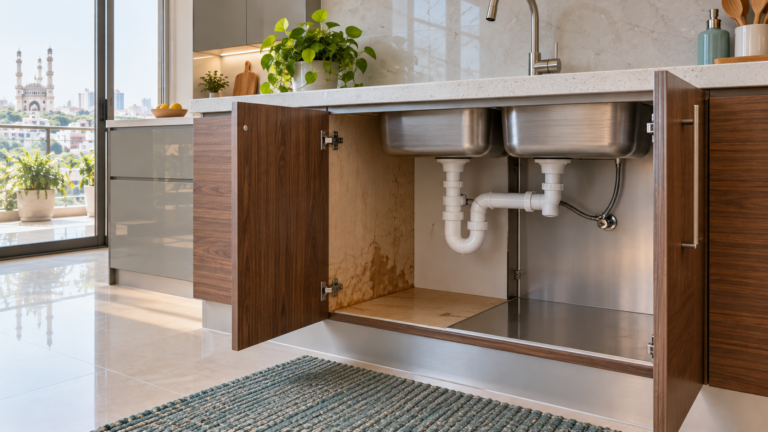

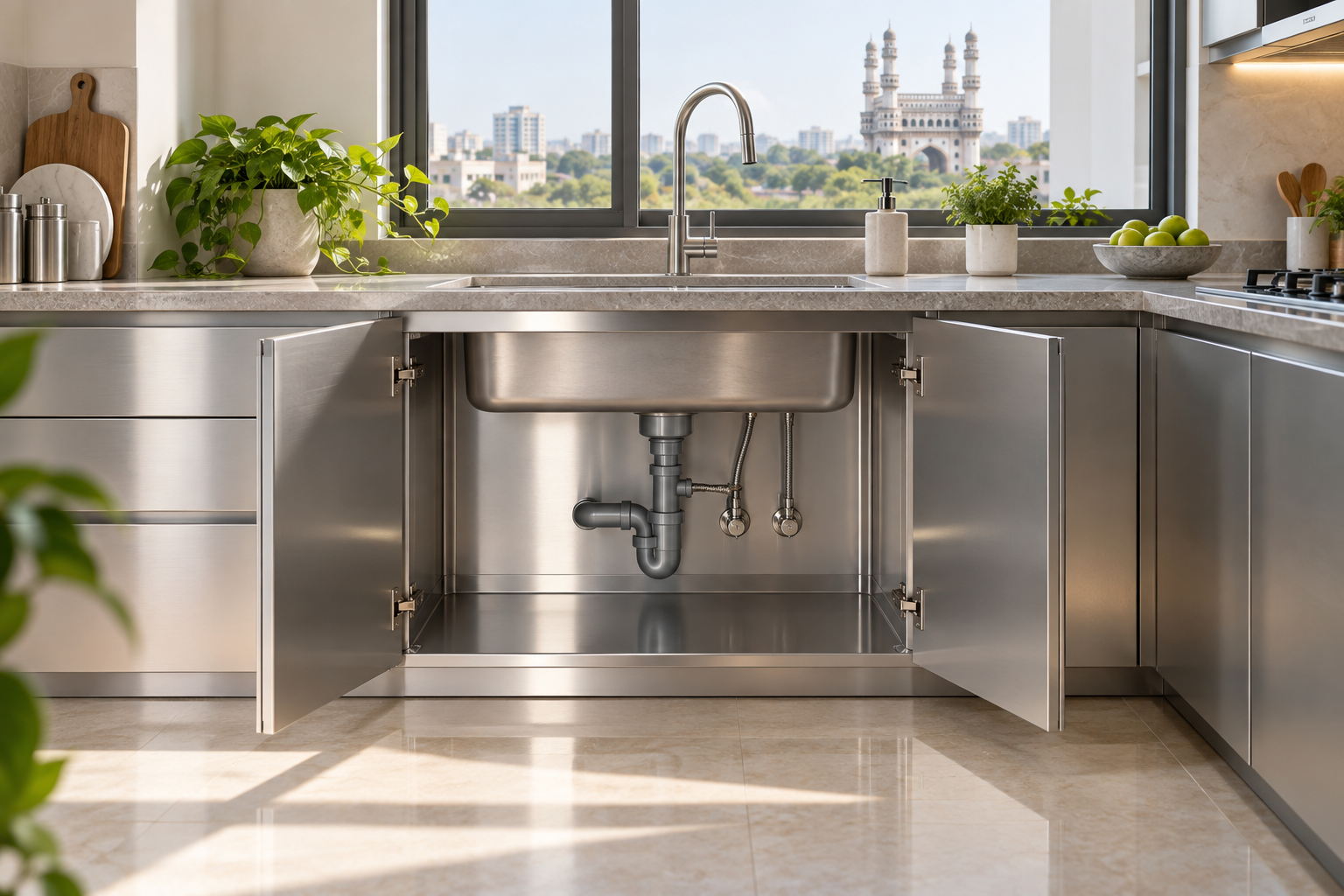
Under-sink cabinet failure begins below the sink, where supply lines, a drain trap, a purifier and cleaning bottles share a dark, poorly ventilated space. Water that reaches an absorbent cabinet body makes it swell, soften and stain long before it shows at the front. The durable answer is a non-absorbent sink base with sealed cut-outs and plumbing that stays reachable for service.
Most people meet this problem in one of two ways. Either a smell or a soft cabinet floor appears months after a slow drip began, or they are comparing quotations and want to know whether the sink base needs something different from the rest of the kitchen. Both situations lead to the same conclusion: the wet zone has to be treated as a system rather than a single material choice.
This guide explains under-sink cabinet failure in practical terms for Hyderabad homes, where humid weather and hard daily use punish poorly detailed cabinetry. It separates the cabinet body, the cut-outs, the plumbing and the service plan, then shows how each part decides whether the base survives. Metal & More Interiors designs and manufactures metal interiors in-house from its factory at B.N. Reddy, Charlapally, with its office at Jai Jawahar Nagar, Yapral Ammuguda Road, Secunderabad.
Under-Sink Cabinet Failure: Quick Answer
The sink base is the hardest-working cabinet in a kitchen. It holds the supply lines, the shut-off valves, the drain trap and often a purifier or waste unit, all inside a closed box with little airflow. Splashes from washing, condensation on a cold pipe and the occasional spill of cleaning fluid add moisture that never fully dries.
An absorbent body of plywood, MDF or particle board takes that moisture into its core and edges. The fibres expand, the panel softens, glue lines lift and the fixing points for hinges and shelves loosen. A non-absorbent metal base made from SS304 stainless steel, aluminium or galvanised steel cannot swell in the same way, but it still needs sealed cut-outs, tidy plumbing holes and a planned way to reach the trap for service.
It helps to read the failure as a chain: a small leak, a hidden path for water, an absorbent material and no access to inspect it. Break any link — stop the leak, dry the space, choose a non-absorbent body or keep the plumbing visible — and the base lasts far longer.
Why the sink base fails before the rest of the kitchen
Every cabinet in a kitchen faces its own conditions, but the sink base combines more risks than any other module. Water is present by design, not by accident. The space is dark and enclosed, and it is often lined with the very products — bleach-based cleaners, descalers, dish liquids — that attack finishes and corrode unprotected metal over time.
The layout adds to the problem. Supply lines run behind and below the bowl, a flexible drain trap turns through several joints, and the base sits at floor level, where wet mopping and floor seepage arrive quietly. A dishwasher or water purifier nearby adds warm, humid air and more hose connections. None of this is unusual; it is simply the normal load of a wet zone.
What turns that load into failure is the hidden path water takes. A drip from a trap joint or a supply nut lands on the rear of the cabinet floor and stays there, because the base is rarely opened. An intact laminate face can look perfect while the unsealed underside, the rear edge or the sink cut-out is already wet. Once water enters an open edge, it travels along the board and behind the surface before it ever shows on the outside.
That is why the sink base fails first, and why a surface fix so often returns. Replacing a swollen shelf does nothing about the leak behind it, and resealing a countertop joint does nothing for water that is already sitting on the base.
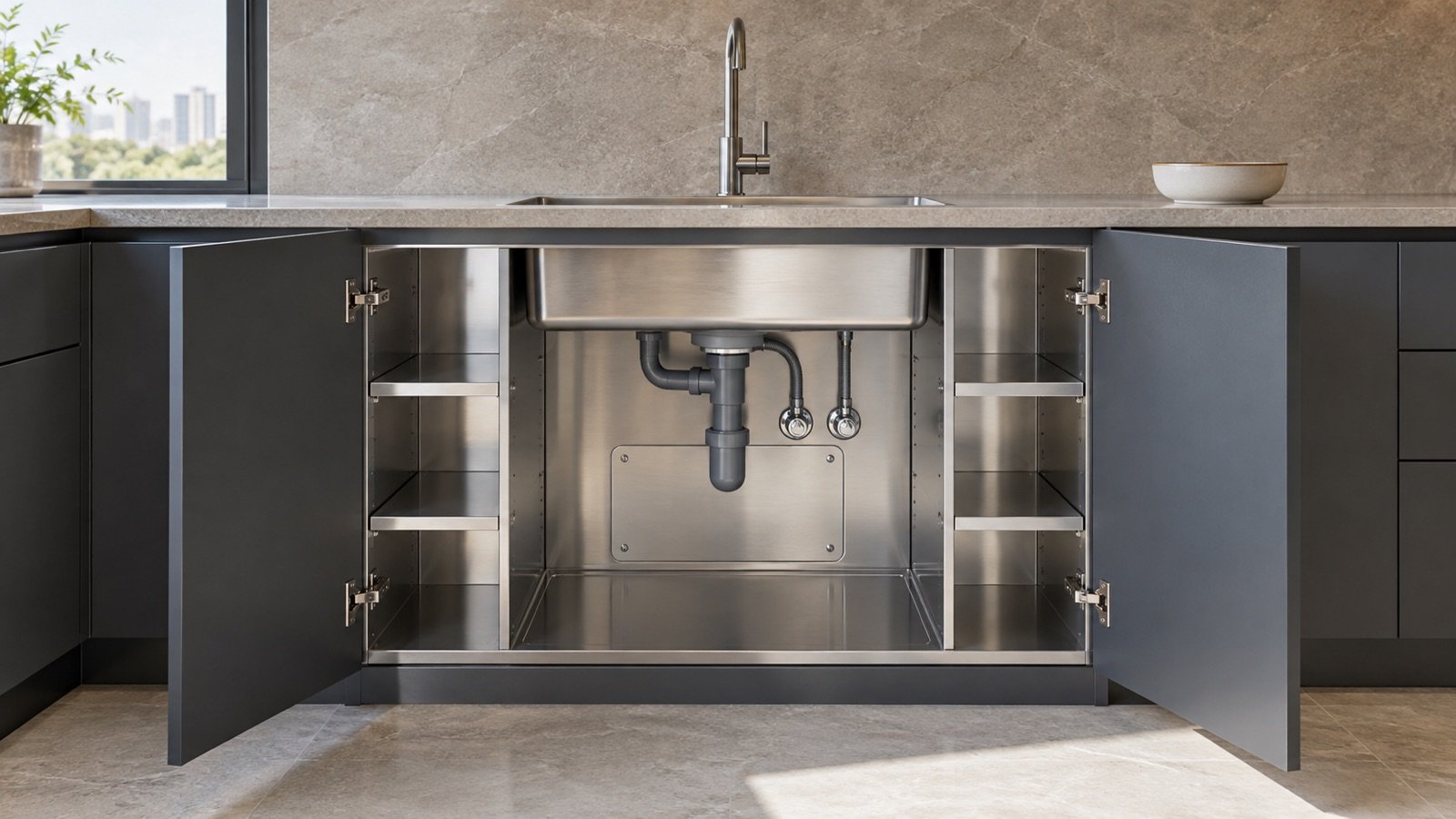
Warning signs of under-sink cabinet failure to catch early
Most sink-base damage is visible before it becomes structural, if anyone looks. Check the cabinet every few months, ideally with a torch, and treat any of the following as a prompt to find the source.
- A musty or damp smell when the cabinet door is opened.
- A cabinet floor that feels soft, spongy or uneven to the touch.
- Dark water staining at the base, the rear panel or along the plinth.
- Swelling or a raised lip at the cut-out around the pipes.
- Peeling, bubbling or lifted edge banding on the carcass.
- Rust marks or a chalky white bloom on hardware and screws.
- A door that no longer closes flush after the monsoon.
- Loose hinge or channel screws that will not tighten.
- A ring or shadow beneath a liner, tray or mat.
Musty odour and staining deserve particular attention, because they point to a slow leak that has already been running for weeks. Long-standing damp also encourages the surface growth described in our guide to mould and fungus inside kitchen cabinets, and it usually sits alongside the wider patterns covered in kitchen cabinet water damage.
How to inspect a failing sink base
Work through the cabinet methodically rather than judging it by the front shutter. Clear everything out, remove any non-adhesive liner and look at the surfaces that are normally hidden. Photograph what you find, note when the symptom first appeared and check the neighbouring modules, because water follows the base and the wall before it becomes obvious.
| Check | What to examine | Why it matters |
|---|---|---|
| Cabinet floor | Press the base near the trap and feel for softness or a raised edge. | A spongy floor means the core has taken on water, not just the surface. |
| Pipe cut-outs | Look at the seal around every hole for the trap, supply and waste pipe. | Open cut-outs are the most common route into a board-based cabinet. |
| Pipework | Run the tap and check each joint, nut and trap connection. | Confirms whether an active leak is still feeding the damage. |
| Rear and plinth | Inspect the back panel and the floor line behind the cabinet. | Seepage and condensation collect where nobody looks. |
| Hardware | Tighten a hinge screw gently and watch for spin or corrosion. | A spinning screw shows the board has softened around the fixing. |
| Access | Ask how the trap and valves would be reached for repair. | A sealed base hides both the leak and the means to fix it. |
The inspection ends with a simple decision. If a single shelf is swollen in an otherwise dry cabinet and the leak has been fixed, that part can often be replaced on its own. If water has reached the base, the rear panel or a run of carcass, a cosmetic patch will not hold, and the honest choice is to correct the water path and rebuild the base in a material that does not absorb it.
Causes of under-sink cabinet failure
Failures cluster around a small number of causes, and most are preventable at the design stage. Water almost never arrives evenly; it concentrates at a joint, a hole or a low point and works on one area for a long time.
- A slow drip from a supply valve, flexible connector or faucet base.
- A perished washer or loose nut at the drain trap, which leaks only when the sink is used.
- A failed seal where the sink meets the countertop, letting water run around the bowl.
- Condensation on a cold supply pipe in a warm, humid kitchen.
- Warm damp air from an adjacent dishwasher or washing machine hose bay.
- Blocked ventilation that traps humidity inside the cabinet.
- Floor seepage or wet mopping against a low plinth.
- Spilled cleaning chemicals that attack coatings and corrode fittings.
- Vibration from a waste-disposal unit working joints loose over time.
The pattern is worth noting: the leak is usually small and intermittent, which is exactly why it survives undetected. A trap that weeps only when the sink drains stays dry during a quick inspection and then wets the cabinet floor twice a day.
How to protect an under-sink cabinet
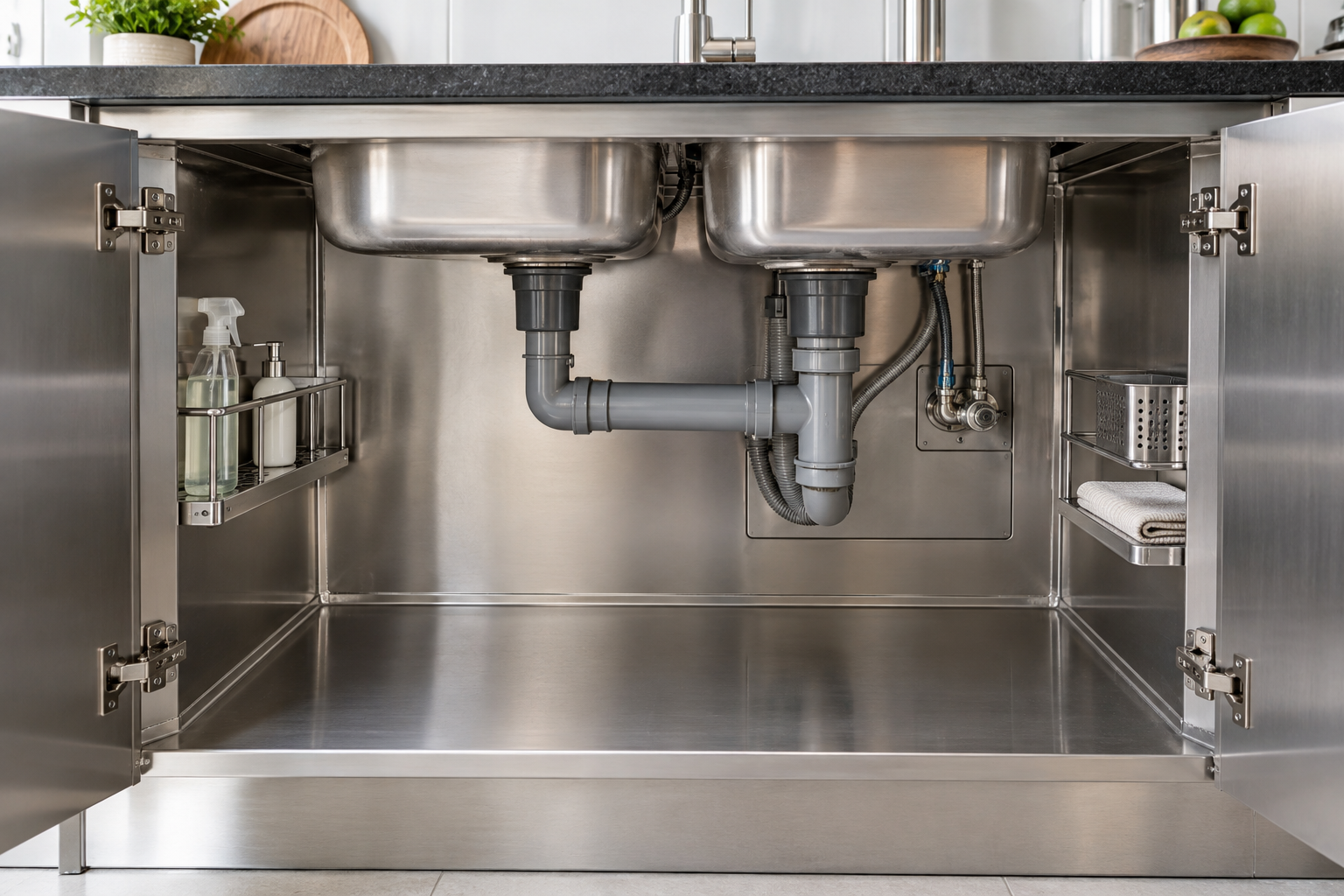
Protection is a set of small decisions, not one product. The first is to keep the plumbing reachable. A removable service panel or an open base gives access to the trap, the shut-off valves and the purifier lines, so a drip can be found and fixed instead of slowly destroying the cabinet from the inside.
The second is to seal what should not be wet. Sink cut-outs, pipe holes and the joint between the counter and the carcass should all be finished with a suitable sealant and a neat, close-fitting edge. A cut-out that is left raw is an open door for water, however good the rest of the cabinet may be.
The third is ventilation and dryness. Cabinets that are closed tight hold damp air, so a small airflow path helps. A wipeable base floor, a raised plinth and the habit of drying up after use all reduce the time water stands on the base.
A liner or tray is often recommended, and it does help with routine cleaning. Treat it as an aid rather than a cure: a liner that covers the base can also hide the first signs of a leak, so check beneath it monthly. A simple water-leak alarm is inexpensive reassurance, and keeping chemicals upright and away from pipework prevents a toppled bottle from sitting against a fitting.
The same thinking applies beyond the kitchen. A utility area or a bathroom vanity faces similar wet-zone exposure, and the principles in our guide to utility and laundry storage in Hyderabad translate directly to the cabinet under a sink.
How Metal & More Interiors builds differently
Metal & More Interiors designs and manufactures metal interiors in Hyderabad, with SS304 stainless steel, aluminium and GI cabinetry fabricated in-house. The value of that in-house control is that the same team measures the room, prepares drawings, fabricates the modules, pre-assembles them and installs them, so the sink base matches the agreed specification rather than a decorative skin over an unnamed body.
The cabinet body and shutters are metal, so there is no wood fibre to absorb water and no glue line to fail. A leak still has to be cleaned up and repaired, but the cabinet itself cannot swell, soften or become a food source for termites. The material is non-absorbent and is accurately described as fire-resistant.
Modules use an Insert Nut Fastening System, where a threaded insert forms a controlled fixing point in the fabricated metal so hardware can be loosened and refitted during service without stripping the panel. Kitchen depth is planned around 2 feet where applicable, then adjusted for the bowl, trap, appliances and clearance. Warranty follows the approved material schedule: lifetime on stainless steel and aluminium, and 15 years on GI, subject to the written project terms.
Choosing a sink-base material
Once the sink base is understood as a wet zone, the material question becomes clearer. The comparison that matters is not which board carries the best water label, but whether the cabinet body can be harmed by water at all.
| Factor | Absorbent board base | Metal sink base |
|---|---|---|
| Water response | Plywood, MDF and particle board absorb water at raw edges and cut-outs, then swell or crumble. | SS304, aluminium and protected GI do not swell through water absorption. |
| Termites | Wood-based boards are a potential food source. | Metal is not a termite food source. |
| Edges and cut-outs | Every hole must be sealed perfectly; a single open edge is a failure point. | Fabricated metal edges are formed and finished; there is no exposed core to swell. |
| Hardware fixings | Screw holding drops once the core softens around a damp fixing. | Threaded inserts keep a repeatable fixing point for service. |
| Service access | Sealing a board base often seals away the plumbing. | Service panels and openings can be planned before fabrication. |
| Care | Keep water out of the core and replace damaged panels. | Wipe dry and use suitable cleaners; the body itself is not the weak point. |
SS304 stainless steel
SS304 is the usual choice for a sink base and other demanding wet zones. Its non-porous, corrosion-resistant surface is hygienic and easy to wipe, and it does not absorb water. Confirm the grade and finish, and clean it with suitable products rather than harsh chloride-rich cleaners or steel wool that can mark the surface.
Aluminium
Aluminium is light, corrosion resistant and useful across kitchens and storage. It suits positions where weight balance matters, provided the profile, reinforcement and hardware fixing are designed properly, and it can carry warm, residential finishes instead of looking industrial.
GI
Galvanised steel adds a zinc protective layer and is normally paired with a painted or powder-coated finish. Coating continuity at fabricated edges and the care instructions should be clear. Metal & More Interiors provides a 15-year warranty on GI under the written project terms.
If the goal is a wet zone that stays serviceable, compare a stainless steel modular kitchen against the board base you might otherwise replace like for like. The same logic applies to other wet areas, including the wall-mounted cabinets covered in our stainless steel vanity units page.
Planning checklist for a new sink base
Use these points whether you are specifying a new kitchen or replacing a failed base.
- Fix any active leak before ordering a replacement cabinet.
- Choose a non-absorbent body for the sink base rather than the wettest board available.
- Seal the sink cut-out and every pipe hole with a close-fitting edge.
- Plan a removable service panel so the trap and valves stay reachable.
- Keep the base floor wipeable and clear of standing water with a raised plinth.
- Allow a small airflow path so damp air cannot become trapped.
- Record the material, finish and hardware separately in the quotation.
- Confirm the warranty period and its exclusions in writing.
- Inspect a finished sample, including the inside, back and fixing points.
A clear quotation should make the wet-zone decisions visible. Two sink bases can look the same in a brochure while one has a sealed metal body with planned access and the other hides an open board edge behind a glossy door.
Frequently asked questions
Why does the under-sink cabinet fail first?
It combines concealed plumbing, low airflow, cleaning chemicals and floor-level moisture in one small space. Small leaks can continue for weeks before they reach the visible front, and an absorbent body keeps the water inside its core.
Should the sink base have a back panel?
A back can improve finish and containment, but the plumbing has to remain reachable. A removable or planned service opening is better than cutting into a sealed panel later.
Can I line a plywood sink cabinet?
A tray or liner can contain a small spill and make cleaning easier, but it cannot protect open cut-outs, rear edges or a hidden leak. Inspect beneath the liner regularly and treat a persistent drip as a repair job rather than a cleaning one.
What should I check under the sink each month?
Open the cabinet, look for staining and swelling at the base and cut-outs, feel the floor for softness, run the tap to watch the trap joints and check that hinges and screws are still firm.
Are metal sink bases waterproof and termite-proof?
Stainless steel, aluminium and GI do not absorb water and are not a termite food source, so the cabinet body cannot swell or be eaten. Water can still harm walls, finishes and hardware, so leaks should still be fixed quickly.
What warranty does Metal & More Interiors provide?
The stated warranty is lifetime on stainless steel and aluminium and 15 years on GI, subject to the written project terms. Review the selected material, coverage and exclusions in the quotation.
Final decision
Treat under-sink cabinet failure as a chain of small failures rather than bad luck. Find the water path, dry the space, and rebuild the base in a material that cannot absorb it, with plumbing that stays reachable for the next service. A metal sink base removes the swelling and termite mechanism entirely, but it still has to be measured, fabricated and installed correctly.
Metal & More Interiors can measure the room, review the failed or planned base and recommend SS304, aluminium, GI or a documented mixed-metal configuration. The office is at Jai Jawahar Nagar, Yapral Ammuguda Road, Secunderabad, and manufacturing is at B.N. Reddy, Charlapally. You can also book a site visit to talk through the details in person.