
Kitchen cabinet water damage is a source problem before it is a cabinet problem. Find and stop the leak, dry the area safely, test whether the structure still holds, and only then decide between repairing the affected module and replacing it. The material a cabinet is built from changes how it reacts to water — it does not remove the need to fix the plumbing.
Need kitchen cabinet repair in Hyderabad? Metal & More Interiors can inspect the failed module, identify whether repair or replacement is safer, and quote a non-absorbent SS304, aluminium or GI solution for the wet zone.
A homeowner usually meets this question in one of three moments: after a burst inlet or a slow drip that has been running behind a sink base for weeks, while comparing quotations for a new kitchen, or while deciding whether a swollen cabinet can still be rescued. Each moment needs a slightly different answer, but the same sequence of steps keeps the decision honest.
This guide explains kitchen cabinet water damage for Hyderabad homes — the warning signs worth photographing, how to dry a cabinet without causing more harm, when a swollen panel can be repaired and when it should be replaced, and how the choice of cabinet material shapes everything else. Metal & More Interiors designs and manufactures metal interiors in-house at B.N. Reddy, Charlapally, with its office at Jai Jawahar Nagar, Yapral Ammuguda Road, Secunderabad.
Kitchen Cabinet Water Damage: Quick Answer
The order of work matters more than the material label. Stop the water first, whether that means closing the supply valve or repairing the drain, because no repair survives an active leak. Then remove stored items, isolate any electrical point near the water, and let the area dry with airflow rather than heat. Only when the cabinet is dry can its structure be judged fairly, because a damp panel can feel soft even when its core is still sound.
Once dry, separate the three questions that are usually blended together. Is the cabinet body still strong and square? Are the finish and hardware reusable? Is there any hygiene problem, such as mould, that a surface clean will not solve? A board that has swollen loses its original dimensions permanently — sanding or repainting the surface does not shrink it back, and the strength around its fixings is already reduced.
For anyone planning a new kitchen, the practical lesson is to design for water before it arrives: name the body material of every module, plan service access at the sink and appliance bays, and treat the wet zones as their own specification rather than an afterthought. The rest of this guide works through the diagnosis, the drying, the repair-or-replace decision and the material choice that follows from them.
What water actually does to a cabinet
Water reaches a cabinet in more than one way, and the route decides how serious the result is. A failed inlet connector or a loose braided hose delivers clean pressure water quickly. A blocked drain or a cracked trap delivers dirty, sometimes smelly water slowly and repeatedly. Splash and steam from daily cooking add humidity rather than pooled water. Each route calls for a different response, but all of them test the same parts of the cabinet.
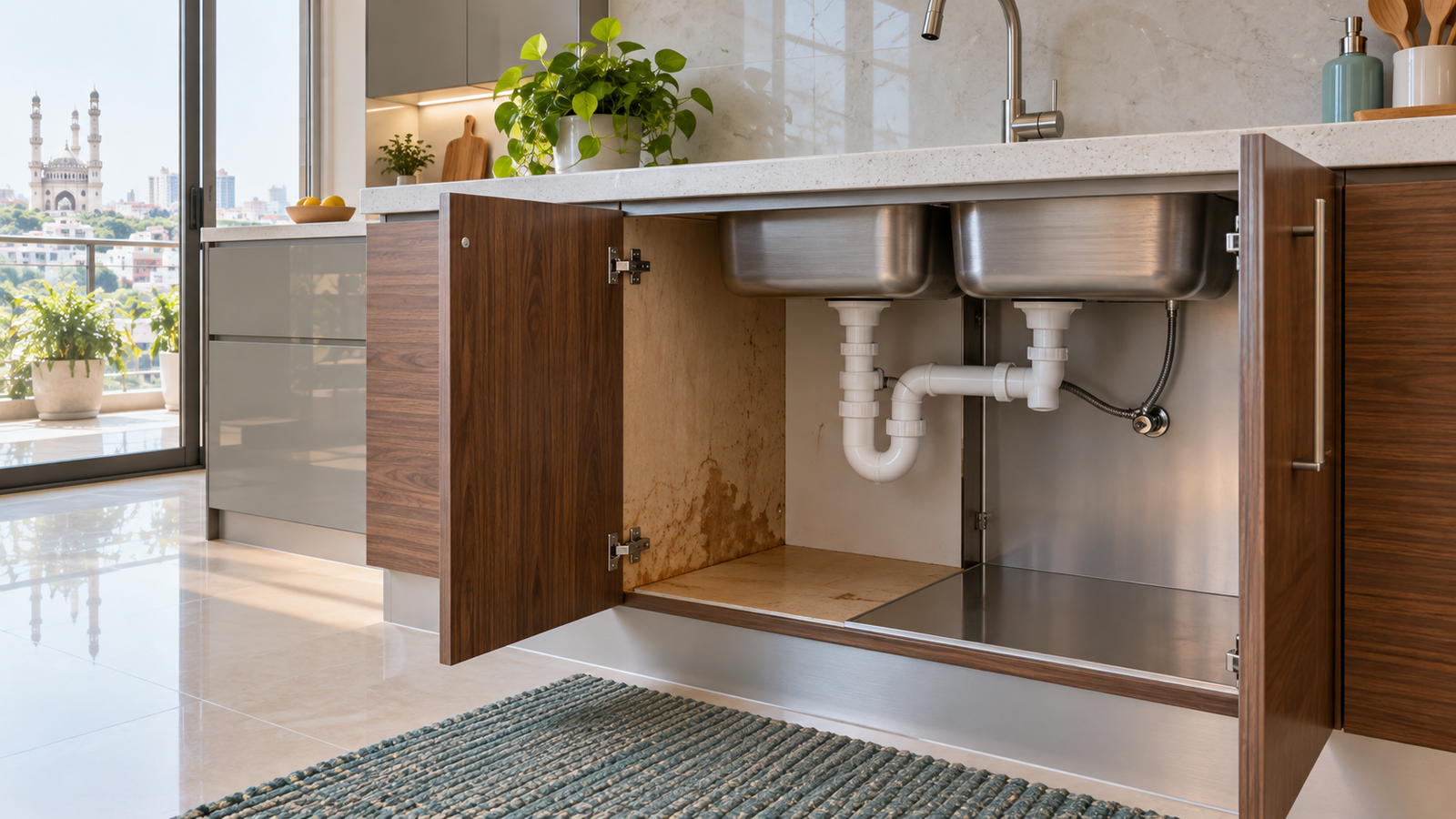
A wood-based board — plywood, MDF, HDF, particle board or HDHMR — is a composite held together by adhesive and compressed fibre. Its faces are usually well sealed, but its edges, hinge cut-outs, shelf-pin holes and pipe penetrations are often far less protected. Water entering one of those openings is drawn into the core, where the fibres swell and push the panel out of shape. This swelling does not reverse: once the board has grown, it will not return to its original thickness or flatness, and its internal strength is permanently reduced.
A metal cabinet behaves differently at the panel level. Stainless steel, aluminium and galvanised steel do not absorb water, so the carcass and shutters do not swell, delaminate or become a food source for termites. That is a genuine advantage in a wet zone. It is not the whole story, though: a cabinet is an assembly of panels, joints, coatings, hardware, wall fixings and the room behind it. Water can still corrode an unprotected edge, stain a powder-coat, seize a hinge, soak the wall and plinth behind the unit, or feed mould on trapped dust and stored cardboard. Making one panel water-resistant is not the same as making the installation water-resistant.
That is why it helps to judge a cabinet as a system rather than a single material. Record each part separately — carcass, shutter, edge treatment, finish, hinge, channel, fixing point, backing, plinth and sealant — and ask how water would behave at each one. A well-sealed board and a well-detailed metal module can both perform; a poorly built version of either can fail.
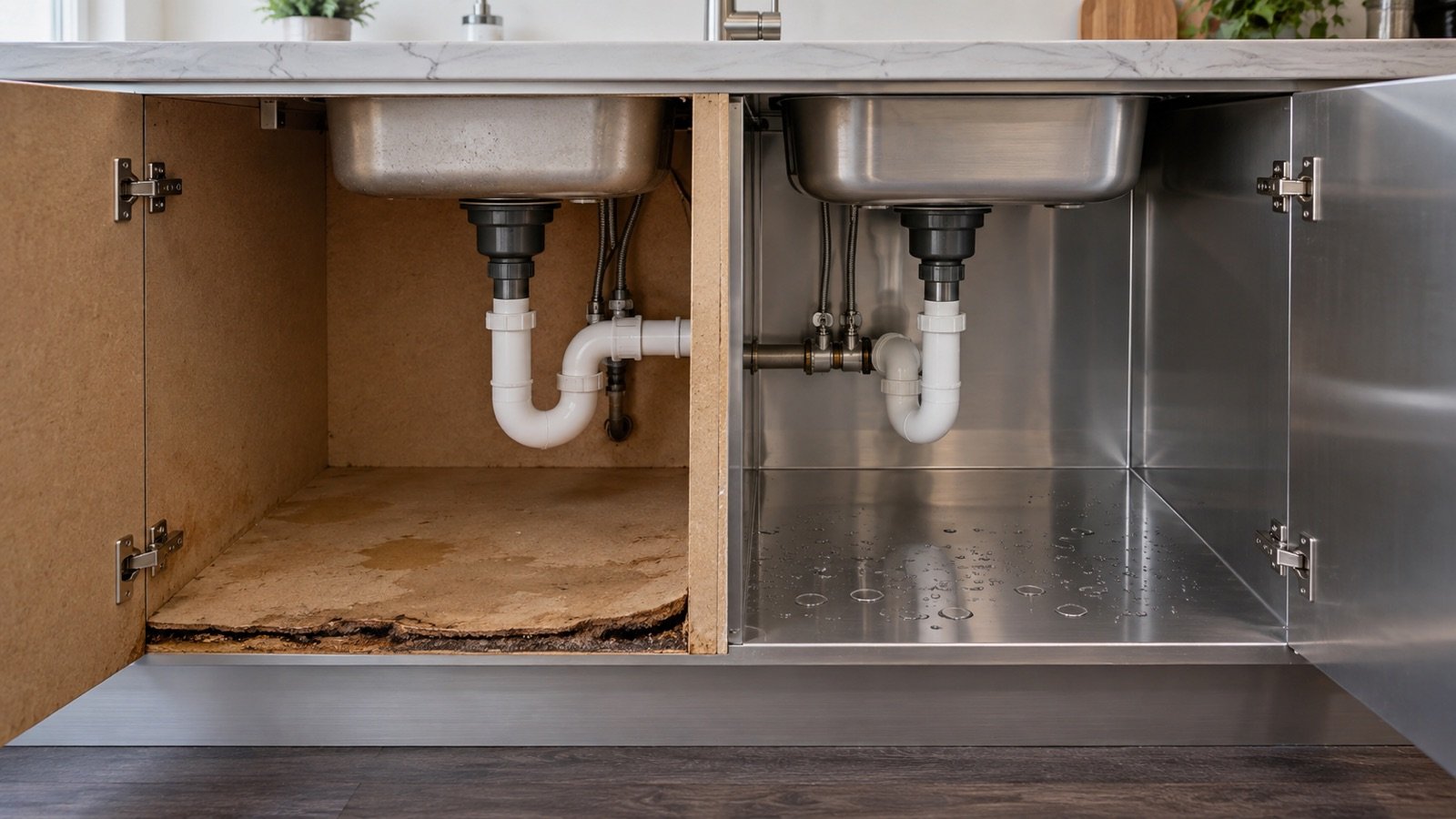
How to assess the damage
Assessment should begin with evidence, not with the visible front of the cabinet. Photograph everything before you move it, because cleaning and drying erase the very marks that show where the water came from. Note the date the symptom first appeared and whether it followed a specific event — a monsoon downpour, a washing-machine cycle, a blocked sink or a recently repaired plumbing line.
Work from the source outward. Trace the pipework or the wall above the cabinet, check the wall behind it and the floor below it, and test the modules on either side, because water travels along a plinth or a level floor before it shows. Feel the base panel, the back panel and the undersides of shelves, not only the door fronts and side panels that are visible in normal use.
| Check | What to examine | Why it matters |
|---|---|---|
| Water source | Trace the inlet, drain, trap, appliance hose and the wall behind the cabinet. | A repair without a fixed source will fail again. |
| Hidden surfaces | Feel the base, back, shelf undersides and the wall directly behind. | Water travels before it shows on the front. |
| Panel condition | Press edges for softness; look for swelling, delamination or bubbling skins. | A swollen core loses strength that surface work cannot restore. |
| Fasteners and hardware | Check hinges, screws, channels, shelf pins and handles for corrosion or looseness. | Compromised fixings fail even when the panel looks intact. |
| Hygiene | Look for mould, dark staining or a persistent odour at the back and base. | Some contamination needs removal, not cleaning. |
| Service access | Confirm the trap, valve and purifier points can be reached. | Accessible plumbing makes the next leak easier to catch. |
A few of these checks are decisive. Softness at an edge or a base panel usually means the core has taken water, and that rarely reverses. Clean water that only touched a sealed surface may leave nothing but a mark. The difference lies in how long the moisture sat and how well the panel was protected at its openings, so note both the extent and the duration of exposure rather than only what you can see today.
Warning signs worth documenting
Some damage announces itself loudly; most of it is quiet. The signs below are worth photographing and dating, because together they form the evidence a manufacturer or technician needs to advise you well. Two or three appearing at once usually points to a source that has been active for some time.
- A musty or damp smell that returns soon after the cabinet is cleaned.
- Dark or yellow staining on the cabinet floor, back panel or shelf underside.
- A soft or spongy feel at a board edge, a base or around a pipe cut-out.
- Bubbling, peeling or lifting of a laminate, veneer or painted skin.
- Rust marks, white corrosion or a rough feel on hinges, screws and channels.
- Doors that no longer sit level, or gaps that have opened or closed on their own.
- Drawers that drag, stick or no longer close flush with the frame.
- Fine black or grey specks of mould, especially at the back and near the plinth.
- Water marks on the wall behind the cabinet, or a damp patch on the floor below.
- A swollen or crumbling plinth or skirting at the base of the unit.
- Repeated condensation on cold metal surfaces in a poorly ventilated kitchen.
A single sign can be cosmetic. Several together, or any softness combined with a persistent odour, suggests the cabinet has been wet long enough to matter. When you ask for advice, send the photos with their dates and note whether the water was clean supply water or waste water, because the two are handled differently: a clean spill is mostly a drying problem, while waste water brings a hygiene question alongside the structural one.
How to dry a cabinet safely
Drying is where a well-meaning homeowner can make the damage worse. The aim is to remove moisture slowly with airflow, not to bake the cabinet dry with heat. High heat can warp a board further, lift a finish and distort a coated metal panel, so the gentlest method that keeps air moving is usually the right one.
- Stop the source first, and confirm the valve or appliance is actually off.
- Isolate electrical points near the water and have them checked by a qualified person before use.
- Remove every stored item — jars, cardboard, cloth and small appliances hold moisture against the cabinet.
- Open all doors and drawers, and pull out removable shelves to expose the surfaces.
- Wipe standing water and clean the area with a mild, suitable cleaner.
- Run a fan across the open cabinet and use a dehumidifier if the room is humid.
- Avoid hair dryers, heaters and direct sun on swollen panels or finished surfaces.
- Do not paint, laminate or seal a surface until it is fully dry, since trapped moisture keeps working underneath.
- Leave a gap behind the cabinet where possible so the wall can dry too.
- Wait until the surface feels stable and any smell has cleared before judging the structure.
How long drying takes depends on the material and the extent of exposure. A sealed surface that only met splash water may be dry within days; a board that took water at an edge, or a wall that has been wet behind a cabinet, can take considerably longer. Resist the urge to close everything up and move on. If mould has formed, address it with proper protection — gloves and a suitable mask — and remember that contamination inside a porous board is difficult to remove completely.
There is a specific warning for mixed kitchens. If a metal cabinet sits beside a wood-based module, the board is usually the part that suffers. The metal may look untouched while the panel behind it, or the one next to it, has swollen. Always check the neighbouring modules and the wall, not only the cabinet that appears to be in the worst condition.
Repair or replace: making the call
The repair-or-replace decision is often framed as a cost question, but it is really a structural and hygiene question that a cost comparison follows. If the core of a board panel has swollen, no amount of filler, paint or re-lamination restores its original strength or fit, and the swollen edge keeps showing at hinge points and joints. If only the finish is marked and the panel is dry and firm, a surface repair can be reasonable.
| Situation | Repair is usually reasonable | Replacement is usually the better call |
|---|---|---|
| Surface marks only | Sealed panel is firm, dry and dimensionally stable. | Panel has swollen, warped or delaminated. |
| Edge damage | Small, sealed, non-structural blemish away from fixings. | Edge softness near hinges, shelf pins or pipe cut-outs. |
| Hardware | A hinge or channel can be cleaned, reset or replaced. | Fixing points are stripped because the board behind them failed. |
| Hygiene | A clean surface with no persistent odour. | Mould has entered a porous core, or odour returns after cleaning. |
| Repeated leakage | The source is fixed and the panel stayed dry. | The same module has been wet more than once. |
| Access | The module can be reached and worked on. | The failed part sits behind sealed units or a fixed plinth. |
Two principles keep the decision simple. First, water damage to the core is rarely reversible, so a swollen structural panel is a replacement item even if it can be sanded smooth. Second, fixing the source matters more than fixing the panel; replacing a cabinet under an active leak only buys time. Where the failed module is a sink base or an appliance bay, it is worth asking whether the replacement should be built from a material that does not absorb water at all.
Cost is not the only long-term consideration. A partial repair that leaves a damp wall, a swollen plinth or a corroded fixing tends to return, and each return interrupts the kitchen again. A single, well-specified replacement can cost less over its service life than three repairs that each solve only the visible part of the problem.
Sink bases and the wet zones
Water damage in a kitchen is rarely spread evenly. It concentrates in a handful of positions, and if you are building or rebuilding a kitchen, those are exactly the positions worth over-specifying rather than treating like every other cabinet.
- Under the sink, where the trap, supply valves and purifier connections sit.
- The dishwasher and washing-machine bay, with its heat, moisture and flexible hoses.
- The water-purifier point, with several small push-fit joints that can weep slowly.
- The refrigerator drip tray and defrost line.
- The hob and chimney area, where steam and grease collect.
- Floor-level cabinets and the plinth, which meet wet mopping and seepage directly.
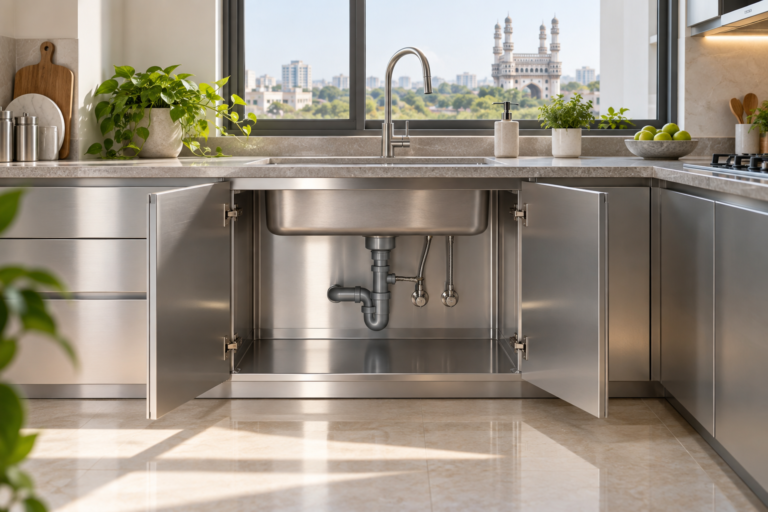
The sink base is the hardest-working module in most kitchens. It carries the trap, the supply valves, the purifier plumbing and often a waste bin, and it is the cabinet most likely to be opened while the pipes above it are dripping. A removable service panel, valves that can be reached without emptying the cabinet, and a base that does not trap water against the wall all reduce the chance that a small drip becomes a large repair.
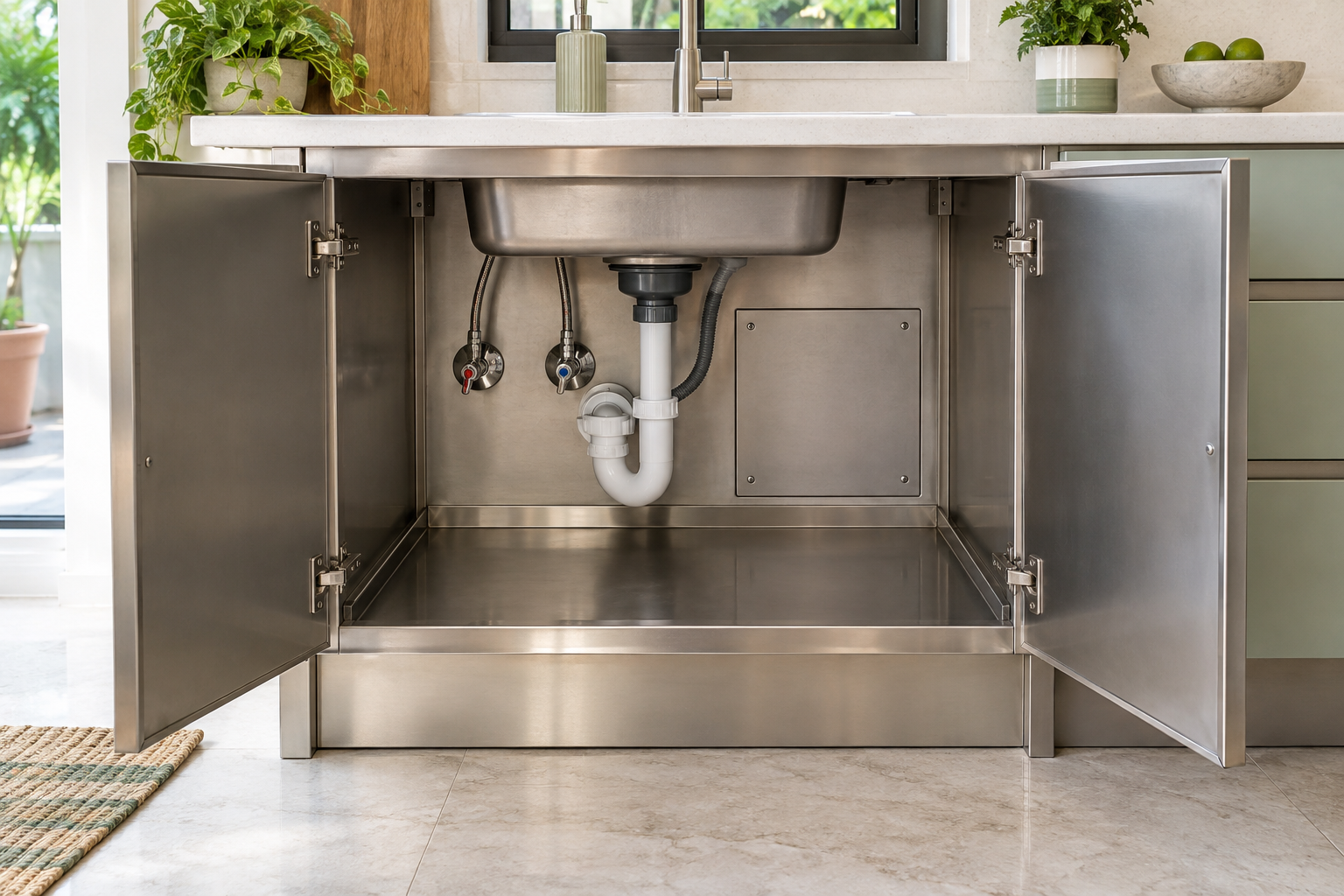
A dishwasher or washing-machine bay adds heat, moisture and hose connections to the mix, and these bays benefit from ventilation and a clear route to inspect the hoses. A purifier introduces small joints that can leak without being noticed for weeks. In all three cases, the design decision that matters most is access: a wet zone you can inspect is a wet zone you can protect, while a fully sealed, inaccessible sink base hides the very warning signs that make the difference between a small fix and a replacement.
The same logic extends beyond the kitchen. Spaces that face washing machines, buckets and floor washing directly benefit from the same approach, which is why it helps to review how to plan durable utility and laundry storage alongside the kitchen. Homes that leak repeatedly are usually better served by looking at every wet room together than by treating one cabinet at a time.
How Metal & More builds for wet zones
Metal & More Interiors designs and manufactures metal interiors in-house in Hyderabad, fabricating SS304 stainless steel, aluminium and galvanised-steel cabinetry at its factory at B.N. Reddy, Charlapally. Because the modules are built rather than assembled from a decorative skin over an unspecified body, the details that decide wet-zone performance — edge protection, service openings, reinforcement and fixing points — are settled at the drawing stage and checked before a module leaves the workshop.
The selected carcass and shutters are metal unless a customer deliberately approves a documented mixed-material or mixed-metal configuration. Because the panel material does not absorb water, a metal sink base or appliance bay does not swell or delaminate the way a fibre board can. Typical kitchen and wardrobe depth is planned around two feet where applicable, then adjusted for the wall, countertop, appliances, services, shutter clearance and room circulation.
Modules use an Insert Nut Fastening System. A threaded insert forms a controlled fixing point in the fabricated metal, so hinges, channels and shelf supports can be anchored, adjusted and re-serviced through the same point instead of a screw working loose in a hole that water has already weakened. In a wet zone that repeatability matters, because joints that stay serviceable are easier to rescue after a leak has been found and fixed.
Warranty follows the approved material schedule — lifetime on stainless steel and aluminium, and 15 years on GI, subject to the written project terms. Metal is termite-proof as a material, non-absorbent and easy to wipe clean, and it is accurately described as fire-resistant. Hettich hardware can be specified where selected; it is not claimed automatically for every fitting, and the chosen series is recorded in the quotation.
Choosing water-resistant materials
For the wet zones in particular, the material question deserves a specific answer rather than the word “waterproof”. No complete cabinet is waterproof in the strict sense, because joints, hardware, fixings and the wall behind it are all part of the installation. What you can choose is a body that does not absorb water and a detailing that keeps water moving away from the structure instead of into it.
SS304 stainless steel
SS304 stainless steel is the most robust choice for demanding wet zones. Its non-porous surface is hygienic, easy to clean and highly corrosion resistant under normal residential care, which makes it well suited to sink bases, vanities and heavy-use kitchens. Confirm the grade and finish, and clean it with suitable products rather than steel wool or harsh chloride-rich chemicals that can contaminate the surface.
Aluminium
Aluminium is lightweight, corrosion resistant and useful across kitchens, wardrobes and storage. Because it is lighter, large doors and wide shelves depend more on their profile, folds and reinforcement than on their own weight for stability. Panel design, alloy and fixing detail all affect performance, and a good supplier will answer these questions directly rather than steering the conversation back to appearance.
GI
Galvanised steel adds a zinc protective layer and is normally paired with a finished surface. Coating continuity, fabricated edges and the care process should be specified clearly, especially at cut edges in a wet zone. Under the written project terms, Metal & More Interiors provides a 15-year warranty on GI.
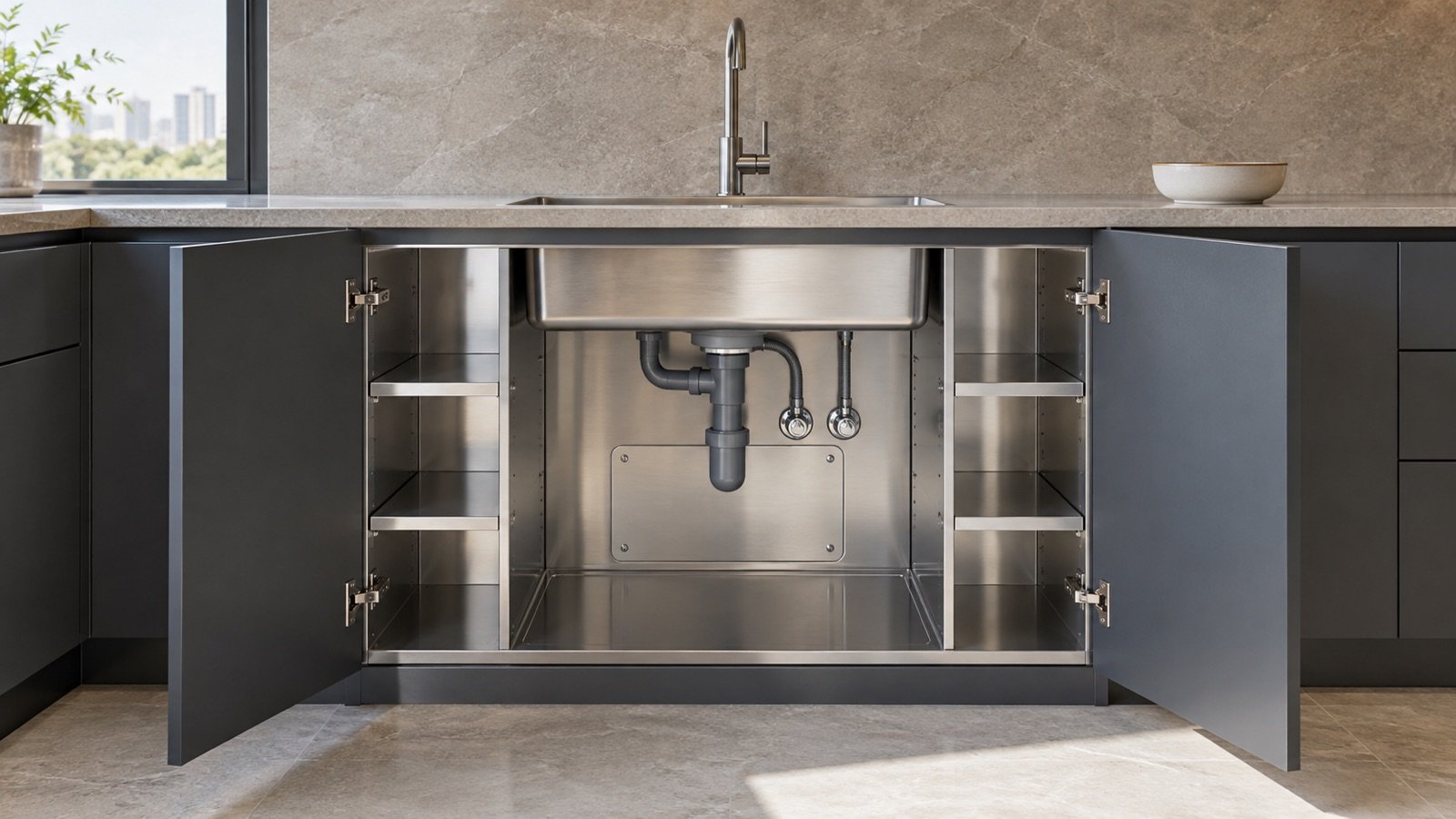
For homes that want the wet zones over-specified and the rest of the kitchen matched, reviewing stainless steel modular kitchens in Hyderabad and aluminium modular kitchens is a useful starting point, and the companion guides on why plywood kitchen cabinets swell and monsoon damage to modular kitchens explain how boards and humidity behave across the season. Homes covering more than one room can weigh the areas we serve in Hyderabad before finalising scope.
Preventing a repeat
Most water damage is preventable, and the measures cost little compared with the repair. They fall into three groups: protect the source, protect the cabinet, and keep an eye on both.
- Replace ageing flexible hoses and check connections twice a year.
- Fit accessible isolation valves so a leak can be stopped without draining the home.
- Keep the trap, purifier joints and appliance hoses visible through a removable panel.
- Seal or protect board edges and pipe cut-outs if any wood-based modules remain.
- Let the wall and cabinet dry after any spill before closing the doors.
- Keep the plinth clear so a slow leak becomes visible rather than hidden.
- Ventilate the kitchen to reduce condensation on cold surfaces.
- Place a drip tray or a leak sensor under the sink where practical.
- Wipe up splashes instead of letting them sit on an edge or a cut-out.
- Re-check hinges, channels and shelf pins after any leak event.
None of this requires a premium kitchen. It requires treating the sink base and the appliance bays as working parts that need access and periodic inspection. A cabinet you can look inside and reach is one whose next leak is caught early, while a sealed, inaccessible sink base hides the warning signs that separate a quick fix from a replacement.
For a new kitchen, write these requirements into the quotation. Ask for the body material, the edge treatment, the fastening method and the service access to be recorded module by module, so that “water-resistant” becomes a set of specifics you can check rather than a word on a brochure. A clear, itemised schedule is also the easiest way to compare two quotations that look identical on the surface.
Frequently asked questions
Can a swollen cabinet be repaired?
Usually not, if the core has swollen. A wood-based board that has absorbed water does not return to its original thickness or strength, and surface sanding or painting hides the problem rather than fixing it. A cosmetic mark on a sealed, dry panel can be repaired, but a swollen structural panel — or one with soft edges near hinges or pipe cut-outs — is normally a replacement item.
How quickly should I act after a leak?
Immediately. Stop the water, isolate electrical points nearby and remove stored items at once, because the longer moisture stays hidden behind a base or a backing panel, the greater the chance of mould, wall damage and loss of hardware alignment. Even a small drip left running for days behind a sink base can cause more harm than a single large spill that is cleaned up quickly.
Are metal cabinets waterproof?
The metal carcass and shutters do not absorb water, so they do not swell or delaminate. The complete installation, however, also includes joints, coatings, hardware, wall fixings, sealants and the plumbing, and none of those is immune to water. It is more accurate to say that a metal cabinet removes the absorption problem while the rest of the installation still needs sensible detailing and regular maintenance.
How do I dry a water-damaged cabinet safely?
Stop the source, remove the contents, open the doors and drawers, and dry with airflow and a dehumidifier rather than heat. Avoid hair dryers, heaters and direct sun, which can warp a board further, and do not seal or paint any surface until it is fully dry. Allow extra time for the wall behind the cabinet, and treat any mould with gloves and a suitable mask.
What should a site visit inspect?
A useful inspection traces the leak, checks the modules on either side, measures the area, records the condition of the panels, fastenings and the wall behind, and confirms how the services can be reached. It should end with a clear recommendation on repair or replacement, the material for any new module, and the written warranty that applies — not only a price for a new cabinet.
Final decision
Treat kitchen cabinet water damage as a sequence rather than a single decision. Stop and identify the source, dry the area slowly, test whether the structure and hygiene still hold, and then choose repair or replacement on structural grounds before cost. The material you build from shapes how the cabinet responds: an absorbent board is the part most likely to swell, while a non-absorbent metal body removes that failure mode but still needs correct detailing, access and maintenance.
Metal & More Interiors can review the failed module or the room, trace where water reaches the cabinet, and recommend SS304, aluminium, GI or a documented mixed-metal configuration with the wet zones treated as their own specification. The office is at Jai Jawahar Nagar, Yapral Ammuguda Road, Secunderabad, and manufacturing is at B.N. Reddy, Charlapally.