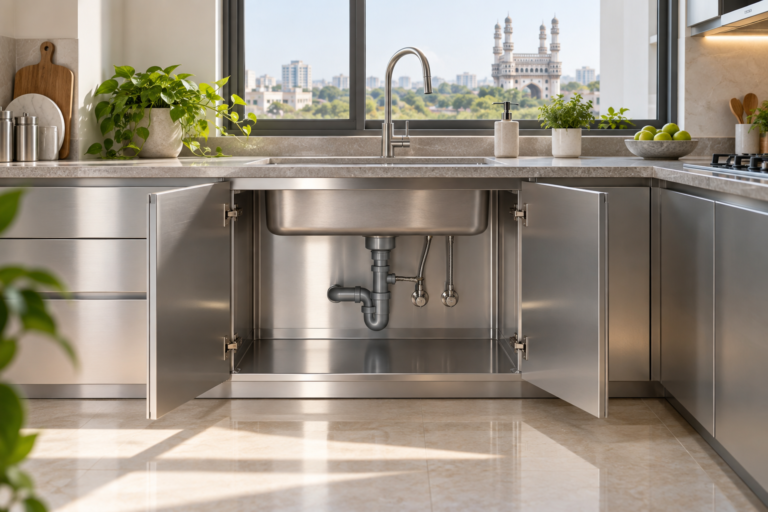

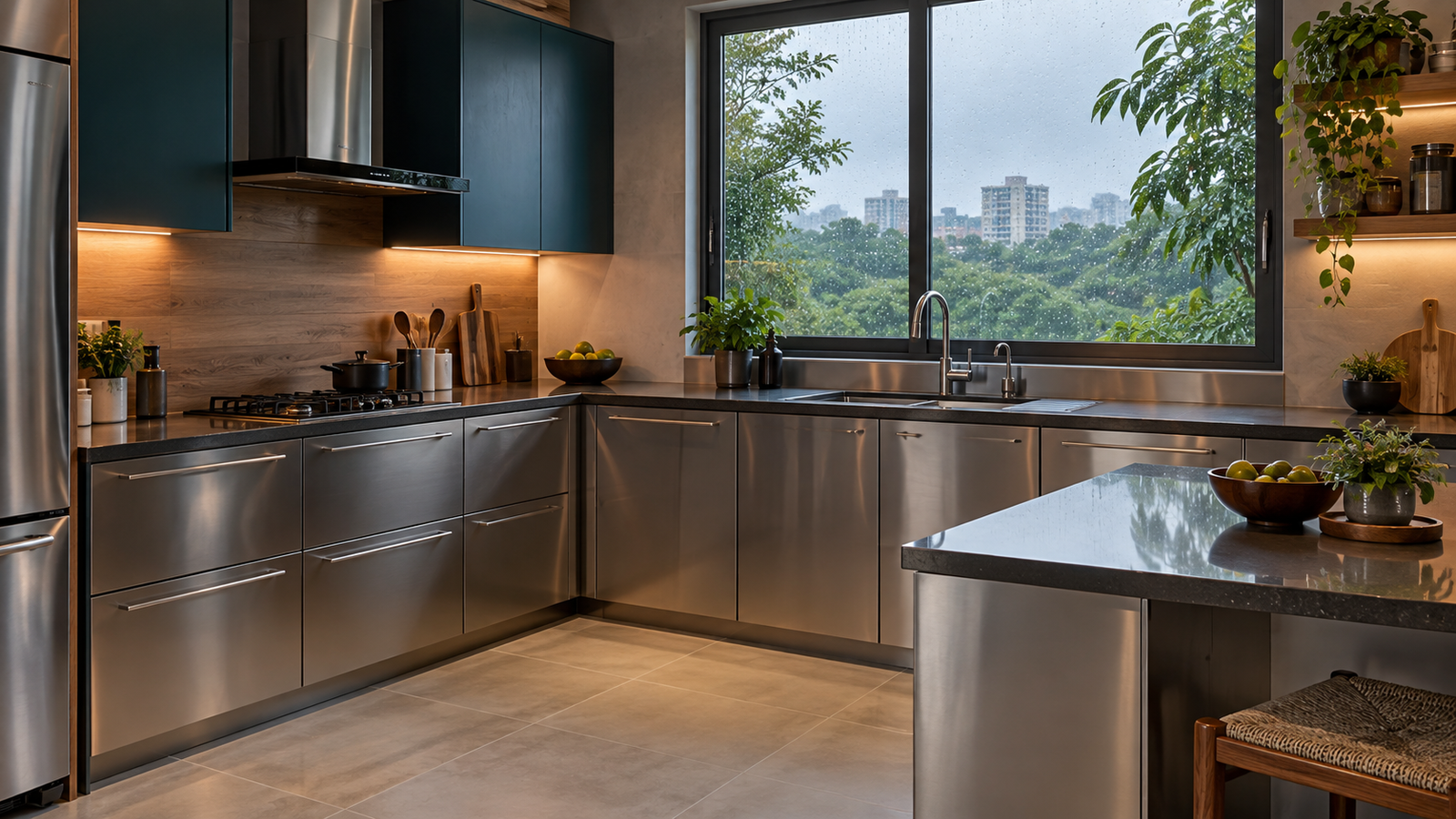
Monsoon damage to modular kitchens in Hyderabad usually begins where humid air, a small leak and slow drying meet. The cabinet material, the wall behind it, the plumbing and the airflow all decide how far the moisture travels, so they have to be judged as one system rather than as separate problems.
Planning a monsoon-proof modular kitchen in Hyderabad? Request a wet-zone assessment and material schedule for SS304, aluminium or GI cabinetry, with service access and moisture routes checked before quotation.
Homeowners in Hyderabad most often ask about this after a wet season has already left a mark — a musty smell under the sink, a door that no longer sits flush, a soft patch at the back of a base unit, or a dull bloom of mould along a shelf. By then the question is no longer whether the kitchen is damp, but which parts can simply be dried, which need repair, and which were the wrong material for that room in the first place.
This guide explains monsoon damage to modular kitchens for homes in and around Hyderabad. It follows one method throughout: find the source of the moisture, understand how each part of the cabinet responds to it, and design or repair so the wet season cannot repeat the same failure. Metal & More Interiors designs and manufactures metal interiors in-house from its factory at B.N. Reddy, Charlapally, with its office at Jai Jawahar Nagar, Yapral Ammuguda Road, Secunderabad.
Monsoon Damage to Modular Kitchens: Quick Answer
Humidity on its own rarely destroys a well-built cabinet. It becomes a problem when water also reaches the cabinet through a leak, a seepage-prone wall, a wet floor or a badly sealed joint, and then cannot dry. That combination lets an absorbent board take on water, lifts a finish, feeds mould and softens the fixing points that hold hinges and channels.
So the first useful question is not “metal or board?” but “where does the moisture come from in this kitchen, and what happens when it arrives?” A sink base, a tall pantry, a utility unit and a bedroom wardrobe each meet a different amount of water and air. A room-by-room schedule that names the cabinet body, the shutters, the finish and the hardware gives a far clearer answer than one general promise about being moisture-proof.
How monsoon humidity reaches a modular kitchen
Monsoon trouble in a kitchen is a delivery problem before it is a material problem. Water has to reach the cabinet, and it has to stay there long enough to do harm. Once you can name the route the moisture takes and the reason it lingers, the right response — a repair, a change of habit or a change of cabinet material — becomes much easier to choose.
Where the water actually comes from
In Hyderabad homes the moisture that damages cabinets seldom arrives as a dramatic flood. It creeps in through several ordinary routes at once:
- Rain-driven seepage through an external wall, a parapet or a window reveal, which shows up as a damp patch on the wall behind a tall unit.
- A slow plumbing leak — an inlet hose, a sink waste joint, a trap, a purifier line or a dishwasher connection — that drips into the base of a cabinet.
- Wet mopping and floor washing, where water is pushed against the plinth and drawn up into a floor-level panel or the bottom edge of a shutter.
- Cooking steam and humid air that enter an open cabinet, then condense on cooler surfaces as the room settles in the evening.
- Rising damp or a damp floor slab in ground-floor homes, which keeps the lowest part of a kitchen in permanent contact with moisture.
Why cabinets stay damp after the rain stops
The wet season in Hyderabad does not end when a shower stops; the air itself can stay heavy for days. High relative humidity slows evaporation, so a small amount of water that would dry quickly in a dry month instead sits inside the cabinet for far longer. A closed sink base or a corner unit has almost no air movement, and a panel pressed against a damp wall has only one face exposed to the room. Add dust, food residue and a little warmth, and you have exactly the conditions mould needs.
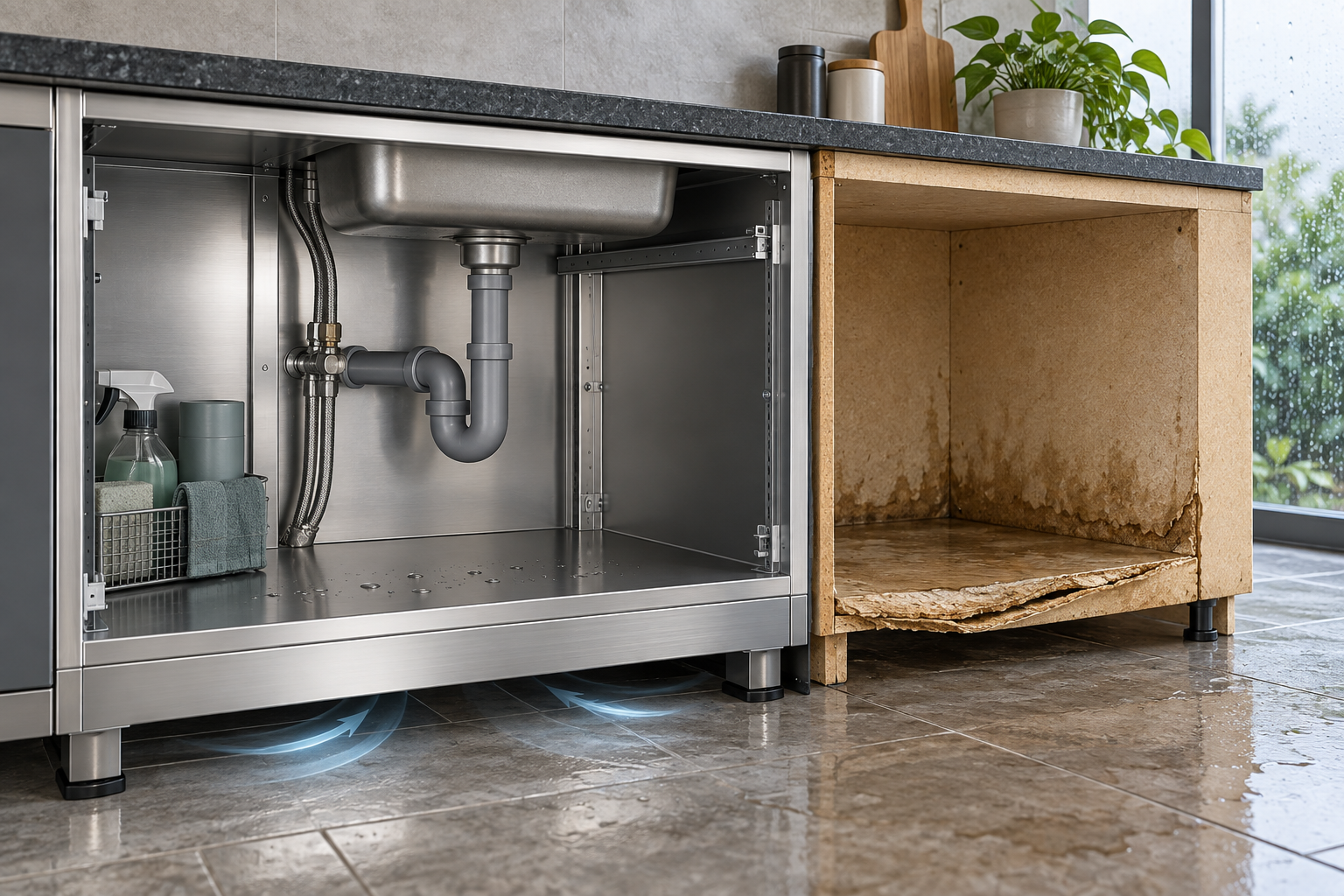
This is why two kitchens in the same building can fail at very different rates. The one with a leak under the sink and a blocked gap behind the cabinet will always struggle more than an identical kitchen where the plumbing is sound and the cabinet can breathe. Treating the material without treating the route simply moves the problem from the cabinet to the wall, the floor or the stored contents.
What the Hyderabad wet season does to cabinets
Hyderabad’s wet weather is long rather than violent. According to the India Meteorological Department, the main monsoon season requires location-specific monitoring; in Hyderabad, the wetter months commonly extend from June into September, and a second wet spell often follows in October. What matters for a kitchen is not one heavy downpour but the fact that the air, the walls and the floors stay humid for weeks, giving moisture time to work its way into anything absorbent.
Ground-floor homes and older colonies
In many older colonies, the kitchen sits at ground level with a plinth close to the floor, a shared wall on one side and drainage that was laid for a different era of the neighbourhood. Water from a blocked drain, a leaking sump or simple wet mopping can reach the base of a cabinet night after night. On a damp slab, a floor-level panel or a plywood carcase has no dry side from which to recover.
Apartments, shared walls and service ducts
In flats, kitchens are often squeezed against common walls and service ducts that carry the plumbing for several homes. A leak two floors up can appear as damp in your cabinet back, and the enclosed duct holds humidity long after the source is fixed. Because the cabinet is built tightly into an alcove, the space behind it never dries and is never inspected.
Water quality, cleaning and cooking habits
Borewell and tanker water can leave mineral deposits on fittings and around the sink, and frequent use of strong cleaners adds another stress on finishes and hardware. A household that cooks twice a day, mops with plenty of water or keeps a damp cloth stuffed under the sink will push far more moisture into the cabinet than a household that wipes surfaces and lets the room air out. These habits matter as much as the material list.
Because conditions change from one neighbourhood to another, a useful assessment has to be local. Metal & More Interiors works across areas we serve in Hyderabad, from older inner colonies to newer apartment corridors, and the cabinet recommendation is adjusted to the wall, the floor and the plumbing a home actually has.
How to assess monsoon damage
Start with evidence. Photograph the affected area, note the date the symptom first appeared and check the neighbouring modules, because water rarely respects the boundary of a single cabinet. Then work outward from the symptom to the source instead of guessing at a repair. Where a leak has clearly been running behind a wall for months, read the wider guide to kitchen cabinet water damage before deciding what to replace.
Reading the warning signs
Musty odour is one of the earliest signals and often the most reliable. Look also for a dull or lifting finish, a swollen or soft edge, dark staining at the back of a base unit, doors that have started to rub, drawers that no longer glide smoothly, and small dark spots on a shelf or rear panel. A cabinet that smells damp when the room has been closed up deserves attention even if its surface still looks intact.
Repair, dry out or replace
Not every damp cabinet needs replacement. If the water source is stopped and the damage is limited to surface mould or light dampness, cleaning and drying may be enough. Where an absorbent panel has swollen or delaminated, the change is usually permanent, because the board has altered rather than merely become wet. In that case drying will not restore its original thickness or strength. Decide in this order: stop the source, dry and inspect, then judge whether the structure and the fixing points are still sound.
| Check | What to examine | Why it matters |
|---|---|---|
| Source and route | Trace plumbing, walls, floor and airflow before touching the cabinet. | A cosmetic repair over an active leak will fail again next season. |
| Symptom pattern | Record odour, staining, softening, door movement and drawer behaviour. | The pattern shows whether the water is recent, chronic or structural. |
| Material response | Note whether the body is absorbent board, metal or a documented mix. | Board can swell and lose strength; metal does not swell by absorbing water. |
| Fixing points | Test hinges, channels and shelf supports for firmness. | Soft or loose fixings mean the structure, not only the finish, has suffered. |
| Access | Check whether the plumbing and the back of the cabinet can be reached. | Serviceable cabinets dry faster and are repaired without demolition. |
| Follow-up | Plan a re-check after the next spell of wet weather. | Confirms the source is truly closed rather than merely dry for now. |
A careful assessment separates three things that are easily confused: the source of the water, the condition of the cabinet, and the suitability of the material for that room. Only the third is solved by buying something new, and only after the first two are understood. Replacing a cabinet without repairing the wall or the plumbing simply hands the same problem to the next one.
Wet zones that fail first
Most monsoon repairs are concentrated in a few positions where water, low airflow and daily use overlap. If a kitchen is going to fail, it usually fails here first.
The sink base
The sink base is the hardest-working cabinet in the kitchen. It carries the inlet connection, the waste pipe, the trap and often a water purifier, and it is opened several times a day. A slightly loose trap or a worn washer is enough to keep the base permanently damp. This is the one position where a non-absorbent body — and a base panel that does not sit in a puddle — pays for itself.
Utility and laundry cabinets
Utility areas combine a washing machine, a sink, wet clothes and often a water heater, so the air is humid for much of the day. Cabinets here meet the same moisture as the kitchen with less ventilation. Storage meant for damp laundry or cleaning supplies should be planned with airflow and a wipe-clean interior rather than sealed into a dark box.
Plinth, back panel and countertop joints
Three quieter details cause a great deal of monsoon damage: a plinth in direct contact with a wet floor, a back panel pressed against a damp wall with no gap, and a countertop joint or sink cut-out that has not been sealed properly. Each is cheap to get right at installation and expensive to correct later, because the damage happens where it is hardest to see.
Choosing SS304, aluminium or GI for a humid climate
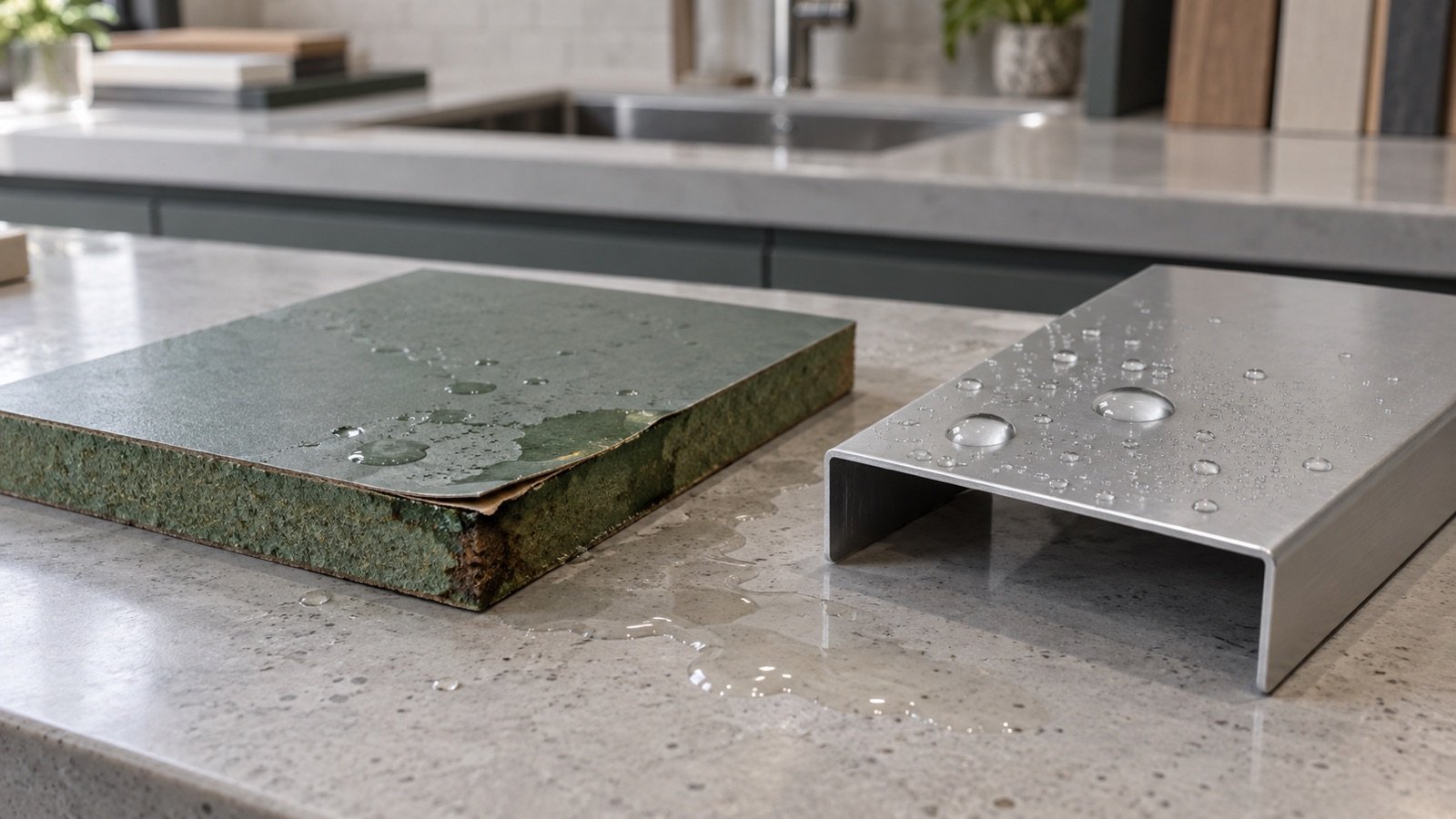
No material removes the need for sound plumbing and airflow, but a non-absorbent cabinet body removes one major pathway for monsoon damage: the uptake of water by the panel itself. Where a home keeps facing damp conditions despite repairs, or where the kitchen is planned for many years of use, that property is worth building in from the start.
SS304 stainless steel
SS304 is the strongest choice for the wettest, busiest positions — a sink base, a utility unit or a home where hygiene matters. Its non-porous surface is easy to wipe and it is highly corrosion resistant under normal residential care. Confirm the grade on the schedule, clean it with mild detergent and a soft cloth, and avoid steel wool or harsh chloride-rich cleaners that can mark or contaminate the surface. For layouts and finishes, see the range of stainless steel modular kitchens in Hyderabad.
Aluminium
Aluminium is light, corrosion resistant and well suited to kitchens, wardrobes and utility storage where weight and clean lines matter. Alloy choice, panel profile, reinforcement and the way the hardware is fixed all affect how it performs. Finished carefully, it supports warm residential colours rather than looking industrial, and it does not swell by taking on water.
GI
Galvanised steel carries a zinc protective layer and is normally paired with a finished surface. Coating continuity, the treatment of cut and folded edges, and the care routine should all be clear before purchase, because an exposed edge is where any coated metal is most vulnerable. Metal & More Interiors provides a 15-year warranty on GI under the written project terms.
| Position or need | Sensible starting point | Why |
|---|---|---|
| Sink base, utility, wet laundry | SS304 stainless steel | Constant moisture plus daily use rewards a non-porous, corrosion-resistant body. |
| General kitchen and wardrobe storage | Aluminium | Light, corrosion resistant and easy to finish in warm residential colours. |
| Finished interiors on a tighter budget | GI with a good finish | Galvanised steel is practical when its edges and coating are properly detailed. |
| Whole-home interiors | A documented mix of metals | Different rooms carry different loads and moisture, so each module is named. |
Two kitchens can look identical in a drawing yet be built from very different bodies, so ask for the material to be named module by module. Homeowners comparing board options should also understand why plywood kitchen cabinets swell, since that mechanism explains much of the damage a non-absorbent body is chosen to avoid.
How Metal & More builds for humidity
Metal & More Interiors designs and manufactures metal interiors in Hyderabad, fabricating SS304, aluminium and GI cabinetry in-house rather than wrapping an unspecified body in a metal-look finish. That control runs from the first site measurement to the final installation, which is what makes it possible to build for a specific room’s moisture rather than for a catalogue picture.
In-house fabrication from measurement to installation
Approved modules are made in the factory at B.N. Reddy, Charlapally, so the body, the shutters, the reinforcement and the service openings are all part of the same construction drawing. Typical kitchen and wardrobe depth is planned around 2 feet where applicable, then adjusted for the wall, the appliances, the services and the room’s circulation. Where a mixed-metal or mixed-material layout is chosen, each module’s material is recorded rather than left vague.
Insert-nut fastening and service access
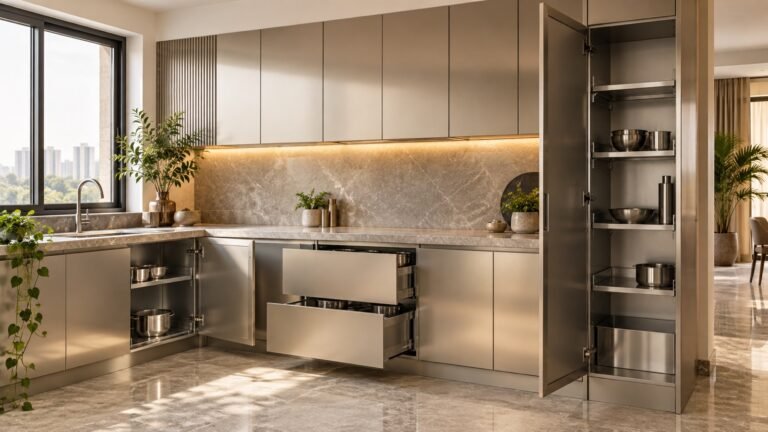
Modules use an Insert Nut Fastening System. A threaded insert forms a controlled fixing point in the fabricated metal, so hinges, channels and shelf supports can be assembled and, when needed, loosened and refitted without damaging the body. That matters in a humid kitchen, where hardware is adjusted as the room moves through the year. Service openings are planned before production, so a trap or a valve can be reached without cutting into a finished cabinet after installation.
Warranty tied to the material
Warranty is connected to the approved material schedule: lifetime on stainless steel and aluminium, and 15 years on GI, subject to the written project terms. Hardware such as Hettich can be specified where selected; it is not claimed for every fitting unless it is recorded in the project. Metal is termite-proof as a material and easy to clean, and it does not swell by absorbing water. The accurate safety description is fire-resistant, not fireproof or fire-rated, unless a specific tested certificate applies to the complete assembly.
A monsoon care and prevention routine
Most monsoon damage is preventable with a short routine that costs little and is repeated at the right time of year. The aim is simple: keep water moving away from the cabinet, and let the kitchen dry between spells of rain.
Before the wet season
- Run a hand under every sink and appliance connection and look for fresh stains, drips or softened board.
- Check the sealant around the sink and countertop joints and renew any that has cracked or lifted.
- Clear the drain, the trap and any floor drain so water cannot back up into the base unit.
- Look at the external wall and window reveals for the first signs of seepage.
- Confirm that the gap behind floor-level cabinets is clean and not blocked by stored items.
During the wet season
Wipe up spills and standing water the same day, leave wet-zone doors slightly open for part of the day, and let the room air out after cooking. A small fan or a dehumidifier used in the kitchen or utility area during a humid spell can make a real difference to how quickly a cabinet dries. If a musty smell appears, treat it as a prompt to find the source rather than as something to cover with fragrance.
Habits that make damp worse
Several common habits quietly feed the problem: storing damp cloths inside a closed cabinet, pushing wet mop water against the plinth, ignoring a slow drip because it is “only small”, and sealing cabinets so tightly that no air can move. Mould is not caused by metal or board alone; it grows where moisture, warmth and a food source such as dust or residue meet. Cleaning and airflow matter as much as the material, which is why persistent damp is worth investigating with the guide to mould and fungus inside kitchen cabinets.
Inspection and quotation checklist
Whether you are repairing an existing kitchen or planning a new one, these points are worth confirming in writing before any work begins.
- Record the cabinet body, shutter, finish and hardware separately, module by module.
- Confirm the material for wet zones such as the sink base and the utility unit.
- Check that a plinth does not sit in permanent contact with a wet floor.
- Leave a gap or a ventilated panel behind floor-level cabinets.
- Keep the plumbing, the trap and the purifier connections reachable.
- Ask how hinges, channels and shelves are fixed and whether they can be re-serviced.
- Approve internal dimensions after the site measurement, not from a drawing alone.
- Operate a finished sample and inspect its inside, back, shelves and fixing points.
- Confirm the warranty period and exclusions for the material you have chosen.
- Plan a re-check after the next spell of wet weather.
A clear quotation makes comparison easier, not harder. Two kitchens can look the same in a rendering while using very different cabinet bodies, joint methods, hardware and service access, and the differences tend to show up only in the second or third monsoon.
Frequently asked questions
Can humidity alone damage a modular kitchen?
Humidity by itself is slow-acting. The damage usually needs a second factor — a leak, wall seepage, a wet floor or poor airflow — that lets moisture reach the cabinet and stay there. Once water is present and cannot dry, absorbent panels swell, finishes lift and mould can grow. Removing the source matters more than the label on the material.
Can a damp or swollen cabinet be saved?
Surface dampness and light mould can often be cleaned and dried once the water source is stopped. Swelling and delamination in an absorbent panel are usually permanent, because the board has changed rather than merely become wet. Base the decision on the structure and the fixing points, not on the surface finish.
Does a metal cabinet stop mould?
No material stops mould on its own. Metal is non-porous and easy to wipe, which removes the damp, food-rich surface that mould colonises, but mould will still grow on dust, sealant, walls or stored items if the kitchen stays damp. Ventilation and leak control remain essential.
Should cabinets have ventilation openings?
Wet zones benefit from managed airflow, but any opening must not create pest access or weaken the module. The right detail depends on the cabinet’s position and the plumbing layout, and it should be planned at the design stage rather than cut in later.
Which cabinet material suits the humid climate best?
For the wettest positions, SS304 stainless steel is the most durable option; aluminium suits most kitchen and wardrobe storage; and GI is a practical choice when its coating and edges are properly detailed. Match the material to the zone and record it in the schedule.
When is the best time to book a monsoon inspection?
During or just after the wet season, when damp patches, odours and door movement are easiest to see. An inspection at that time can trace the source while the evidence is still visible, and set out a repair or a material change before the next season.
Final decision
Use monsoon damage to modular kitchens as a way of thinking, not as a reason to buy the most expensive option. Find where the water comes from, judge how much of the cabinet it has already affected, and only then decide whether to repair, dry out or replace. A non-absorbent body such as SS304, aluminium or GI removes one pathway for damage, but it still depends on sound plumbing, airflow and careful installation.
For homes in Hyderabad that meet the same damp conditions year after year, that combination is worth planning for rather than repairing. Metal & More Interiors can survey the room, review the failure point and recommend SS304, aluminium, GI or a documented mixed-metal layout to suit the wall, floor and plumbing. The office is at Jai Jawahar Nagar, Yapral Ammuguda Road, Secunderabad, and manufacturing is at B.N. Reddy, Charlapally.