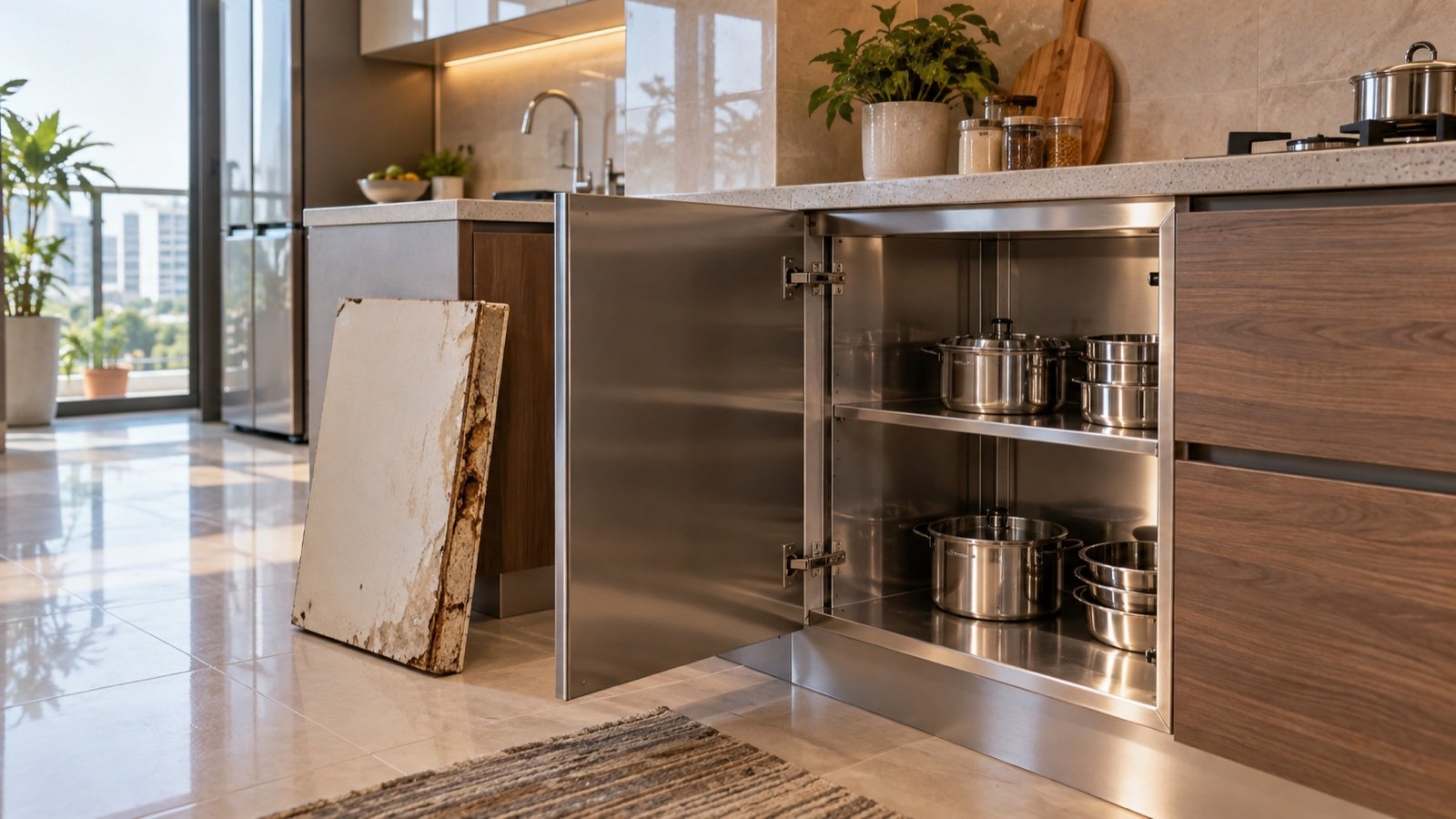
Particle board can be an economical and consistent panel for dry interior furniture, but a kitchen places it under steam, spills and the risk of slow leaks. Comparing particle board vs metal kitchen construction comes down to how each cabinet body handles moisture at its edges, how its fixings hold after years of use, and how easily a module can be repaired or serviced.
Most homeowners reach this question in one of three moments: while comparing two very different quotations, while planning a rental or budget kitchen, or after a base cabinet has already swelled near the sink. Each situation needs a different level of detail, but the underlying test is the same. Separate the cabinet into its parts — carcass, shutter, edge, hardware, back panel and plinth — and ask how each part behaves in the exact spot where it will be installed.
This guide explains particle board vs metal kitchen choices without slogans or price claims. It covers how particle board is made, where it genuinely works, why edges and wet zones decide the outcome, and when a fabricated metal carcass is the more durable answer. Metal & More Interiors designs and manufactures metal interiors in-house from its factory at B.N. Reddy, Charlapally, with its office at Jai Jawahar Nagar, Yapral Ammuguda Road, Secunderabad.
Quick answer
Particle board is an engineered panel made from wood particles bound with resin and pressed into flat sheets. In dry, well-supported furniture it stays flat, accepts laminate neatly and holds its price advantage. The material itself is not the problem; the exposure is. A cabinet core that is absorbent by nature will react badly to standing water, repeated dampness and unprotected cut edges.
A metal kitchen uses fabricated stainless steel, aluminium or galvanised steel as the structural body. It does not swell by drinking water and it is not a food source for termites. Those are real advantages in a wet, warm room, but they are not a licence to ignore design. Grade selection, coating continuity, fold detail, fixing points and installation quality still decide whether the finished module performs.
The honest comparison is therefore never “which label wins?” It is “which complete system survives my room?” A particle-board layout protected from moisture can serve a dry utility unit well. A sink base, tall pantry, dishwasher bay or loft that sits against a damp wall is judged differently, and that is where a non-absorbent carcass earns its place.
Understand particle board before comparing
Particle board — also sold as chipboard or flakeboard — is manufactured by mixing wood chips or sawdust with a binder and pressing the mixture under heat into a uniform sheet. The result is flat, predictable and inexpensive to produce in large volumes, which is why it became the default carcass material for entry-level modular kitchens and wardrobes. Its consistency is genuine: unlike natural timber, it does not arrive with hidden knots or wild grain movement.
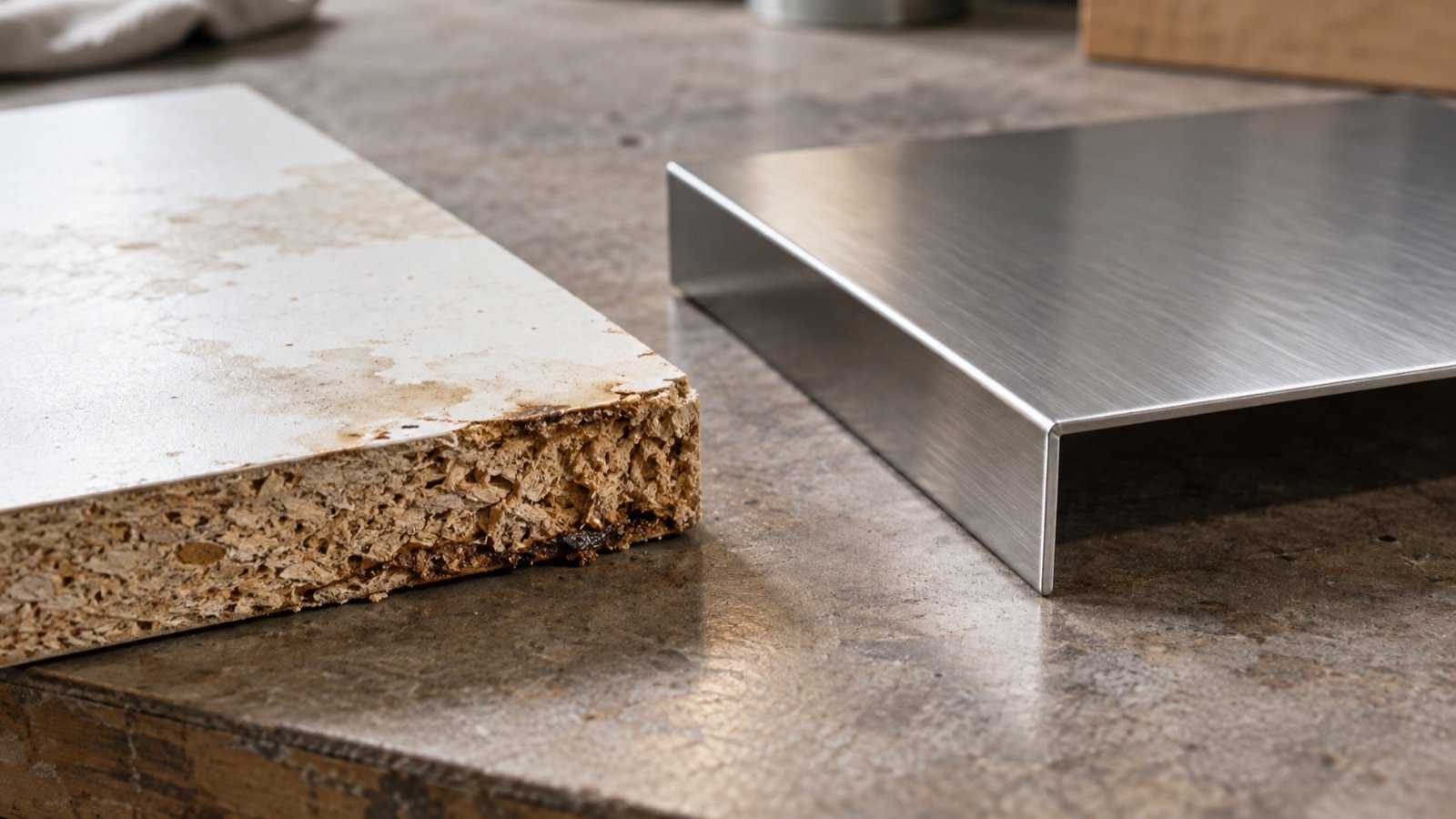
The weakness sits in the same uniformity. Because the sheet is a mass of compressed particles, water absorbed at an unprotected point travels into the core and the particles swell and separate. A moisture-resistant grade is sometimes specified, and it resists damp better than a standard board, but “moisture-resistant” is not “waterproof”. No board product should be treated as a substitute for keeping the core dry.
Edges are the first line of defence. A laminate face can be wiped clean, yet the cut line around a sink, the back edge against a wall and the plinth contact point are where water usually finds the core. Sealing quality, edge banding, silicone discipline and accurate fabrication all matter more than the decorative surface the customer actually sees. When sealing fails quietly, the visible damage appears later and far from the original leak.
Repair behaviour also differs from metal. A swollen particle-board panel rarely returns to its original thickness or strength once it has absorbed water. Drying may slow further damage, but the affected section usually has to be cut out and replaced, and matching a discontinued laminate years later is difficult. That repair reality, not just the original purchase, is part of the true cost of ownership.
A cabinet is a system, not a single sheet. Good measuring, square carcasses, correct panel support and coordinated hardware can make any material perform better than a badly built module of a premium label. Equally, a solid board used without adequate support or protection will underperform no matter how strong its specification looks on paper. Judge the construction, the fixings and the service plan alongside the panel name.
Particle board vs metal kitchen: how to evaluate the cabinet
Begin with evidence rather than a showroom front. If a cabinet has already failed, photograph the affected zone, note when the symptom first appeared and test the adjoining modules for softness or a musty smell. For a new project, ask to operate a finished sample and inspect the parts that are normally hidden — the inside of the carcass, the back panel, the underside of shelves and every fixing point. A glossy shutter tells you almost nothing about the structure behind it.
Then separate the specification into named components. The carcass material, shutter material, finish, edge treatment, hardware series, plinth and back panel should each be identifiable. A quotation that names only “modular kitchen with laminate finish” leaves the most important decisions open, and two visually identical elevations can hide entirely different cabinet bodies. The table below sets out the factors that usually decide whether a kitchen ages gracefully or fails early.
| Decision factor | Particle-board cabinet | Metal cabinet |
|---|---|---|
| Moisture at the core | Particle board absorbs water through cut edges and exposed fixings; performance depends on grade and sealing. | A non-absorbent body does not swell through water uptake; grade and finish still need to match the zone. |
| Edge and cut-out sealing | Critical. Sink cut-outs, backs and plinth edges are the usual entry points for failure. | Folded or formed edges remove the absorbent core from the water path. |
| Termite exposure | Wood-derived and organic; the panel remains a potential food source. | SS304, aluminium and GI are not termite food sources. |
| Fastening and repeat service | Screw holding depends on board density and on the same point not being disturbed repeatedly. | Engineered threaded inserts create fixing points that can be reopened for service. |
| Load and span | Stiffness depends on thickness and support; wide unsupported shelves can sag over time. | Folds, returns and planned reinforcement give a fabricated module its rigidity. |
| Repair after water damage | The swollen section is usually replaced rather than restored. | Individual components can be removed and refitted without dismantling a decorative skin. |
| Finish range | Broad, low-cost decorative laminates and veneers in many colours and textures. | Powder-coat, PU, textured, glass and acrylic-compatible finishes with an option for visible metal. |
| What to verify in writing | Exact board grade, edge treatment, back panel and warranty exclusions. | Exact metal, thickness or profile, coating, fastening system and warranty terms. |
The most useful questions are blunt and specific. What exactly is the cabinet body made of? How are the sink cut-out and back edge protected? How are the hinges and channels fixed, and into what? Can a technician reach the plumbing or remove a failed module without destroying the surrounding finish? What does the warranty actually cover, and what excludes a claim? Clear answers separate a real quote from a rendering.
Why particle board swells and what it means for a kitchen
Swelling is not a coating failure; it is a core failure. When water reaches the compressed particles, they pull moisture in, expand and push against the surrounding laminate. The panel thickens unevenly, so a base cabinet floor can lift, a shutter can drag, a drawer can jam and a hinge can lose its bite. Because the change happens inside the panel, the surface may look intact until the swelling has already become structural.
The kitchen supplies the exact conditions that start this process. A slow drip under the sink can wet a cabinet floor for weeks before anyone notices. Steam from an open dishwasher, a wet mop against the plinth and a leaking purifier connection all add moisture across the year. Hyderabad’s monsoon humidity raises the background level further, so a cabinet that copes in a dry month may struggle through the rains. This is why the same board can behave differently in two homes of identical design.
The practical lesson is not that every particle-board cabinet is doomed. It is that the decision should follow the exposure. For a dry bedroom wardrobe, a study unit or an upper wall cabinet that never meets water, a sealed particle board can be perfectly reasonable. For the zone around a sink, a dishwasher bay, a floor-level module against an external wall, or any point where a leak could go unnoticed, the absorbent core carries more risk than many buyers expect.
Repair economics complete the picture. Once a base panel has swollen, the usual fix is replacement, and matching a laminate batch that may have been discontinued is often impossible. A homeowner then faces replacing a whole run to keep the kitchen visually consistent. A non-absorbent body changes that arithmetic: a leak may still need attention, but it does not automatically destroy the cabinet structure around it.
Fastening, hardware and repeat service
Hinges and drawer channels are moving parts. They are aligned at installation and adjusted again after months of daily use. In a particle-board cabinet, that depends on screw holding in the board itself. If the same hole is tightened, loosened and tightened again, or if a hinge pulls against a low-density zone, the fixing can strip and the screw no longer grips. A premium hinge cannot compensate for a fixing point that has lost its material.
Metal addresses this at the connection rather than the surface. Metal & More Interiors uses an Insert Nut Fastening System. A threaded insert is set into the fabricated metal module so a matching fastener can be removed and refitted without enlarging a hole or destroying the surrounding panel. That supports repeatable assembly during the build and predictable service later, when a hinge, channel or shelf clip needs to be replaced.
The system is only as good as the discipline around it. Holes must be positioned accurately, the cabinet must be square, and the hardware must be matched to the expected load. An insert is not a repair patch for a misaligned module; it is a controlled connection in a correctly built one. When a design must carry heavy pull-outs, wide shelves or tall shutters, the fixing plan and the reinforcement should be settled before fabrication, not improvised on site.

When you compare samples, look past the hardware logo. Open the shutter fully and watch how the hinge plate meets the carcass. Pull a loaded drawer and check whether the channel stays aligned. Ask how a damaged component would be replaced if the same fitting had already been adjusted several times. A cabinet and its hardware should behave as one system, and a metal body is designed to keep that system serviceable over its life.
Sink base, plinth and wet-zone planning
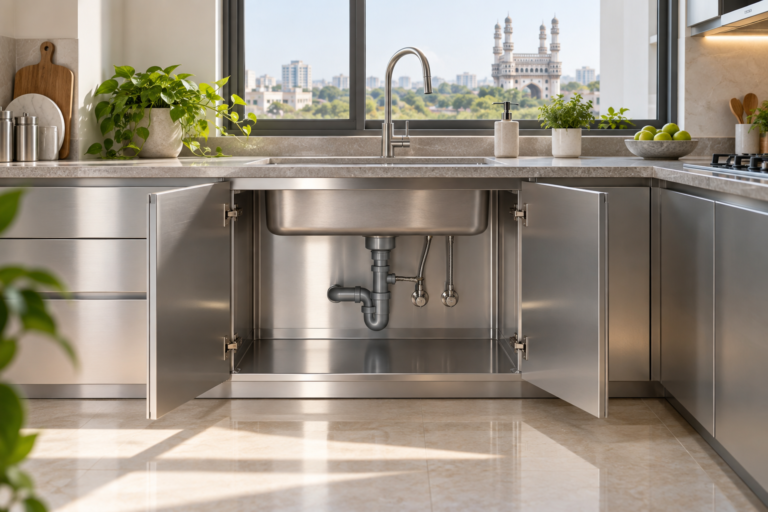
The sink base is the fairest stress test in any kitchen. It combines plumbing connections, cleaning chemicals, a cut-out in the worktop above, repeated daily access and the constant possibility of a slow leak. Add a dishwasher beside it and the bay also carries warm moisture and hose connections. A particle-board sink base therefore depends almost entirely on flawless sealing and a homeowner who notices problems early — two conditions that are hard to guarantee.
Planning matters as much as the material. The service area should include a removable panel, accessible shut-off valves and a visible route to inspect the trap. Flexible connectors, purifier tubes and electrical points should not be sealed permanently behind a fixed board, because a leak that cannot be seen cannot be fixed in time. The cabinet floor should be easy to wipe and should not trap water against the wall where it can quietly soak upward.
Floor-level modules deserve the same attention. A plinth that wicks water from mopping, a base panel sitting directly on a damp floor, or a cabinet against an external wall that stays cool and condensation-prone all raise the moisture load. Raising the base slightly, detailing a clean floor line and choosing a non-absorbent body for the riskiest positions are simple measures that pay back over the life of the kitchen. If the wet work, plumbing or appliances are also being planned, a combined kitchen and wardrobe package can coordinate those details from the start.
Moisture control is still a room-level job. A non-absorbent cabinet will not repair a leaking tap, and metal fittings can still be marked by aggressive cleaning chemicals over time. The goal is to reduce the water reaching the cabinet, keep the source visible and choose a body that does not turn one unnoticed drip into a structural failure.
How Metal & More builds differently
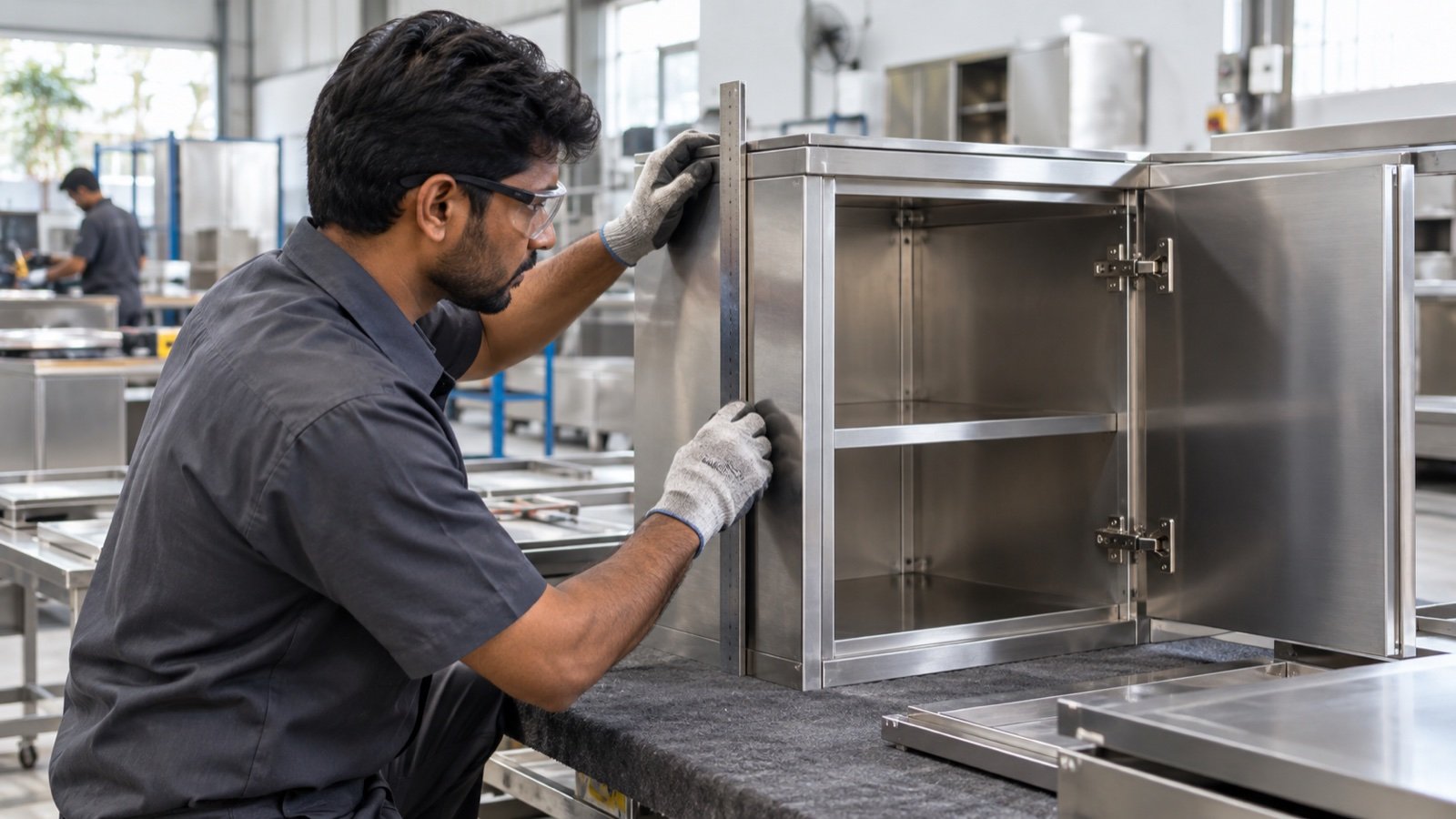
Metal & More Interiors designs and manufactures metal interiors in Hyderabad, with SS304, aluminium and GI cabinetry fabricated in-house at its Charlapally unit. The practical value of that control is simple: the same team handles site measurement, shop drawings, fabrication, pre-assembly, quality checks and installation, so the cabinet is built as one system rather than assembled from parts of uncertain origin.
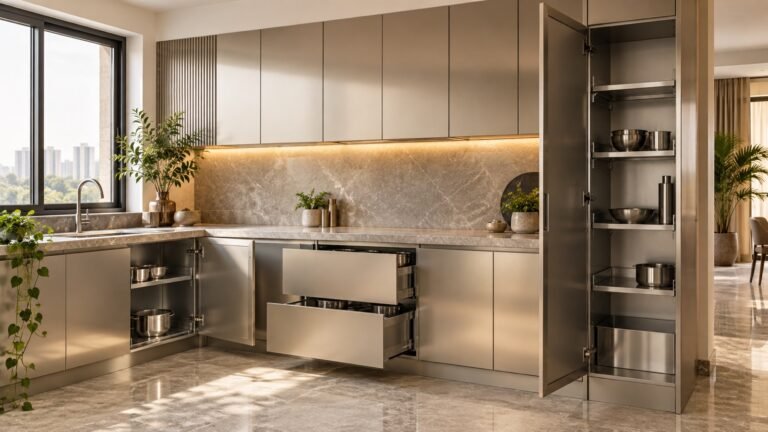
The selected carcass and shutters are metal unless a customer deliberately approves a documented mixed-metal or mixed-material configuration. Typical kitchen and wardrobe depth is planned around 2 feet where applicable, then adjusted for the wall, worktop, appliances, shutter clearance, services and room circulation. Modules are fabricated with planned folds, returns, reinforcement and insert-nut fixing points, and service openings are designed before production so access never depends on rough cutting on site.
Warranty is tied to the approved material schedule: lifetime on stainless steel and aluminium, and 15 years on GI, subject to the written project terms. The manufacturer, metal grade, finish, hardware and exclusions should all appear in the quotation. Hettich hardware may be specified where selected and approved in the project; it is not assumed automatically for every fitting. Metal is termite-proof as a material, non-absorbent and straightforward to clean, and the accurate safety description is fire-resistant.
That in-house route also keeps future service realistic. Because the construction is mechanical rather than a decorative skin over an unspecified core, a damaged or worn component can be identified, removed and replaced. For a homeowner planning to stay for a decade or more, or to rent out the property and keep the kitchen presentable, a serviceable metal module is easier to maintain than a panel that must be protected from water for its entire life.
Best kitchen cabinet material in Hyderabad: match the material to the zone
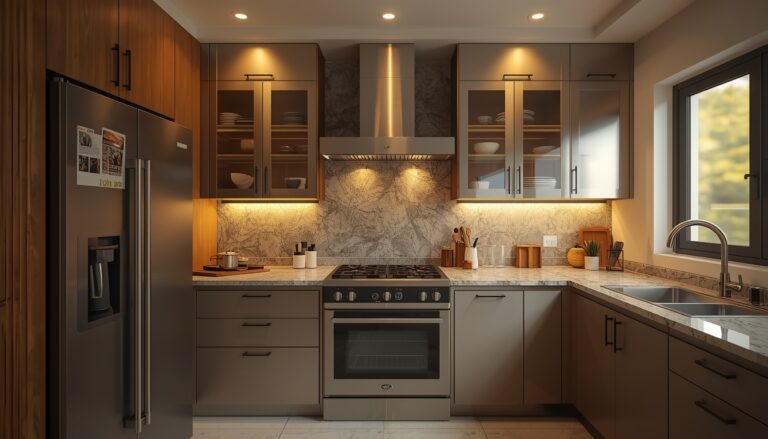
Searches for the best kitchen cabinet material in Hyderabad often produce one universal answer, but a kitchen contains several different environments. The sink base faces water and plumbing access; a pantry faces shelf loads; an oven tower needs ventilation and heat clearance; floor-level units face wet mopping. The better specification assigns material, reinforcement and access according to each risk.
Homeowners comparing termite-resistant kitchen cabinets should examine the entire room, not only the new carcass. Metal is not a termite food source, and particle board remains wood-derived. Existing timber, wall dampness and concealed voids may still need inspection. For people searching for water-resistant kitchen cabinets in Hyderabad, the same system thinking applies: non-absorbent metal removes board swelling from the cabinet body, but plumbing, hardware and adjacent finishes still require sensible maintenance.
A written schedule turns these search terms into a buildable decision. It should name the material for every carcass and shutter, record the wet-zone details, identify the fastening system and show how technicians will reach services later.
Choosing SS304, aluminium or GI
Metal kitchen cabinetry is not one material. The right grade depends on the zone, the load and the finish you want, and the choice should be recorded module by module rather than applied blindly across a whole home. The table below is a starting point; the final schedule should follow a site review.
| Material | Where it suits | What to confirm |
|---|---|---|
| SS304 stainless steel | Sink bases, dishwasher bays and high-use wet zones where hygiene and corrosion resistance matter most. | Grade confirmation, finish, and a cleaning routine that avoids steel wool and chloride-rich cleaners. |
| Aluminium | Kitchens, wardrobes and storage where light weight and clean residential finishes are useful. | Alloy, profile design, reinforcement and how hardware fixes into the panel. |
| GI (galvanised steel) | General cabinetry where a zinc-protected steel body is paired with a finished surface. | Coating continuity, fabricated edge treatment, care instructions and the 15-year warranty terms. |
SS304 stainless steel
SS304 is the demanding-zone choice. Its non-porous surface is hygienic and resists corrosion under normal residential care, which is why it works around sinks and appliances. Confirm the grade and finish, and avoid steel wool or harsh chloride-rich cleaners that can contaminate or mark the surface over time.
Aluminium
Aluminium is light, corrosion resistant and versatile across kitchens, wardrobes and storage. Profile design, alloy, reinforcement and the fixing detail still decide how it performs under load. Finished well, it supports a refined residential look rather than an industrial one.
GI (galvanised steel)
Galvanised steel adds a zinc protective layer and is normally paired with a finished surface. Check coating continuity and how fabricated edges are treated, since these are where corrosion would begin. Metal & More provides a 15-year warranty on GI under the written project terms.
Before deciding, review the relevant service pages so the material and the room are matched: a stainless steel modular kitchen in Hyderabad, galvanised steel kitchens in Hyderabad, and a full spread of related options. Homeowners also weighing a board alternative can read the metal vs MDF kitchens comparison or the explanation of why plywood kitchen cabinets swell, both of which apply the same logic to a different panel.
Quotation and planning checklist
A clear quotation should make comparison easier, not harder. Normalise the scope before you look at any total: count the base, wall, tall and loft units, then list the carcass material, shutter material, finish, hardware, accessories, end panels, transport and installation. Two kitchens can look identical in a rendering while using very different bodies, joint systems and service arrangements.
- Record the carcass and shutter material room by room — never accept “modular” alone.
- For particle board, confirm the grade, edge banding, back panel and how sink cut-outs are sealed.
- For metal, confirm whether each module is SS304, aluminium or GI, plus thickness or profile and coating.
- Check unsupported shelf spans and how wide shelves are reinforced.
- Inspect hinge, channel and handle fixing points, and ask how they are serviced.
- Keep plumbing, drainage and electrical points reachable through a removable panel.
- Approve finish samples under the lighting of the actual room.
- Confirm the warranty period, coverage and exclusions in writing.
- Operate a finished sample and look inside, not just at the elevation.
If the kitchen sits in a high-moisture position and the budget allows, it is reasonable to mix materials: a non-absorbent body for the sink base and other wet zones, with sealed boards only in genuinely dry upper positions. What matters is that the decision is written down, not left to a vague promise. Ask for internal dimensions after site measurement too, because folded edges and hardware can reduce usable storage even when the outside width looks the same.
For formal product compliance, ask the supplier which Indian Standard applies to the specified material and verify published information through the Bureau of Indian Standards. A category name alone is not evidence of certification.
Frequently asked questions
Is particle board always unsuitable for kitchens?
No. Moisture-resistant grades of particle board can work in dry, well-sealed and well-ventilated positions. The caution applies mainly to wet zones, floor-level modules and any point where a slow leak could reach an unprotected edge.
What happens when particle board gets wet?
The compressed wood particles absorb water, swell and lose cohesion, so the panel thickens unevenly. Drying may slow further damage, but it rarely restores the original thickness or strength, and the affected section usually has to be replaced.
Are metal kitchen cabinets heavier than particle board?
Weight depends on the material and construction rather than the category. Aluminium is light, and folded sheet-metal modules gain stiffness through shape rather than solid thickness. The finished cabinet should be judged as a complete system, including hardware and support.
Can metal cabinet shutters match home interiors?
Yes. A metal body can carry powder-coated, PU, textured, glass or acrylic-compatible finishes, and warm wood-look surfaces are available so the kitchen does not have to look industrial. Confirm the approved sample and the cleaning method.
Which metal should I choose — SS304, aluminium or GI?
SS304 suits the wettest, most demanding positions, aluminium suits light, clean residential cabinetry, and GI is a zinc-protected steel body paired with a finished surface. The right mix should follow a site review and be recorded module by module.
What warranty applies to a metal kitchen?
The stated warranty is lifetime on stainless steel and aluminium and 15 years on GI, subject to the written project terms. Always review the selected material, coverage, care requirements and exclusions in the quotation.
Final decision
Use particle board vs metal kitchen as a buying framework, not a contest between labels. Particle board is a capable, economical panel when the exposure is dry and the edges stay sealed; its risk rises sharply wherever water, steam or an unnoticed leak can reach the core. Metal offers a non-absorbent, termite-proof and serviceable structure, but it still depends on correct grade selection, fabrication, reinforcement and installation to deliver on that promise.
The safest approach is to match the material to the zone, write the specification down, and keep future service in view. Metal & More Interiors can measure the room, review the storage or failure point and recommend SS304, aluminium, GI or a documented mixed-metal configuration. The office is at Jai Jawahar Nagar, Yapral Ammuguda Road, Secunderabad, and manufacturing is at B.N. Reddy, Charlapally.