Choosing between a metal vs WPC kitchen turns on how each cabinet body behaves under water, load, heat and repeated servicing, not on a single label. WPC resists termites and tolerates moisture better than conventional wood boards, while fabricated metal adds structural stiffness, a non-absorbent body and threaded fixing points. The right answer depends on the exact grade, the span, the hardware and how the room is used.
Most Hyderabad homeowners first hear about WPC while hunting for a kitchen material that will not swell like plywood or particle board. It is a fair material to consider, but “WPC” and “metal” each cover a wide family of products. Two WPC panels can differ in density and internal structure, and stainless steel, aluminium and galvanised steel differ in strength, finish and care. A useful comparison therefore names the material inside each cabinet module instead of trusting a category name.
This guide explains metal vs WPC kitchen construction using the same test applied across this cluster: identify the exposure, specify the whole system and keep future service possible. It works through moisture, termites, stiffness, heat, fastening, finish and repairability for Hyderabad homes. Metal & More Interiors designs and manufactures metal interiors in-house from its factory at B.N. Reddy, Charlapally, with its office at Jai Jawahar Nagar, Yapral Ammuguda Road, Secunderabad.
Quick answer
WPC, short for wood-plastic composite, is a board or profile made from a polymer blended with wood-derived fibre or a mineral filler. Depending on the product it is formed as a solid sheet, a foamed panel or a hollow extruded profile. Its appeal in a kitchen is that it does not feed termites and tolerates water far better than ordinary fibre boards, which makes it a genuine option in wet or humid rooms.
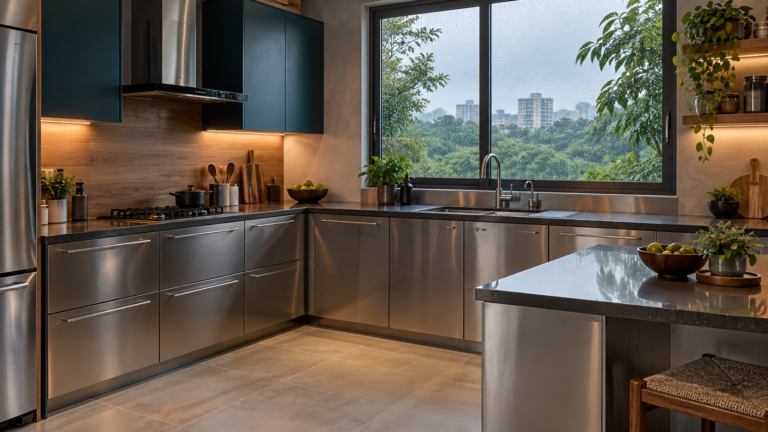
Metal cabinetry instead relies on a fabricated body of SS304 stainless steel, aluminium or galvanised steel. A metal module does not swell by soaking up water and is not a termite food source. Folds, returns, stiffeners and threaded fixing points give it rigidity and make it serviceable, provided the grade, coating and fabrication are right.
Neither category is automatically better. A dense WPC panel with proper support can serve a dry cabinet well, while a badly built metal unit can rattle or be hard to repair. Judge the finished module — its carcass, span, fixing points and finish — rather than the word printed on the brochure.
Understand WPC before you compare
How WPC is made
WPC is produced by mixing a thermoplastic polymer — usually polyethylene or PVC — with wood flour, sawdust or a mineral filler, then extruding or pressing the blend into sheets and profiles. Because the recipe and the process vary from one factory to another, two products sold as “WPC” may not share density, stiffness or screw-holding behaviour. The mix ratio, the foaming level and the wall thickness of the profile all change how the finished panel performs.
Solid sheets versus hollow profiles
A solid WPC sheet and a hollow extruded profile are very different structural components. The solid sheet resists deflection better in short spans and holds a screw more predictably, though it is heavier and costs more to move. The hollow profile is light and economical, but its skin can flex under a wide shelf and its voids may not grip a fastener unless the fixing lands on a reinforced rib. Ask which type is being quoted, and at what thickness.
What WPC does and does not solve
WPC removes two familiar problems: it does not attract termites as a food source, and it does not behave like a wood-fibre board that soaks up water and swells. It does not, however, make an entire cabinet immune to moisture. Joints, edge trims, adhesives, skins, hardware and service cut-outs are still part of the assembly, and a trapped leak can damage the wall, the plinth or the fittings even when the panel itself is unaffected. Water resistance is a property of the material, not a promise about the whole installation.
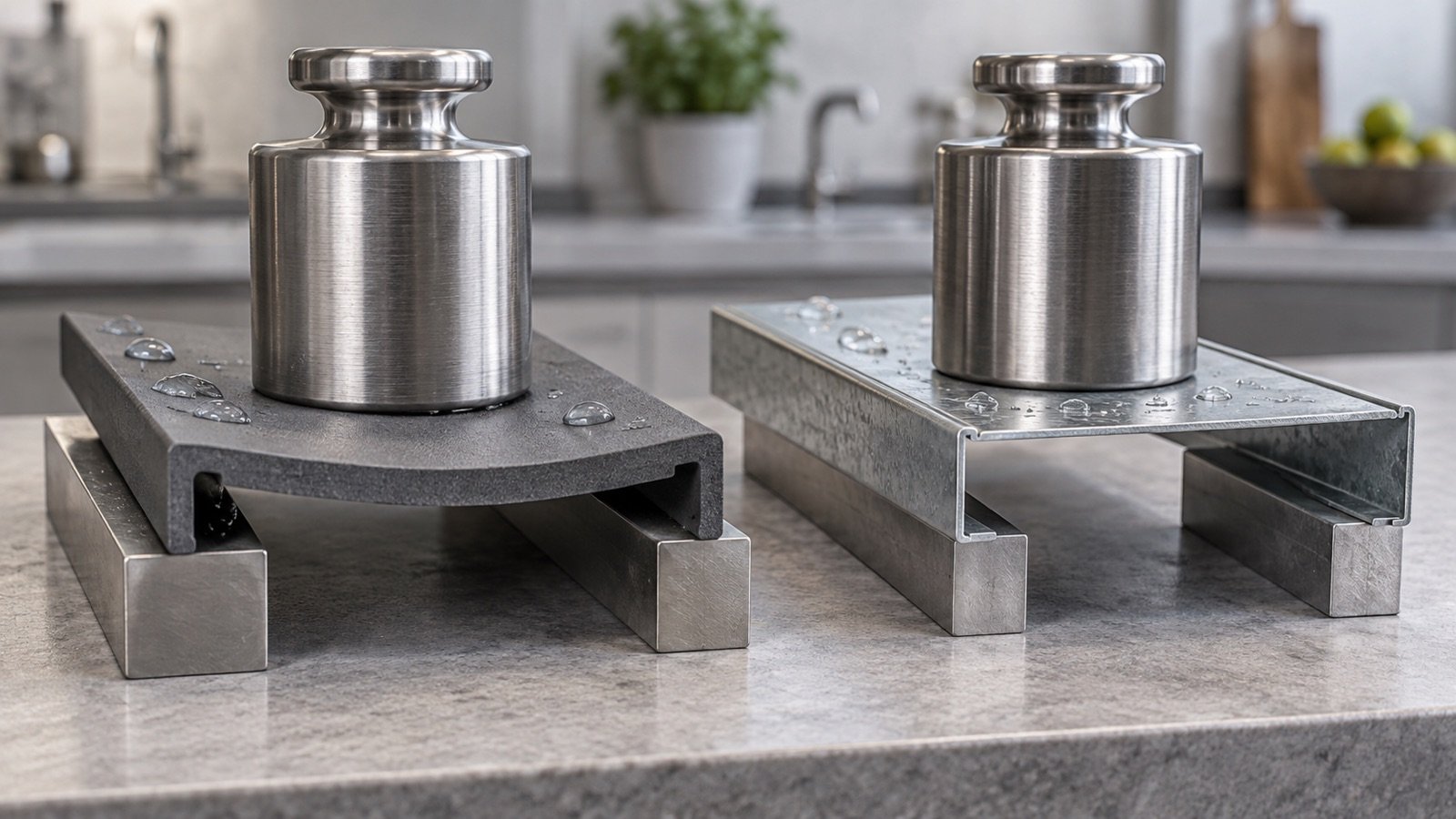
Metal vs WPC kitchen: the practical comparison
The table below sets out the factors that decide whether either material suits a particular module. Read it as a list of questions to ask, not as a scoreboard.
| Decision factor | WPC cabinet system | Metal cabinet system |
|---|---|---|
| Moisture | Tolerates water better than conventional wood-fibre boards, but the formulation and the full assembly still decide the outcome. | Stainless steel, aluminium and protected GI do not swell through water absorption; the grade and finish must still match the zone. |
| Termites | Commonly chosen because it is not conventional timber and is not a preferred food source. | Metal is not a termite food source. |
| Stiffness and spans | Depends on density, thickness, profile geometry, reinforcement and shelf span. | Folded panels, returns and planned reinforcement create a rigid fabricated module. |
| Fastening and repair | Screw holding depends on density, fixing zone and how often a point is reused. | Engineered threaded inserts create repeatable fixing points for assembly and service. |
| Heat exposure | Polymer-rich products can respond to temperature; follow the maker’s limits near heat sources. | Metal is fire-resistant, though finishes, seals and nearby materials still matter. |
| Finish | Various colours and surface treatments, depending on the product. | Supports colour, texture, glass, wood-look and visible-metal finishes for residential design. |
| Verification | Confirm manufacturer, formulation, thickness, profile, reinforcement and written warranty. | Confirm metal grade, thickness or profile, finish, fastening, fabrication and written warranty. |
The table leads to one conclusion: the material name is only the starting point. A WPC cabinet with a thin hollow skin and no reinforcement can sag under a load that a modest metal shelf carries comfortably, while a metal cabinet assembled out of square will fight every hinge fitted to it. In both cases the sheet is rarely the weakest link — the detailing is.
Stiffness, unsupported spans and heat exposure
A shelf does not fail because it is made of “WPC” or “metal”. It fails because the load, the span and the support were never matched. A short spice shelf, a pantry shelf stacked with grain, and a tall shutter carrying a glass front all test a material in different ways. The design question is how much the finished panel moves under its real load.
WPC stiffness rises with density and falls with hollow voids. Where a profile is light, the designer may shorten the unsupported span, add a central support or specify a thicker wall. Pressing a sample down with one finger tells you very little; ask instead about a full-width installed shelf carrying its intended load.
Fabricated metal gains rigidity from geometry — folds, returns, ribs and the way a panel locks into the cabinet sides. Shape matters more than raw thickness, which is why two similar-looking steel shelves can behave differently. Ask to operate a finished wide shelf and a loaded drawer, and watch whether the cabinet stays square as they move.
Heat is the second variable. Polymer-rich products can soften or distort if they sit too close to a hob, a built-in oven or a hot service line, so respect the maker’s temperature limits and leave proper clearance. Metal is correctly described as fire-resistant — it does not feed a fire the way a combustible board can — but that is not a certified fire rating, and nearby finishes, seals and accessories still deserve attention.
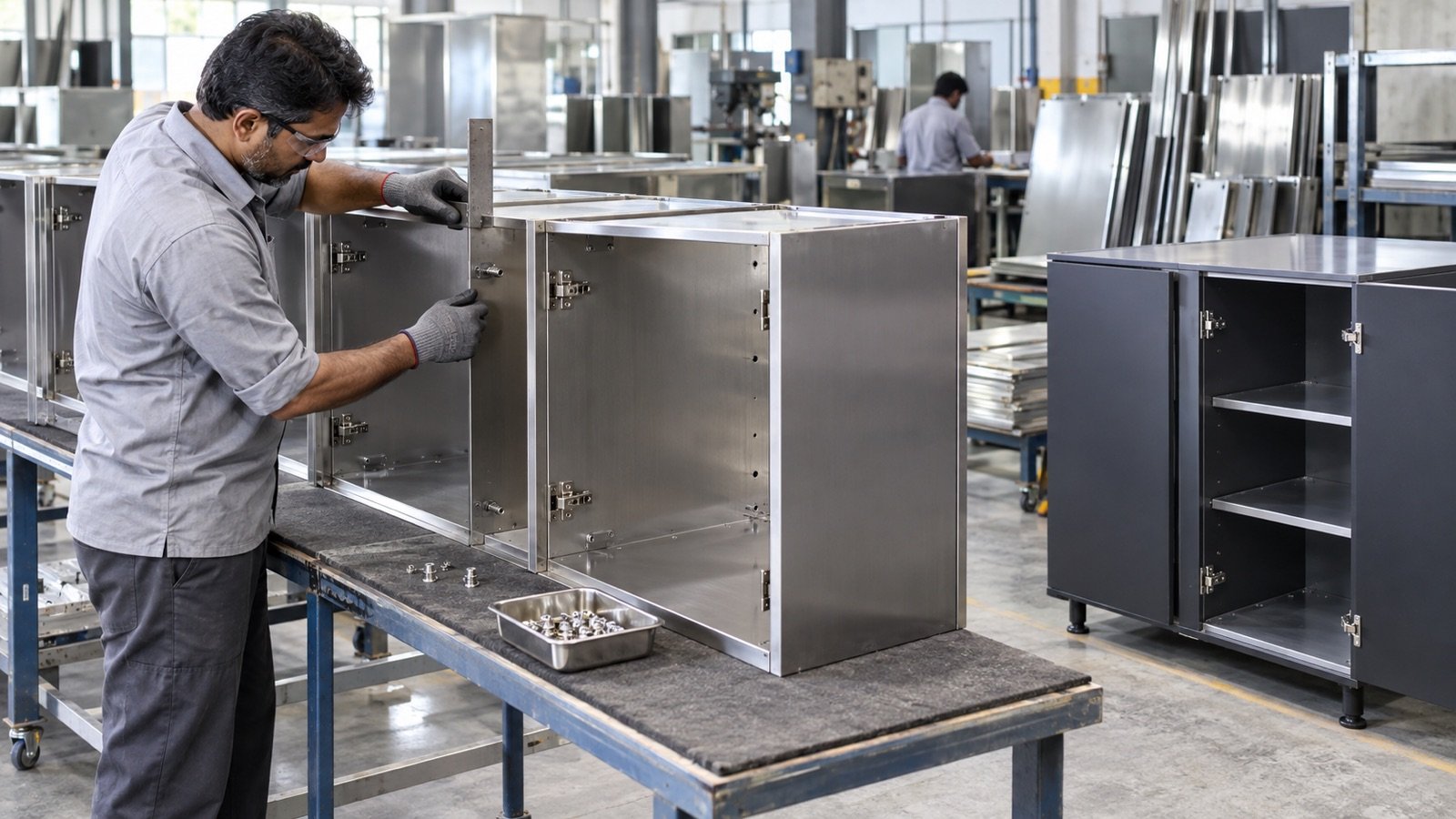
Fastening, hardware and repairability
Hinges, drawer channels and shelf pins are the parts of a kitchen that move, and moving parts get adjusted. In WPC, screw holding depends on density, the fixing zone and how often the same hole has been reused. If a screw bites only into a thin skin, a routine hinge adjustment can strip the fixing and leave the door loose.
Metal & More Interiors uses an Insert Nut Fastening System across its fabricated modules. A threaded insert forms a controlled connection in the metal body, so a matching fastener can be unscrewed and re-fitted during service without slowly destroying the surrounding material. The system supports repeatable assembly, and it still relies on accurate hole position and a square cabinet.
Repairability separates a kitchen that lasts from one that is replaced wholesale. Ask how a single damaged door, drawer or shelf is removed, and whether the fixing point will accept a new screw in the same location. In a metal module the answer is usually a swap and a re-fix, with the surrounding cabinets left untouched.
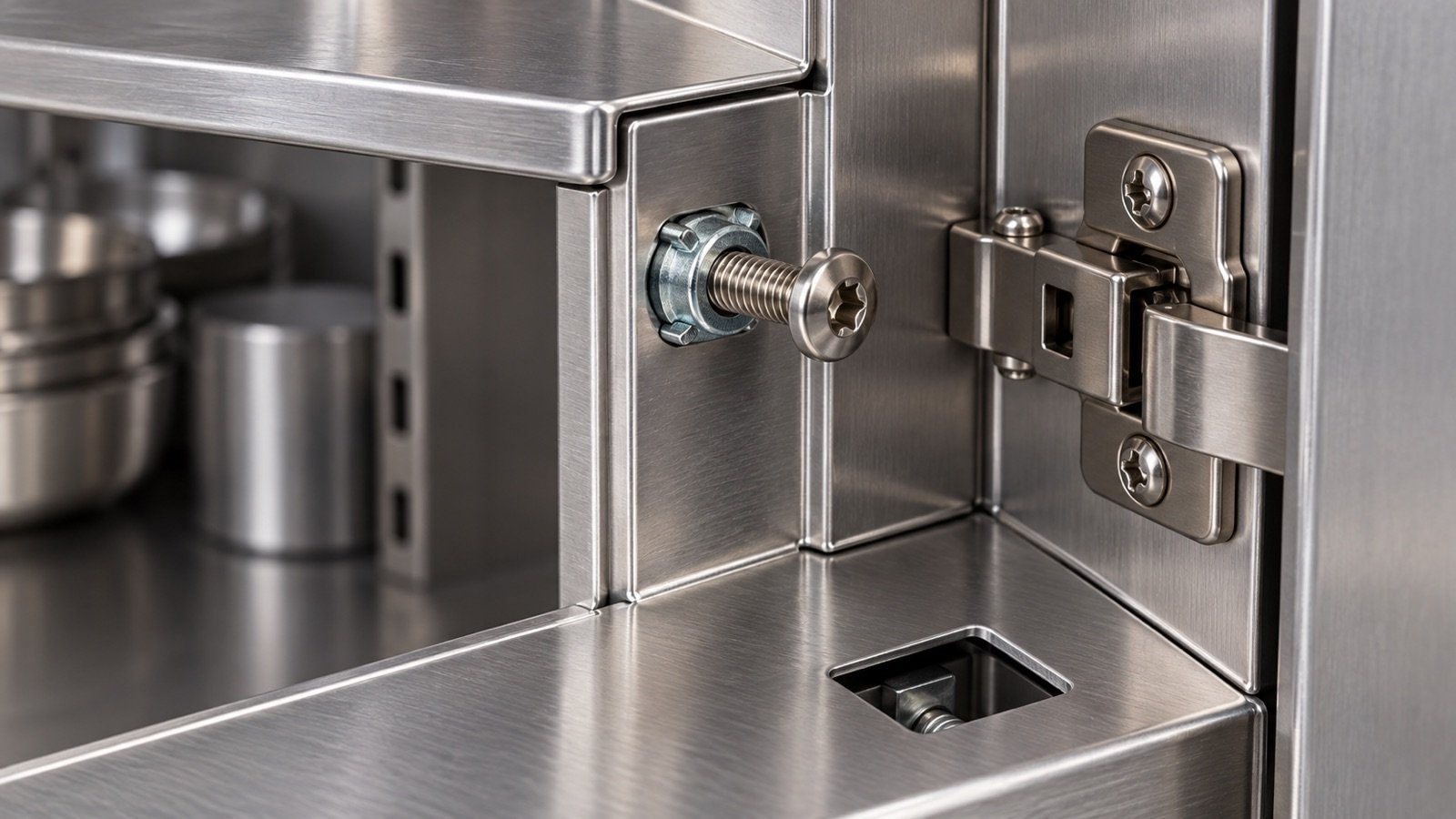
Look past the hardware logo when you compare quotations. Open a shutter fully, inspect the hinge plate, pull a loaded drawer and check the internal corner. A premium hinge mounted to a weak or hollow fixing zone cannot rescue the door; the cabinet and the hardware have to work as one system.
Sink bases, utility zones and floor-level cabinets
The sink base is the fairest test of any kitchen material. It carries plumbing connections, cleaning chemicals, daily opening and the chance of a slow, unseen leak. A dishwasher bay adds warm damp air and hose connections, and a utility or laundry cabinet adds yet another source of splashes. Judge these zones separately from a dry overhead unit.
Plan a removable service panel, accessible shut-off valves and a clear line of sight to the drain trap. Do not seal a purifier connection or a flexible hose behind a fixed board that must be cut open later. A cabinet floor that wipes clean and does not trap water against the wall is worth more than a decorative interior.
Both WPC and metal avoid the swelling pattern of a soaking fibre board, but neither removes the need to control moisture. Aggressive cleaners can still mark metal finishes, and unsuitable chemicals can dull a WPC skin. Fix the source of any leak promptly and follow the written care guidance for the material that was actually installed.
How Metal & More Interiors builds differently
Metal & More Interiors fabricates metal interiors in Hyderabad and manufactures SS304, aluminium and GI cabinetry in-house at B.N. Reddy, Charlapally. That in-house control runs from site measurement and shop drawings through fabrication, pre-assembly, quality checks and installation, which is where a metal kitchen earns its advantages over a catalogue kit.
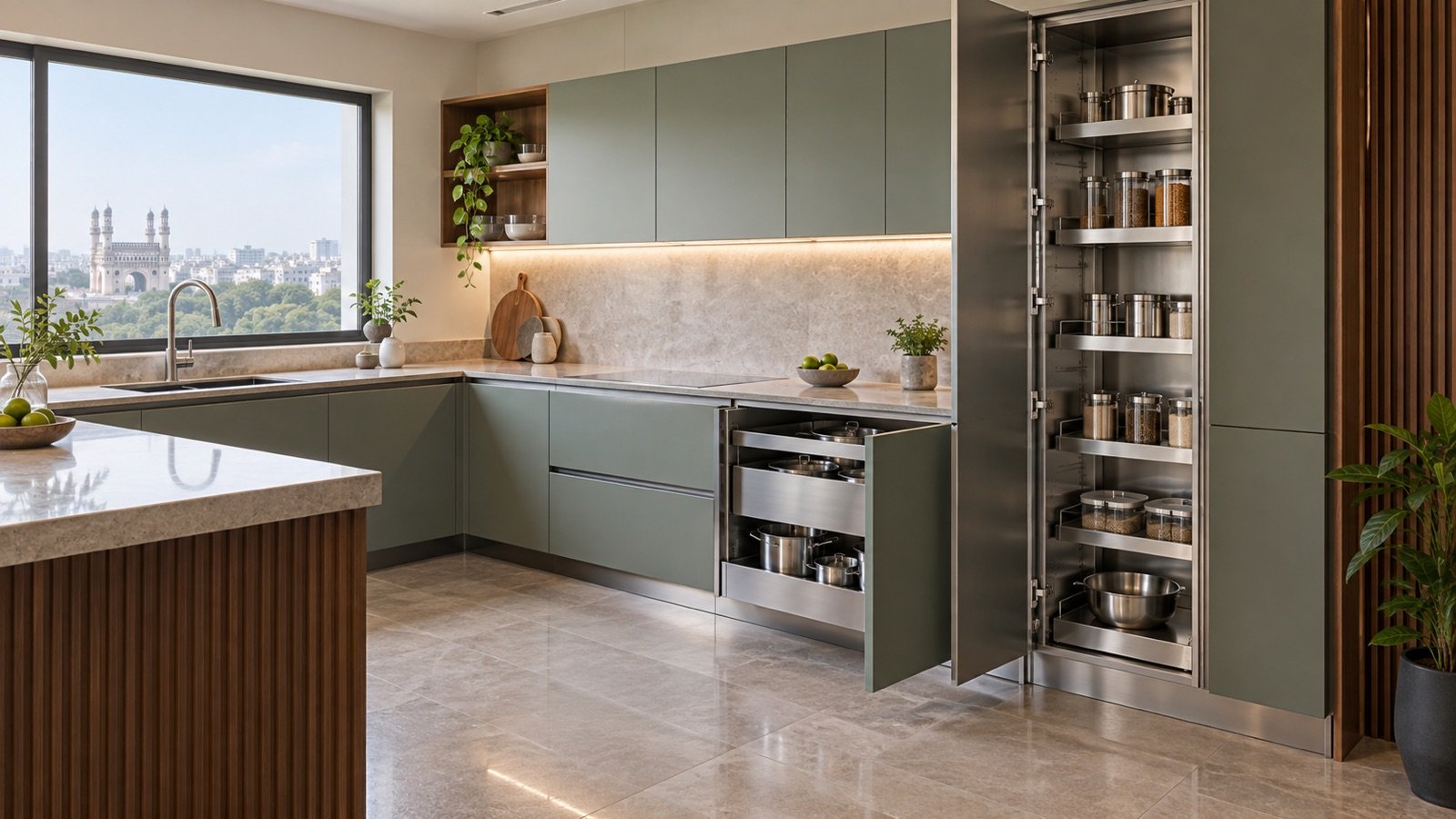
The approved carcass and shutters are metal unless a customer deliberately chooses a documented mixed-material configuration. Kitchen and wardrobe depth is planned around 2 feet where applicable and then adjusted for the wall, countertop, appliances, shutter clearance and circulation. Folds, reinforcement and insert-nut fixing points are designed into each module rather than added afterwards.
Warranty follows the material schedule: lifetime on stainless steel and aluminium and 15 years on GI, subject to the written project terms. Hettich hardware can be specified where a project selects it and is not assumed for every fitting. Metal is termite-proof as a material, does not absorb water and is easy to wipe clean; the accurate safety description is fire-resistant.
A metal kitchen need not look industrial
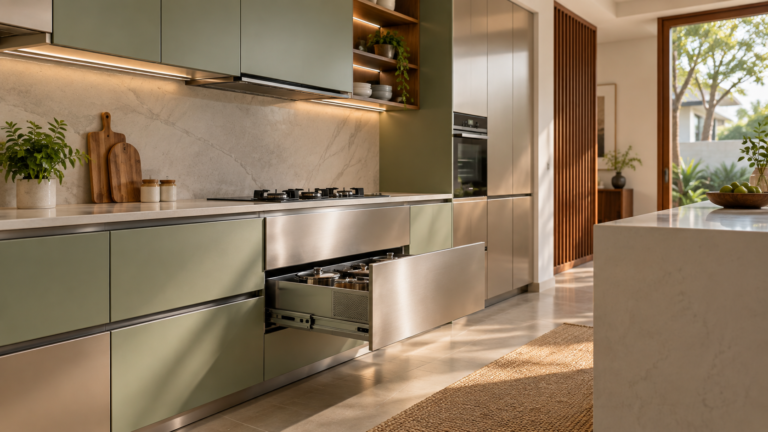
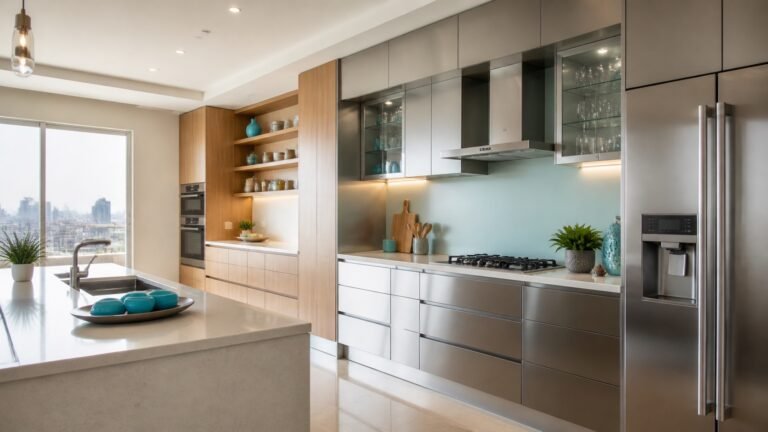
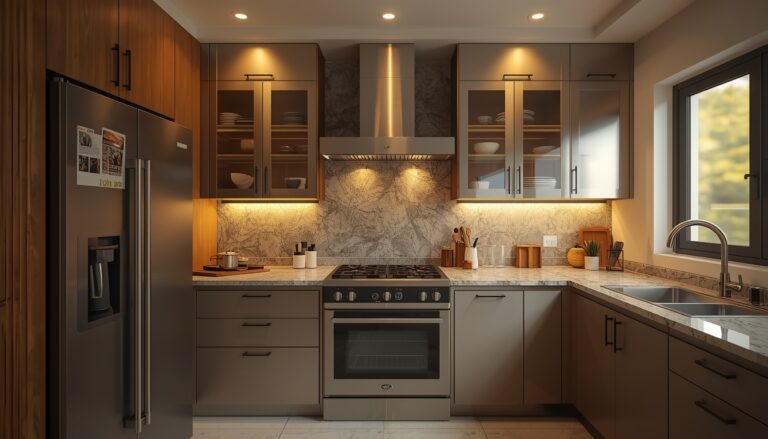
The commonest objection to metal is an image of a commercial canteen. Residential metal interiors can carry soft colours, matte and textured surfaces, wood-look finishes, glass, fluted panels and handleless profiles. The metal is the structure behind the elevation; the visible face follows the interior brief.
Choose finishes under the light that will actually fall on them. You can compare colour and surface options in the 3D Finish Studio before requesting a detailed quotation. Check shutter gaps, end panels, fillers, loft lines and ventilation around appliances. Dark surfaces show dust differently from pale ones, and glossy faces show fingerprints sooner, so match the finish to the household’s cleaning habits as much as to the mood board.
The same logic extends past the kitchen. Vanities, crockery units, utility storage, wardrobes and full-home interiors can all use a metal body where a room calls for durability, each with its own depth, load and ventilation plan rather than a copied kitchen module.
WPC kitchen disadvantages and the searches that matter
Homeowners searching for WPC kitchen disadvantages are usually trying to understand stiffness, heat response, screw holding and how one WPC formulation differs from another. Those are better questions than asking whether every WPC product is simply good or bad. A solid panel, hollow profile and foamed sheet can carry loads differently, so the quotation should name the product and show how wide shelves and hinge zones are reinforced.
A useful WPC vs steel kitchen cabinets comparison also separates water resistance from structural serviceability. WPC can perform well around moisture when its formulation and joints are appropriate. A fabricated metal carcass is non-absorbent and can use threaded insert-nut fixing points for repeat access. The best kitchen cabinet material in Hyderabad depends on the room, cabinet span, wet zone, heat clearance and expected service life.
People looking for a termite-resistant metal kitchen should remember that stainless steel, aluminium and GI are not termite food sources, while the condition of surrounding timber and walls still deserves inspection. Choosing a metal modular kitchen manufacturer in Hyderabad also makes factory control, material traceability and after-installation service relevant parts of the decision.
Choosing between SS304, aluminium and GI
SS304 stainless steel
SS304 is the strongest choice for demanding wet zones: it is corrosion resistant, hygienic and non-porous, and it fabricates into a rigid body. Confirm the grade and finish, clean with suitable products and avoid steel wool or chloride-heavy cleaners that can mark the surface.
Aluminium
Aluminium is light, corrosion resistant and works across kitchens, wardrobes and storage. Its performance depends on the alloy, the profile and the reinforcement behind each fixing. It accepts quiet residential finishes without advertising that it is metal.
GI
Galvanised steel carries a zinc protective layer and is normally supplied with a finished surface. Check that the coating is continuous and that cut edges and care instructions are clear. Metal & More Interiors provides a 15-year warranty on GI under the written project terms.
Before deciding, review the relevant service pages: stainless steel modular kitchens, aluminium modular kitchens in Hyderabad and the modular kitchen gallery. Homeowners weighing other boards can read the metal vs MDF kitchen and metal vs HDHMR kitchen comparisons.
How WPC and metal age over the years
A kitchen changes as it ages. Doors drift, channels loosen, a seal fails and a shelf quietly takes on more weight than it was sold to carry. The material that copes best is not the one with the loudest claim, but the one whose fixing points, surfaces and joints can be maintained.
WPC tends to keep its shape in dry, well-ventilated cabinets, but a profile near a heat source or under a persistent drip can discolour or lose stiffness, and its fixing points are only as strong as the material around them. Metal resists those moisture and termite failures, yet it, too, asks for correct coatings, sensible cleaners and hardware loaded within its range.
Design for the fifth year, not only for the day of installation. Keep services reachable, allow a damaged module to be swapped, and choose a finish that survives the household’s real cleaning routine. A kitchen that can be repaired and serviced is the one that stays in use.
How to compare WPC and metal quotations
Two quotes can look similar on a one-page layout while describing different kitchens. Normalise the scope before comparing totals: count the base, wall, tall and loft units, then list carcass material, shutter material, finish, hardware series, baskets, end panels, transport, installation, service access and warranty.
For a WPC item, ask for the manufacturer, product name, grade, thickness, solid or hollow construction, reinforcement, edge treatment and fastener method. For a metal item, ask whether each module is SS304, aluminium or GI, then record thickness or profile, finish, fold or frame construction, reinforcement, the Insert Nut Fastening System and the warranty.
Request a signed drawing and material schedule after site measurement, and check internal dimensions rather than only overall width, because folds and profiles reduce usable space. Confirm clearances for the refrigerator, dishwasher, chimney, gas line, purifier, windows and doors, and ask how future service will be handled.
- Name every carcass and shutter material, room by room.
- Confirm wet-zone, heat-zone and floor-contact details.
- Check unsupported shelf spans and any reinforcement.
- Inspect hinge, channel and handle fixing points.
- Keep plumbing and electrical services reachable.
- Approve finish samples under the home’s lighting.
- Record warranty coverage and exclusions in writing.
- Operate a finished sample and inspect its interior.
For formal product compliance, ask the supplier which Indian Standard applies to the specified material and verify published information through the Bureau of Indian Standards. A category name alone is not evidence of certification.
Frequently asked questions
Is WPC completely waterproof?
No single material makes a whole cabinet waterproof. WPC tolerates water better than ordinary fibre boards, but joints, trims, adhesives, hardware and service cut-outs still belong to the assembly. Ask for the maker’s data and warranty rather than treating one claim as covering the entire kitchen.
Does metal feel industrial?
It does not have to. Residential metal kitchens use warm colours, matte or textured finishes, wood-look shutters, glass and handleless profiles. The metal forms the body, while the visible face is chosen for the interior.
Which material handles termites better?
Stainless steel, aluminium and galvanised steel are not a food source for termites. WPC is also often chosen for termite resistance because it is not conventional timber, but the surrounding walls, plinth and any timber trim should still be inspected.
How should I choose between aluminium, GI and SS304?
Match the metal to the zone, the load, the finish and the warranty you expect. SS304 suits wet, heavy-use areas, aluminium suits light corrosion-resistant storage, and GI is a galvanised option with a finished surface. The choice is confirmed after the room is measured.
Can a metal cabinet be repaired later?
Yes, and that is part of the point. Threaded insert-nut fixing points let hardware be loosened and re-fitted, and a damaged door or shelf can be replaced without disturbing the cabinets around it. Good service access keeps small problems small.
Final decision
Treat metal vs WPC kitchen as a decision framework rather than a contest of labels. WPC can be sensible where its grade, thickness, profile and fixing zones are specified for the module, and metal is compelling where the priority is a non-absorbent, termite-proof body with engineered, serviceable connections. Either one still depends on correct design, fabrication and installation.
The next practical step is to compare written specifications and inspect a finished module. Metal & More Interiors can measure the room, review the wet zones, loads, appliances and service points, and recommend SS304, aluminium, GI or a documented mixed-metal configuration. The office is at Jai Jawahar Nagar, Yapral Ammuguda Road, Secunderabad, and manufacturing is at B.N. Reddy, Charlapally.