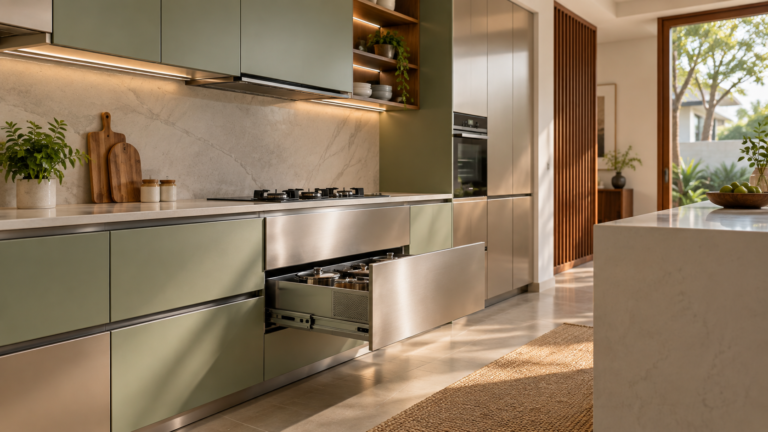
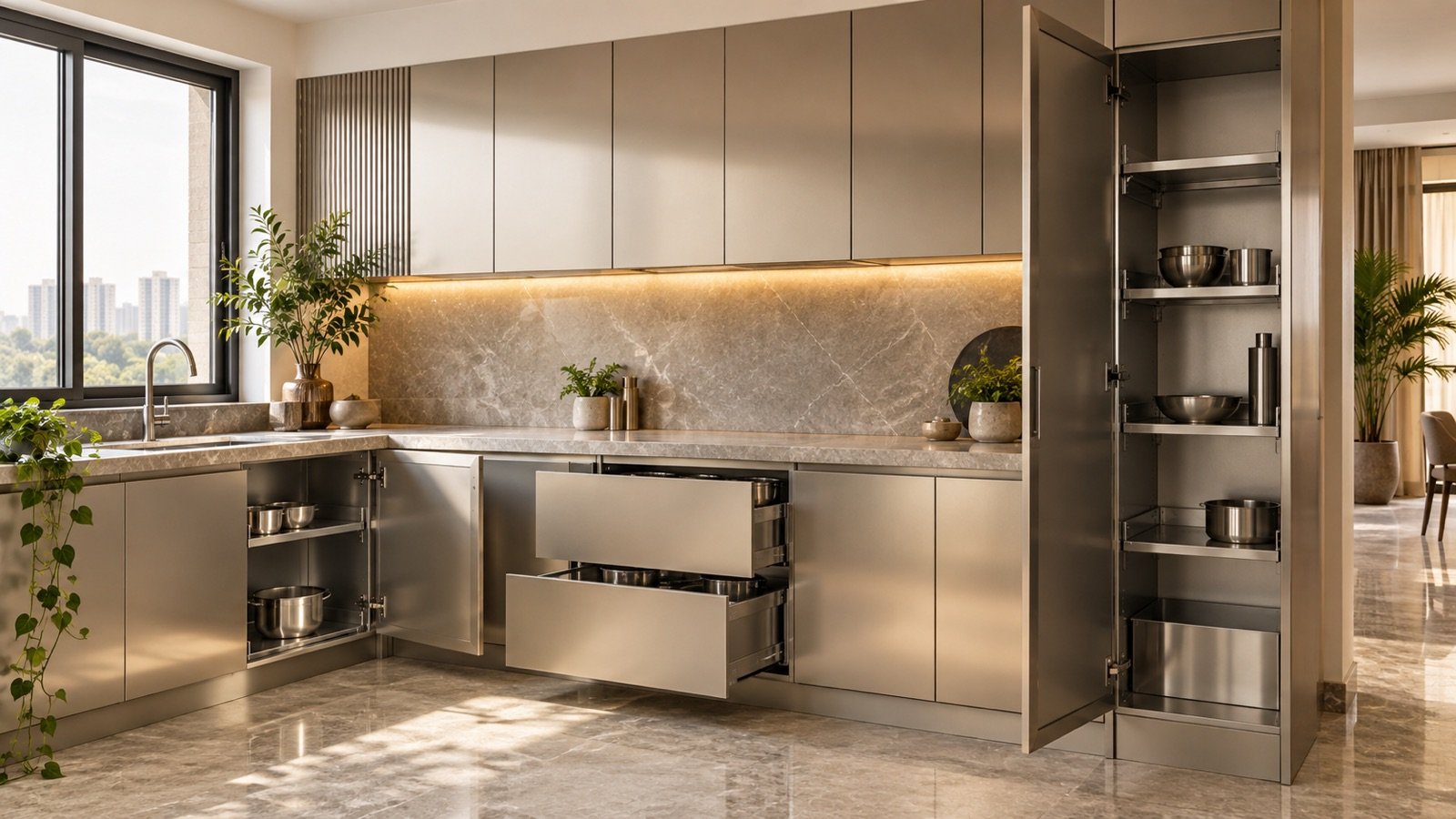
A metal vs HDHMR kitchen decision is usually framed around moisture, but moisture resistance and water tolerance are not the same property. HDHMR improves on ordinary MDF in density and humidity performance, while fabricated metal cabinetry removes the absorbent board from the cabinet body altogether. The better choice depends on the module, the wet zones, expected loads, screw-holding demands and how long the kitchen must stay serviceable.
HDHMR entered Indian kitchen conversations as an answer to swelling MDF, so homeowners now meet it while reading quotations or replacing a water-damaged carcass. The label is only useful when the board grade, edge sealing, fastener support and warranty are also clear, because two kitchens can both say “HDHMR” and still behave very differently.
This guide explains metal vs HDHMR kitchen construction for Hyderabad homes without price claims or blanket promises. It works through what HDHMR actually is, how density and screw holding behave, where moisture reaches a cabinet, and how a fabricated metal system answers those same demands. Metal & More Interiors designs and manufactures metal interiors in-house at B.N. Reddy, Charlapally, with its office at Jai Jawahar Nagar, Yapral Ammuguda Road, Secunderabad.
Quick answer
HDHMR is a high-density, high-moisture-resistance engineered fibre board. It holds screws better than ordinary MDF and tolerates humidity for longer, but it is still a wood-fibre product that can be damaged by sustained water at an exposed edge or cut-out. Metal cabinetry changes the failure mode rather than the coating: a fabricated stainless steel, aluminium or galvanised steel body does not swell by absorbing water and is not a termite food source.
Neither material removes the need for correct design. HDHMR depends on board grade, edge sealing, joint protection and hardware support. Metal depends on the grade selected, coating continuity, fold and reinforcement detail, accurate fabrication and serviceable fixing points. The honest comparison is made module by module, not as a single verdict for the whole kitchen.
Start with the positions that actually fail in a working kitchen: the sink base, the dishwasher bay, floor-level units, wide pantry shelves and any cabinet near a plumbing or condensation source. Once those are named, it becomes clear where an engineered board is sufficient and where a non-absorbent metal body earns its keep.
Understand HDHMR before comparing
HDHMR stands for high-density high-moisture-resistance board. It is produced by compressing wood fibre with resin under higher density and pressure than standard MDF, which raises internal bond strength and improves how the panel behaves as humidity rises and falls. In a normal kitchen this shows up as better dimensional stability and stronger resistance to screw pull-out than a low-density board would offer.
The improvement is relative, and that qualification matters. HDHMR is moisture resistant; it is not waterproof in the sense of being unaffected by water. Prolonged contact at a cut edge, a hinge cup, a screw hole or a scratched coating gives water a route into the fibre core. Once the core takes on water, swelling, softening and a loss of fixing strength can follow, and a swollen panel usually cannot be dried back to its original shape.
Grade and manufacturer therefore carry real weight. Density figures, resin content, sanding quality and edge integrity vary between suppliers, so two boards sold under the same HDHMR name can behave differently under identical conditions. Ask for the brand, thickness and grade rather than accepting the category word on its own.
- Which manufacturer and grade of HDHMR is specified in the quotation?
- How are cut edges, hinge cups and shelf-pin holes sealed?
- What protects the cabinet floor and the sink cut-out from standing water?
- Which hardware series is used, and how is it fixed into the board?
- What do the written warranty terms include and exclude?
- Can the panel underneath the sink be inspected or replaced without dismantling the run?
A supplier who can answer these points is describing a system. A supplier who answers only with the phrase “moisture resistant” is describing a category, and the two are not interchangeable.
Metal vs HDHMR kitchen comparison
The table below compares the two systems on the factors that decide how a kitchen ages. Each column describes a complete assembly rather than a single panel, because joints, fixings and finishes usually decide the outcome long before the base material does.
| Decision factor | HDHMR cabinet system | Metal cabinet system |
|---|---|---|
| Moisture | Higher moisture resistance than standard MDF, but sustained water at an exposed edge, cut-out or fixing hole can still reach the fibre core. | Stainless steel, aluminium and protected GI do not absorb water, so the panel does not swell at a cut edge; grade and finish must still match the zone. |
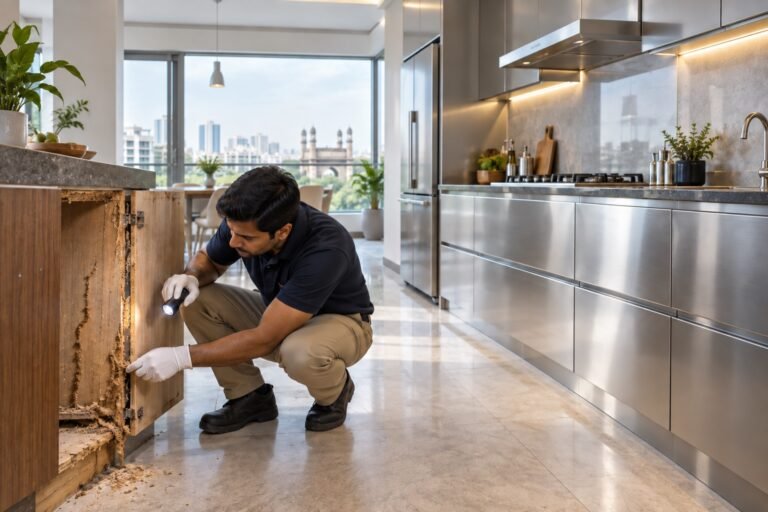
| Termites | A wood-fibre board, so it remains an organic material and the surrounding room and timber still deserve inspection. | Metal is not a termite food source. |
| Density and screw holding | Better grip and pull-out resistance than ordinary MDF; depends on grade, screw type, pilot hole and edge distance. | Engineered threaded inserts create repeatable fixing points for hinges, channels and future service. |
| Stiffness and spans | Depends on thickness, density and shelf support; wide unsupported spans need reinforcement. | Folds, returns, profiles and reinforcement give rigidity without relying on sheet thickness alone. |
| Fastening and service | A re-drilled or stripped screw hole weakens the connection, so adjustments must respect the core. | Insert-nut connections can be removed and refitted during service. |
| Heat | Fibre board needs clearance from heat sources and protection of exposed edges near hobs and ovens. | Fire-resistant as a material; the full assembly, finishes and nearby materials still matter. |
| Finish | Wide laminate, veneer and paint choices; performance depends on edge banding and surface sealing. | Supports colour, texture, powder-coat, glass, acrylic-compatible and visible-metal finishes. |
| Verification | Confirm manufacturer, grade, thickness, edge sealing, hardware and written warranty. | Confirm metal, thickness or profile, finish, fastening, fabrication and written warranty. |
Read the table as a set of trade-offs rather than a score. HDHMR wins on familiarity, machinability and the widespread availability of laminate and veneer finishes. Metal wins on non-absorbency, resistance to termite consumption and the option to design repeatable threaded fixing points into the module itself. Each of those advantages only appears when the system around it is built properly.
What “moisture resistant” really means
Moisture resistance describes how a board behaves as humidity rises and falls. Water tolerance describes what happens when liquid water sits against the panel for hours or days. HDHMR improves the first; it does not guarantee the second. That distinction explains why the same board can last well in a dry bedroom wall unit and still fail beneath a leaking sink.
Water reaches a cabinet in fairly predictable ways: a slow drip from a trap or supply line, water tracking along an unsealed countertop joint, wet mopping against a plinth, condensation on cold pipework, and overflow that is wiped up far too late. On an engineered board the vulnerable points are the exposed core at cut edges, screw and hinge holes, and any scratch through the surface finish. Sealing at installation is critical, and it can be undermined later by a fitter who drills a fresh hole without resealing it.
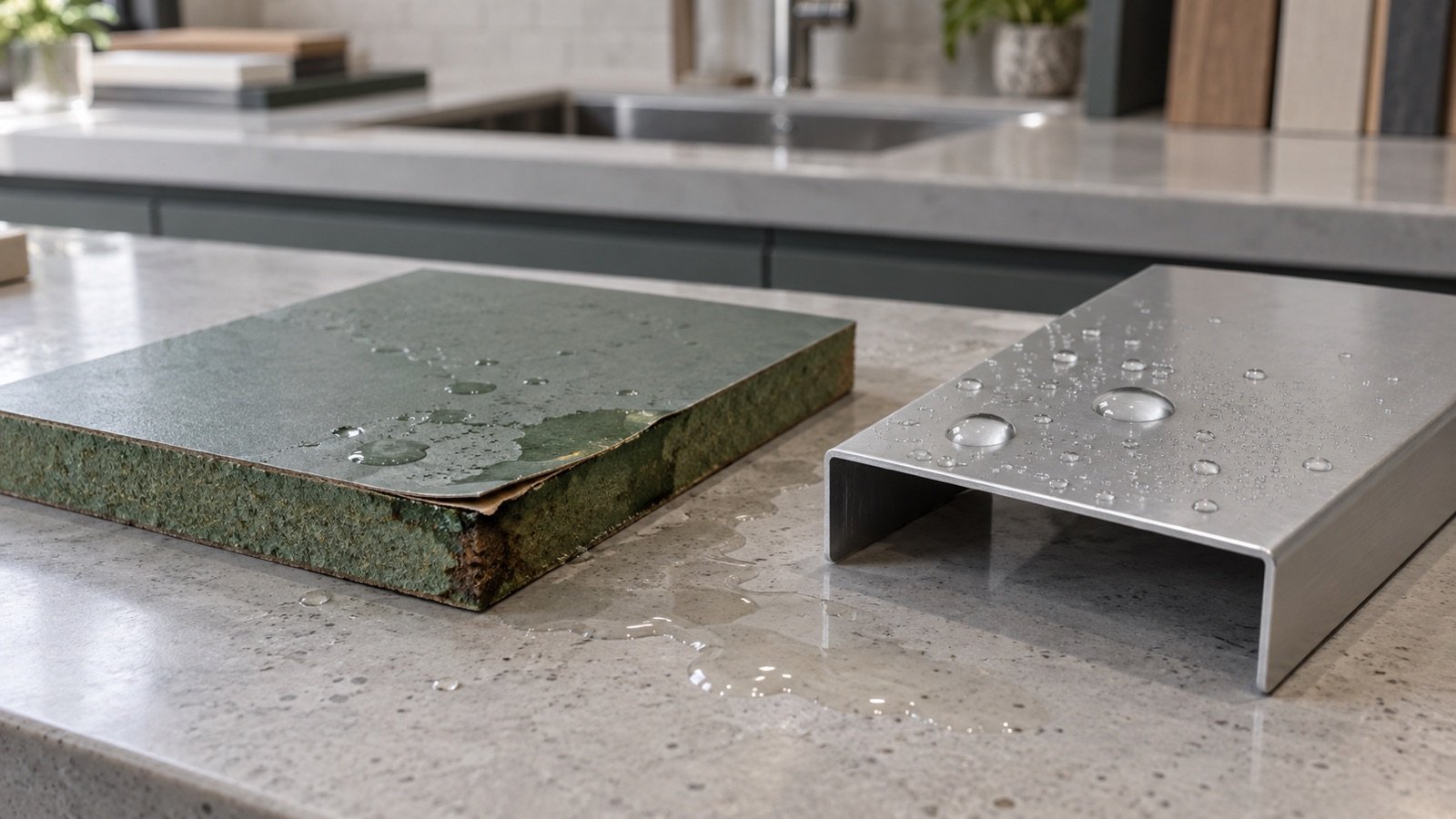
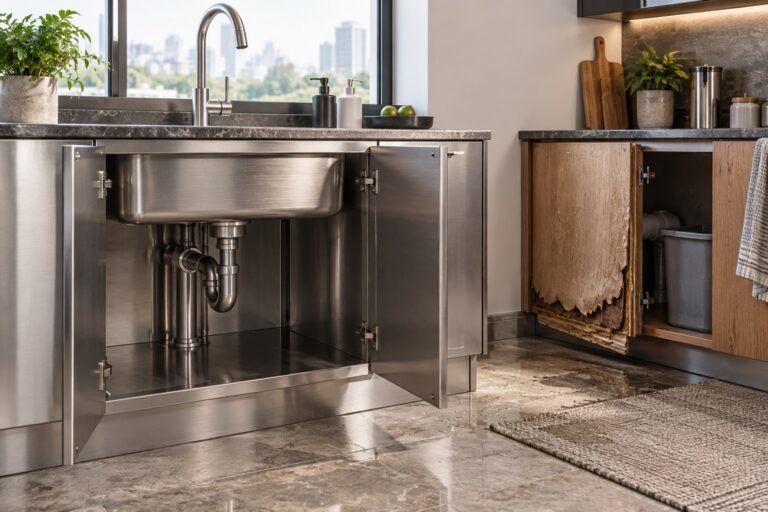
A metal body behaves differently under the same conditions. Stainless steel, aluminium and galvanised steel do not absorb water into their structure, so the panel does not swell or soften at a cut edge. That does not make the whole cabinet invulnerable. Hardware can corrode if it stays wet, trapped water can still damage the wall behind the cabinet, and unsuitable cleaners can stain an otherwise sound surface. The difference is that the failure mode shifts from “the board takes on water” to “the assembly must be kept dry and clean”, and only one of those is within the homeowner’s control.
Density, screw holding and load behaviour
Screw holding is where HDHMR earns its reputation. A denser core grips a screw more firmly than a low-density board, so hinges and drawer runners resist loosening better during everyday use. This matters because kitchen hardware is adjusted, loaded and occasionally removed for service, and a board that loses its grip at a hinge cup will let a door sag even when the hinge itself is perfectly sound.
Density is not the only variable, though. Screw holding also depends on the screw type, the pilot hole, the distance from the edge, whether the fixing enters the face or the edge, and how many times the same point has been disturbed. A dense panel can still strip if a fitter over-torques a screw, and re-drilling a failed point in the same place usually makes it weaker rather than stronger.
Unsupported span is a separate question from screw holding. A pantry shelf carrying grocery weight behaves very differently from a short cup shelf, and a tall shutter carries different loads again. For any board material, shelf width, thickness, edge support and expected load should be specified together. For metal, stiffness comes from folds, returns, profiles and reinforcement rather than from sheet thickness alone, so the fabricated shape and the way the panel joins the cabinet sides decide how little the shelf moves.
The only reliable test is a realistic one. Load a wide shelf, open a tall door fully, pull a loaded drawer and check whether the cabinet stays square under that load. A hand-pressed offcut in a showroom cannot reproduce the behaviour of an installed module carrying daily weight.
Fastening, hardware and future service
Hinges and drawer channels are the parts most likely to need adjustment over the life of a kitchen, so the quality of a cabinet depends as much on how the hardware is fixed as on the brand stamped on it. In HDHMR the fixing relies on the density of the core and the integrity of the screw hole, which means repeated adjustment, a stripped hole or a carelessly drilled hinge cup can each weaken the connection over time.
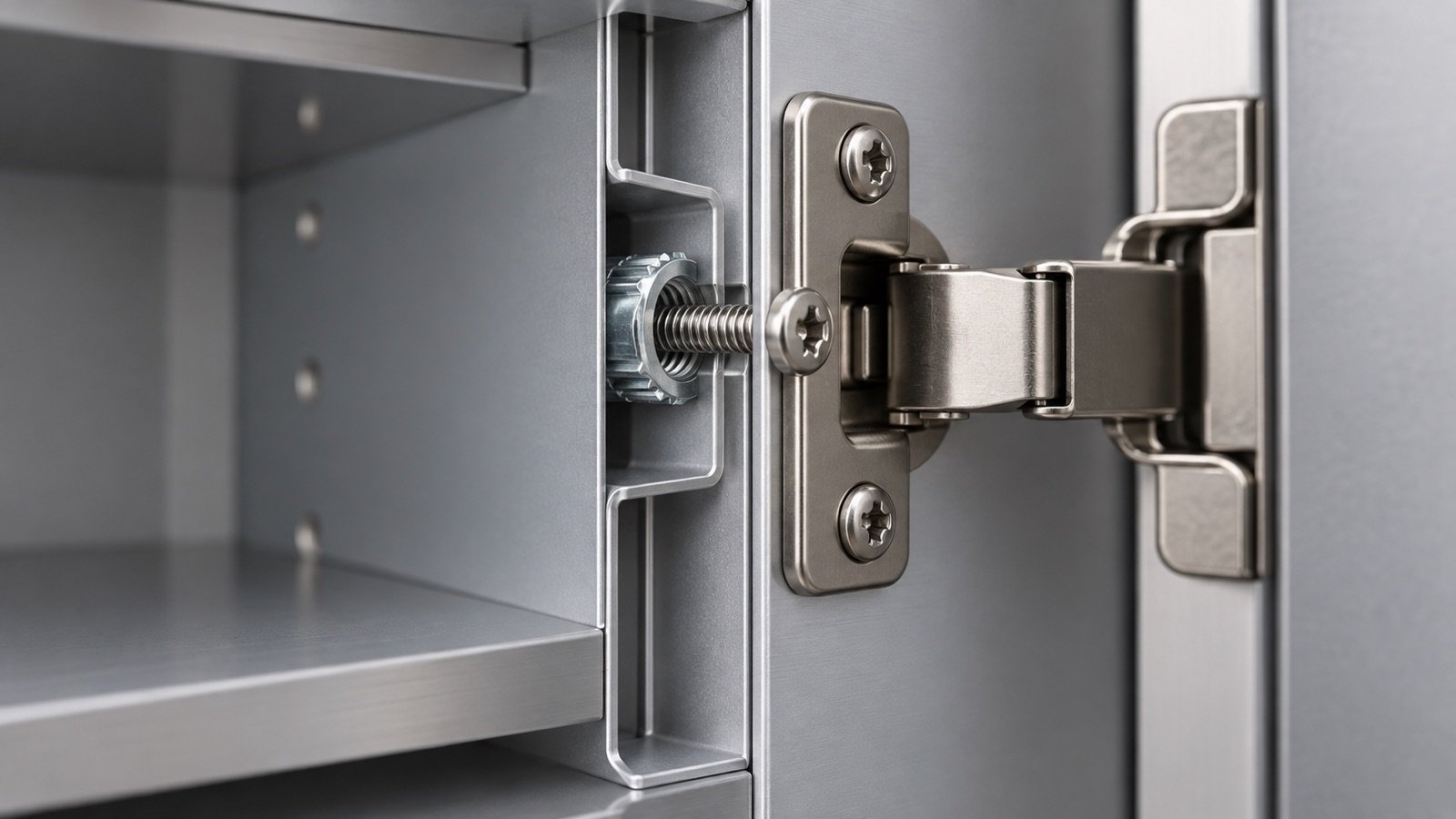
Metal & More Interiors uses an Insert Nut Fastening System in its fabricated modules. A threaded insert forms a controlled fixing point, so a compatible fastener can be removed and refitted during service instead of driving a screw into a fresh hole each time. The system is designed to support repeatable assembly; it does not replace accurate hole positions, cabinet squareness or correct hardware loading.
When comparing samples, look past the logo on the hinge. Open the door through its full arc, inspect the hinge plate, pull the drawer out to its stop, examine a corner joint and ask how a damaged part would be replaced. A premium hinge fitted to an unsupported fixing zone cannot perform as intended, and no hardware guarantee survives a fixing point that was never designed to hold it.
How Metal & More builds differently
Metal & More Interiors designs and manufactures metal interiors in Hyderabad, with SS304 stainless steel, aluminium and galvanised steel cabinetry fabricated in-house. The practical value of that arrangement is control: site measurement, shop drawings, fabrication, pre-assembly, quality checks and installation are handled by one team, so the cabinet body is built to the approved schedule rather than treated as a decorative skin over an unspecified core.
The selected carcass and shutters are metal unless a customer deliberately approves a documented mixed-material or mixed-metal configuration, and in that case the choice is recorded room by room so the finished build matches the design. Typical kitchen and wardrobe depth is planned around 2 feet where applicable, then adjusted for the wall, appliances, shutter clearance, services and room circulation.
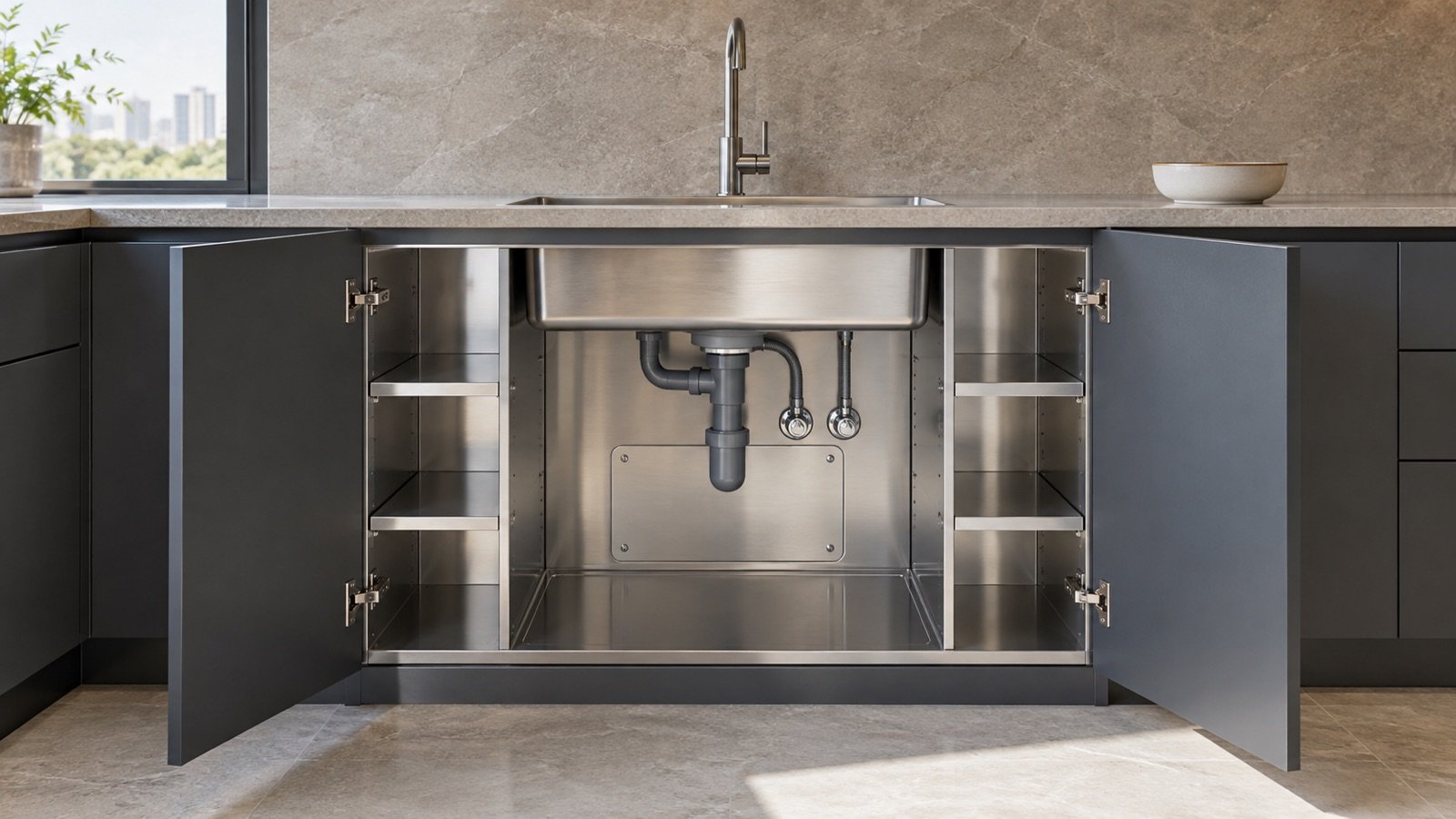
Warranty is tied to the chosen material: lifetime on stainless steel and aluminium, and 15 years on GI, subject to the written project terms. Metal is termite-proof as a material, non-absorbent and easy to clean, and the accurate safety description is fire-resistant, not a certified fire rating. Hettich hardware can be specified where selected; it is not claimed automatically for every fitting.
HDHMR vs aluminium kitchen: related buying questions
A homeowner researching HDHMR vs aluminium kitchen options is usually trying to solve three separate problems: moisture exposure, reliable fixing points and long-term maintenance. HDHMR improves on ordinary MDF, while aluminium provides a lightweight, corrosion-resistant and non-absorbent cabinet body. The right answer should still be tested against shelf spans, hardware loads, finish quality and access to services.
For searches such as best kitchen material for moisture or wet-area kitchen cabinet material, distinguish humidity from an active leak. A sealed engineered board can perform well in normal use, but prolonged water at a cut edge or hinge cup can reach the fibre core. Stainless-steel and aluminium cabinets are non-absorbent kitchen cabinets, so they do not swell in the same way; plumbing and hardware still need inspection and care.
People searching for a long-lasting modular kitchen in Hyderabad should compare the complete specification rather than one material claim. Ask for the carcass, shutter, finish, fastening, service access and warranty in writing, then inspect a finished sample under realistic load.
Choosing SS304, aluminium or GI
Where a metal body is chosen, the next decision is which metal suits each module. The three options differ in corrosion behaviour, weight, finish and cost, so a single kitchen may sensibly use more than one where the exposure changes from zone to zone.
SS304 stainless steel
SS304 is the premium choice for demanding wet zones because of its corrosion resistance, hygienic non-porous surface and robust fabricated construction. It suits sink bases, dishwasher bays and floor-level units where water is most likely to linger. Confirm the grade and finish, use appropriate cleaners, and avoid steel wool or harsh chloride-rich chemicals that can contaminate or mark the surface.
Aluminium
Aluminium is lightweight, corrosion resistant and useful across kitchens, wardrobes and storage. Profile design, alloy, reinforcement and fixing detail affect how it performs, so these should be specified rather than assumed. It can be finished to look refined and residential while keeping the non-absorbent cabinet body that drew the buyer to metal in the first place. A stainless steel modular kitchen and an aluminium specification can sit side by side in the same home for that reason.
GI
Galvanised steel uses a zinc protective layer and is normally paired with a finished surface. Coating continuity, fabricated edges and the care routine should all be clear before approval, because an uncoated cut edge is the weak point in any galvanised component. Metal & More Interiors provides a 15-year warranty on GI under the written project terms.
Explore the relevant pages before deciding: modular kitchen in Hyderabad, the metal vs MDF kitchen guide, the metal vs WPC kitchen guide and glass and acrylic finishes for metal interiors. Homeowners who want to see how a metal body takes a warm, residential treatment can also review physical finish samples before approving a palette.
Quotation and specification checklist
Two quotations can look similar on a rendering while describing very different cabinets inside. Normalise the scope before comparing totals: count the base, wall, tall and loft units; list the carcass and shutter material; note the finish, hardware series, baskets, end panels, transport, installation, service access and warranty. One quote may include items that another quietly defers to a later stage.
For an HDHMR quotation, ask for the manufacturer, grade and thickness, then confirm how cut edges, sink cut-outs and hinge cups are sealed, how shelf spans are supported, and what happens to the panel if a leak is discovered late. For a metal quotation, ask whether each module is SS304, aluminium or GI, then record the thickness or profile, finish, fold or frame construction, reinforcement, Insert Nut Fastening System and warranty.
- Identify every carcass and shutter material room by room.
- Confirm wet-zone, heat-zone and floor-contact details.
- Check unsupported shelf spans and how they are reinforced.
- Inspect hinge, channel and handle fixing points on a finished sample.
- Keep plumbing and electrical service points accessible.
- Approve finish samples under the home’s actual lighting.
- Record warranty coverage and exclusions in writing.
- Operate a finished module and inspect its interior construction.
Request a signed drawing and material schedule after site measurement, and check internal dimensions rather than overall width alone, because hardware, folded edges and profiles change the usable storage inside a module. Confirm clearances for the refrigerator, dishwasher, chimney, gas line, purifier, windows and doors. If the finished specification is unclear, it is worth using the talk to the team option to get the schedule explained before anything is ordered.
For formal product compliance, ask the supplier which Indian Standard applies to the specified material and verify published information through the Bureau of Indian Standards. A category name alone is not evidence of certification.
Frequently asked questions
Is HDHMR waterproof?
It is moisture resistant rather than waterproof. HDHMR tolerates humidity better than ordinary MDF, but a cut edge, hinge cup or damaged surface left in contact with water can still let the fibre core take on moisture. Sealing and prompt repair of leaks remain important.
Is HDHMR stronger than MDF?
High-density grades generally offer greater internal bond strength and better screw holding than ordinary MDF, which helps hinges and runners stay firm. Whether that improvement is enough depends on the exact grade, the module and the load it must carry.
Why consider metal if HDHMR is moisture resistant?
Metal changes the failure mode instead of only slowing it. A fabricated stainless steel, aluminium or galvanised steel body does not absorb water and is not a termite food source, so the cabinet does not depend on coatings and edge sealing to protect an absorbent core.
Can HDHMR and metal be mixed in one kitchen?
A mixed specification is possible when a homeowner deliberately chooses it, for example a metal sink base with board carcasses elsewhere. Every module’s material should still be documented room by room so the finished kitchen matches the approved design.
Which metal suits a wet kitchen zone best?
SS304 stainless steel is usually the strongest choice for sink bases, dishwasher bays and floor-level units because of its corrosion resistance and non-porous surface. Aluminium and galvanised steel can suit other positions once the exposure, load and finish are reviewed module by module.
What warranty applies to Metal & More metal cabinets?
The stated warranty is lifetime on stainless steel and aluminium and 15 years on GI, subject to the written project terms. Always review the selected material, coverage, care requirements and exclusions in the quotation.
Final decision
Use metal vs HDHMR kitchen as a decision framework rather than a contest between labels. Identify where water, termites and repeated fixing actually threaten the cabinets, inspect the hidden construction, and choose a system that can be serviced. HDHMR is a reasonable engineered board when its grade, sealing and support are specified honestly. Metal is compelling when the priority is a non-absorbent body, resistance to termite consumption and fixing points that survive repeated adjustment.
Whichever route is chosen, the quality of the outcome depends on the same discipline: measure the room, write down each material, protect the wet zones, keep services reachable, and confirm the warranty in writing. Metal & More Interiors can measure the room, review the failure point or storage need and recommend SS304, aluminium, GI or a documented mixed-metal configuration. The office is at Jai Jawahar Nagar, Yapral Ammuguda Road, Secunderabad, and manufacturing is at B.N. Reddy, Charlapally.