
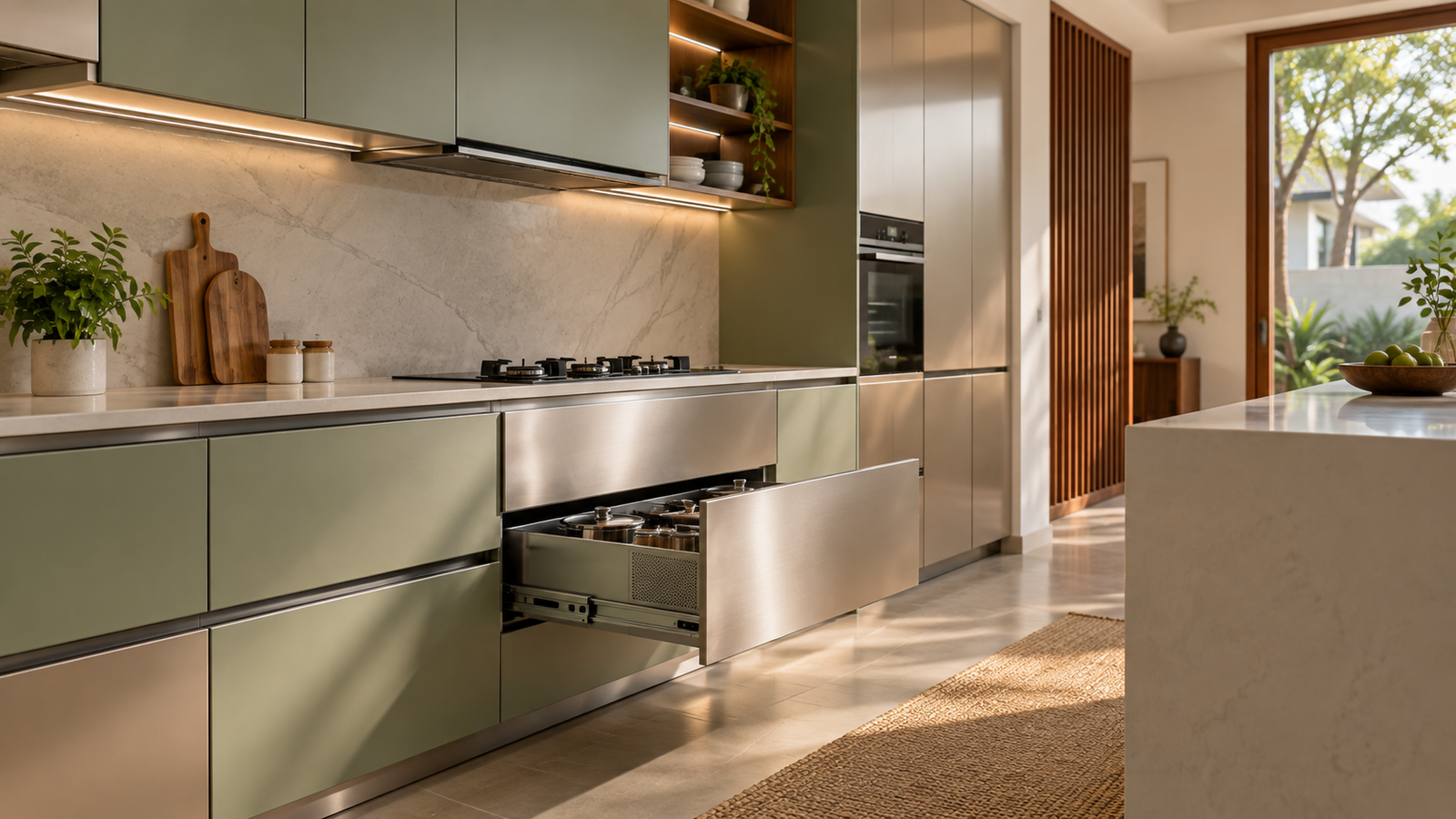
When planning a high-end kitchen renovation in Hyderabad, Bangalore, or Chennai, prospective homeowners frequently ask one critical question: are steel kitchen cabinets noisy? Visions of clanging restaurant kitchens, ringing sheet metal, and rattling utensil drawers often cause hesitation during material selection. Homeowners wonder whether choosing stainless steel over traditional plywood invites disruptive echoes into their living spaces.
Looking for quiet steel kitchen cabinets in Hyderabad? Compare SS304 and GI options, acoustic shutter construction and soft-close hardware, then request a room-specific estimate from Metal & More Interiors. Explore our stainless-steel kitchen range or use the instant kitchen estimate.
The definitive engineering answer is clear: genuine, precision-crafted steel kitchen cabinets are NOT noisy. In fact, when engineered with double-skinned sandwich panels, acoustic honeycomb or PU foam cores, and German hydraulic deceleration, a modern stainless steel kitchen operates at whisper-quiet sound levels under 25 decibels—consistently outperforming traditional plywood kitchens that creak, bind, and warp over time.
However, the question of why some people still ask are steel kitchen cabinets noisy comes down to the stark contrast between cheap single-sheet commercial fabrication and certified residential modular engineering. Not all metal cabinetry is built the same. In this definitive 2026 guide, we analyze the vibrational physics of metal, explain why uninsulated metal clatters, and reveal the proven acoustic soundproofing methods that make modern stainless steel kitchens exceptionally silent.

Table of Contents
- The Science: Why Are Steel Kitchen Cabinets Noisy in Commercial Setups?
- Double-Skin Architecture: How Acoustic Honeycomb & PU Cores Deaden Sound
- Hardware Deceleration: Why German Soft-Close Eliminates Shutter Slamming
- Are Steel Kitchen Cabinets Noisy in Indian Cooking Environments?
- Acoustic Benchmark Matrix: Insulated Steel vs. Commercial Metal vs. Plywood
- 7 Proven Ways to Ensure Steel Kitchen Cabinets Are Never Noisy
- Frequently Asked Questions
- Upgrade to Whisper-Quiet Luxury: Metal & More Interiors
The Science: Why Are Steel Kitchen Cabinets Noisy in Commercial Setups?
To understand whether are steel kitchen cabinets noisy in residential homes, one must look at vibrational acoustics and resonant frequencies. Sound is mechanical energy transmitted through pressure waves. When a metallic spoon, heavy kadhai, or ceramic plate strikes a sheet of metal, kinetic energy transfers directly into the material.
In low-cost commercial restaurant kitchens or budget utility setups, fabricators utilize thin, single-sheet 22-gauge (0.6 mm) or 24-gauge (0.5 mm) metal panels. These unbacked, single-wall metal sheets lack mass and damping. When struck, the thin metal acts exactly like a musical cymbal or gong: it flexes elastically and reverberates at high frequency, generating an unmistakable metallic ring that echoes across the room.
In contrast, premium residential cabinetry engineered by Metal & More Interiors avoids single-wall resonance altogether. By using heavy 0.8 mm (20-gauge) certified AISI 304 food-grade stainless steel from Jindal Stainless, formed with computer-numeric-control (CNC) folding, the metal structure possesses superior rigidity and mass. When rigid double-folded panels are bonded to internal acoustic core insulation, impact energy is converted into microscopic thermal energy within milliseconds. According to standardized Sound Transmission Class (STC) acoustic principles, this sandwich architecture dampens impact vibrations by over 85%.
Double-Skin Architecture: How Acoustic Honeycomb & PU Cores Deaden Sound
If you ask an architectural engineer are steel kitchen cabinets noisy, their immediate response will focus on shutter construction. The definitive boundary between a noisy metal cabinet and a whisper-quiet luxury installation is double-skin box-section shutter engineering.
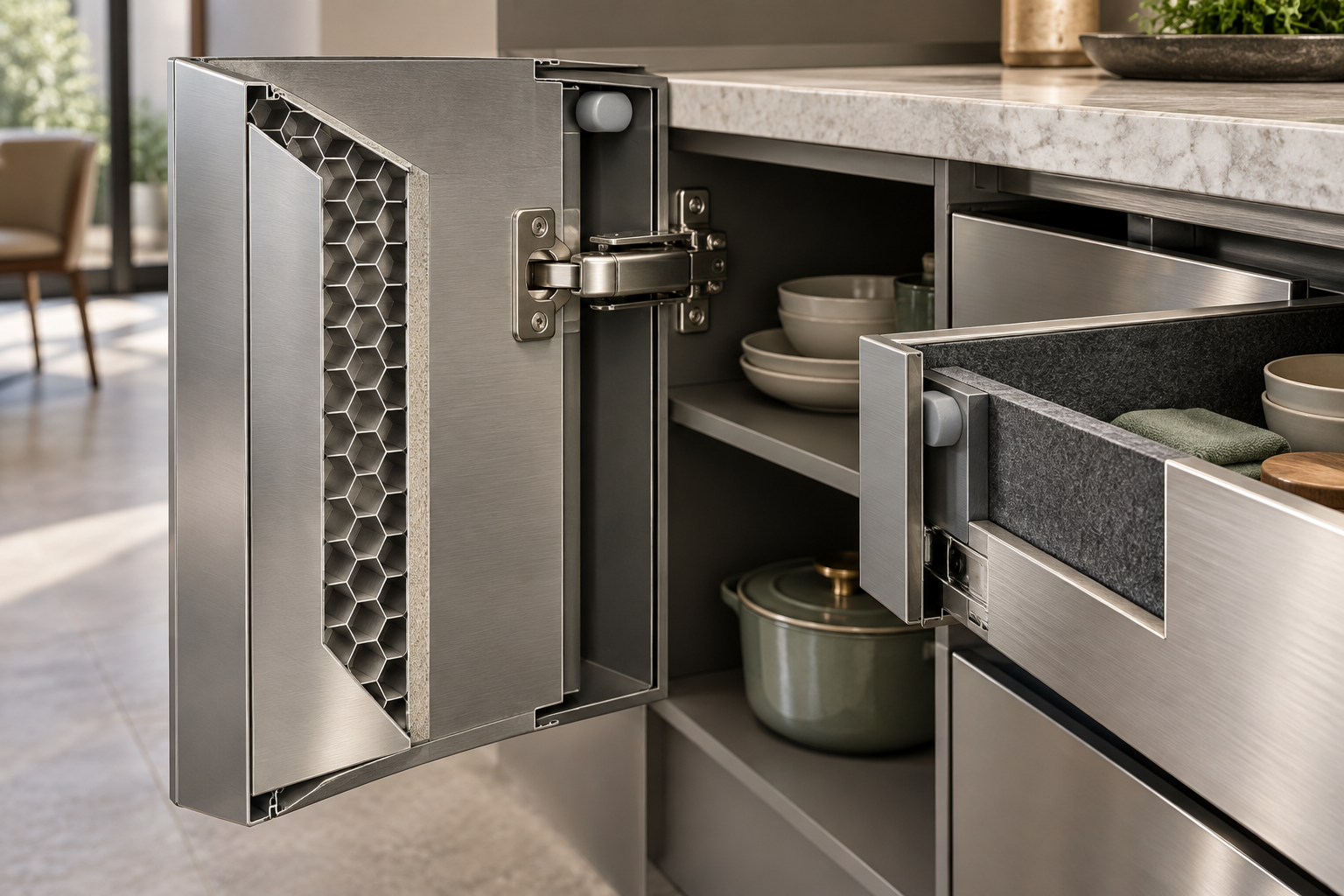
In bespoke residential manufacturing, cabinet shutters are never fabricated from a single sheet of metal. Instead, two precision-cut 0.8 mm sheets are folded into a rigid, double-walled perimeter box. The hollow interior between the two metal skins is then completely filled with specialized sound-deadening core materials:
1. High-Compression Hexagonal Honeycomb Core
Standard across all Metal & More shutter doors and shelves. Hexagonal cellular geometry traps sound waves in thousands of independent acoustic micro-chambers. This eliminates drum reverberation and imparts a reassuring, solid heft to every door without adding excessive dead weight to hinges.
2. High-Density Injected PU Foam Core Upgrade
An optional acoustic upgrade where high-density Polyurethane (PU) foam is thermally bonded between the metal skins. This monolithic foam core completely deadens sound transmission, producing a deep, muted thud comparable to closing the door of a premium German luxury automobile.
Essential Structural Specification: While shutter doors and horizontal shelves feature internal core filling for maximum acoustic deadening, cabinet carcass panels are fabricated from 0.8 mm Jindal SS304 or Galvanised Iron (GI) with CNC return flanges and internal stiffeners. This provides 100% termite-proof, fire-resistant rigidity without internal carcass filling, adhering to certified Indian Stainless Steel Development Association (ISSDA) standards for modular hygiene.
Hardware Deceleration: Why German Soft-Close Eliminates Shutter Slamming
In any kitchen environment—whether constructed from plywood, particle board, or metal—over 80% of perceived daily noise originates from two hardware movements: door slamming and drawer runner friction. When a heavy wooden shutter door slams shut without dampers, it generates an aggressive 75 to 80 dB acoustic shock.
To ensure that steel kitchen cabinets noise is completely eliminated, precision modular systems integrate certified German hardware:
- Integrated Hydraulic Soft-Close Hinges: Premium Hettich Sensys hinges incorporate concealed liquid dampers inside the hinge arm. As the shutter swings shut, the damper catches the door during the final 30 degrees of travel, gently decelerating its velocity to ensure a completely silent, zero-decibel closure.
- Synchronized Tandem Drawer Systems: Hettich InnoTech and AvanTech tandem drawer boxes feature concealed fluid dampers and synchronized gear tracks. Even when loaded with 35 to 40 kg of heavy brass utensils, cast iron pans, and spices, the drawers glide effortlessly with an operating sound level below 25 dB.
- Perimeter Silicone Dampening Studs: Food-grade silicone and neoprene buffer pads are recessed into cabinet corner contacts. This guarantees that metal surfaces never make direct contact with metal during closing.
Are Steel Kitchen Cabinets Noisy in Indian Cooking Environments?
A specific concern often raised by homeowners in Jubilee Hills, Kokapet, and Banjara Hills is whether are steel kitchen cabinets noisy when subjected to intensive regional cooking practices. Indian kitchens handle heavy stainless steel thalis, pressure cookers, stone grinding accessories, and heavy iron cookware that are frequently moved in and out of drawers.
In an uninsulated or poorly designed metal kitchen, placing a heavy pressure cooker onto bare metal shelves can produce an irritating rattle. However, in a professionally planned stainless steel modular kitchen in Hyderabad, this sound is fully mitigated through thoughtful accessory integration:
- Acoustic Drawer Mats: High-grip, washable silicone and polymer drawer liners are fitted into all tandem drawers. When heavy cookware is placed inside, the flexible mat instantly absorbs the impact shock, preventing utensil-on-metal clatter.
- Undermount Sink Acoustic Pads: Washing heavy vessels under running tap water can cause thin steel sinks to vibrate. By factory-bonding thick sound-deadening rubber pads and spray-on anti-condensation undercoating beneath the sink basin, water flow resonance is muffled entirely.
- Vibration-Isolated Countertop Support: Heavy quartz and granite countertops are bedded onto structural acoustic sub-frames. When heavy food processors or mixer-grinders run at high speeds, mechanical vibrations cannot transfer into the cabinetry carcasses below.
Additionally, unlike wood that absorbs cooking moisture and expands—which causes drawer runners to jam and scrape against swollen cabinet carcasses—stainless steel maintains exact millimeter tolerances for decades. For more material insights, explore our comprehensive guide on whether steel kitchen cabinets rust.
Acoustic Benchmark Matrix: Insulated Steel vs. Commercial Metal vs. Plywood
When comparing cabinetry longevity and sound control, how does precision-engineered stainless steel compare against traditional plywood and commercial metal? The performance matrix below provides clear empirical benchmarks:

| Acoustic Performance Metric | Metal & More SS304 / GI | Uninsulated Budget Metal | BWP Marine Plywood |
|---|---|---|---|
| Shutter Slam Decibel Level | Silent (< 25 dB) | Loud Clang (75–85 dB) | Moderate Thud (45–60 dB) |
| Utensil Impact Resonance | Deadened / Solid “Thud” | High Metallic Ring | Damped Natural Wood |
| Drawer Glide Sound | Whisper-Quiet Tandem Track | Rattling Ball-Bearings | Gradual Friction Grind |
| Moisture & Warping Creak | Zero Swelling, Zero Creak | Zero Swelling | Swells, rubs & creaks after 5 yrs |
| 10-Year Acoustic Retention | Permanent (Lifetime Fit) | Joints loosen and rattle | Hinges sag, screw holes strip |
7 Proven Ways to Ensure Steel Kitchen Cabinets Are Never Noisy
To guarantee that your installation remains entirely soundproof and operates at whisper-quiet decibel levels, ensure your modular design incorporates these 7 soundproof rules for silent steel kitchen cabinets:

- Mandate Double-Skin Shutter Construction: Reject single-sheet door panels unconditionally. Double-walled box-sections with honeycomb or injected PU foam cores are non-negotiable for acoustic soundproofing.
- Demand Certified German Soft-Close Hardware: Insist on authentic Hettich Sensys hinges with integrated multi-axis hydraulic deceleration to prevent shutter slams.
- Choose Tandem Drawer Systems Over Wire Baskets: Standard wire pull-outs rattle when stacked with bowls and pots. Synchronized tandem drawer boxes keep cookware stable and silent during extension.
- Install High-Grip Silicone Drawer Mats: Line all utensil, thali, and cutlery drawers with washable food-grade silicone liners to cushion metal-on-metal utensil impacts.
- Equip Sinks with Automotive Sound-Damping Pads: Ensure undermount sink bowls feature thick rubber acoustic pads bonded to the bottom and sides with anti-condensation coating.
- Use Mechanical Fastening with Threaded Inserts: High-tensile mechanical joints and insert nuts derived from CNC engineering prevent panels from loosening or rattling over decades of thermal expansion.
- Apply Acoustic Polyurethane (PU) Exterior Finishes: Baked automotive-grade PU coatings not only seal metal against grease, but also add surface viscoelasticity that further dampens airborne sound frequencies.
Frequently Asked Questions
Are steel kitchen cabinets noisy when closing doors?
No. Quality residential steel kitchen cabinets utilize double-skinned shutters filled with acoustic honeycomb or PU foam cores, paired with German hydraulic soft-closing hinges. The doors smoothly decelerate during closing and latch with a silent, muted contact without any metallic clang.
Do pots and pans make a loud ringing noise inside stainless steel drawers?
Not when proper acoustic drawer organization is installed. In modern modular setups, tandem drawers are equipped with high-density washable silicone acoustic mats. These mats cushion the impact of heavy pressure cookers, kadhais, and thalis, eliminating metal-on-metal clatter completely.
How does steel cabinet noise compare to wooden plywood cabinets over time?
While plywood cabinets may initially sound quiet, moisture absorption causes wooden frames to warp and hinge screws to strip after 5 to 7 years. This leads to sagging doors that rub and squeak against the carcass. In contrast, precision CNC-engineered steel never swells, maintaining identical silent acoustic performance for over 30 years.
What makes Metal & More Interiors steel kitchens whisper-quiet?
Our proprietary sound-isolation architecture combines 0.8 mm Jindal SS304/GI sheet metal, double-walled shutters with high-compression honeycomb or injected PU foam cores, German Hettich soft-close tandem systems, and concealed perimeter silicone buffers to ensure sound levels remain below 25 decibels.
Build Beyond Noise: Experience Whisper-Quiet Steel Interiors
Don’t let misconceptions about metal noise prevent you from experiencing termite-proof, non-absorbent kitchen cabinetry engineered for quiet daily use. Visit the Metal & More Interiors experience center and manufacturing facility in Secunderabad to test-drive our acoustic shutters, soft-closing tandems, and bespoke PU finishes in person.
Book a Factory & Design Consultation Get Approximate Estimate