

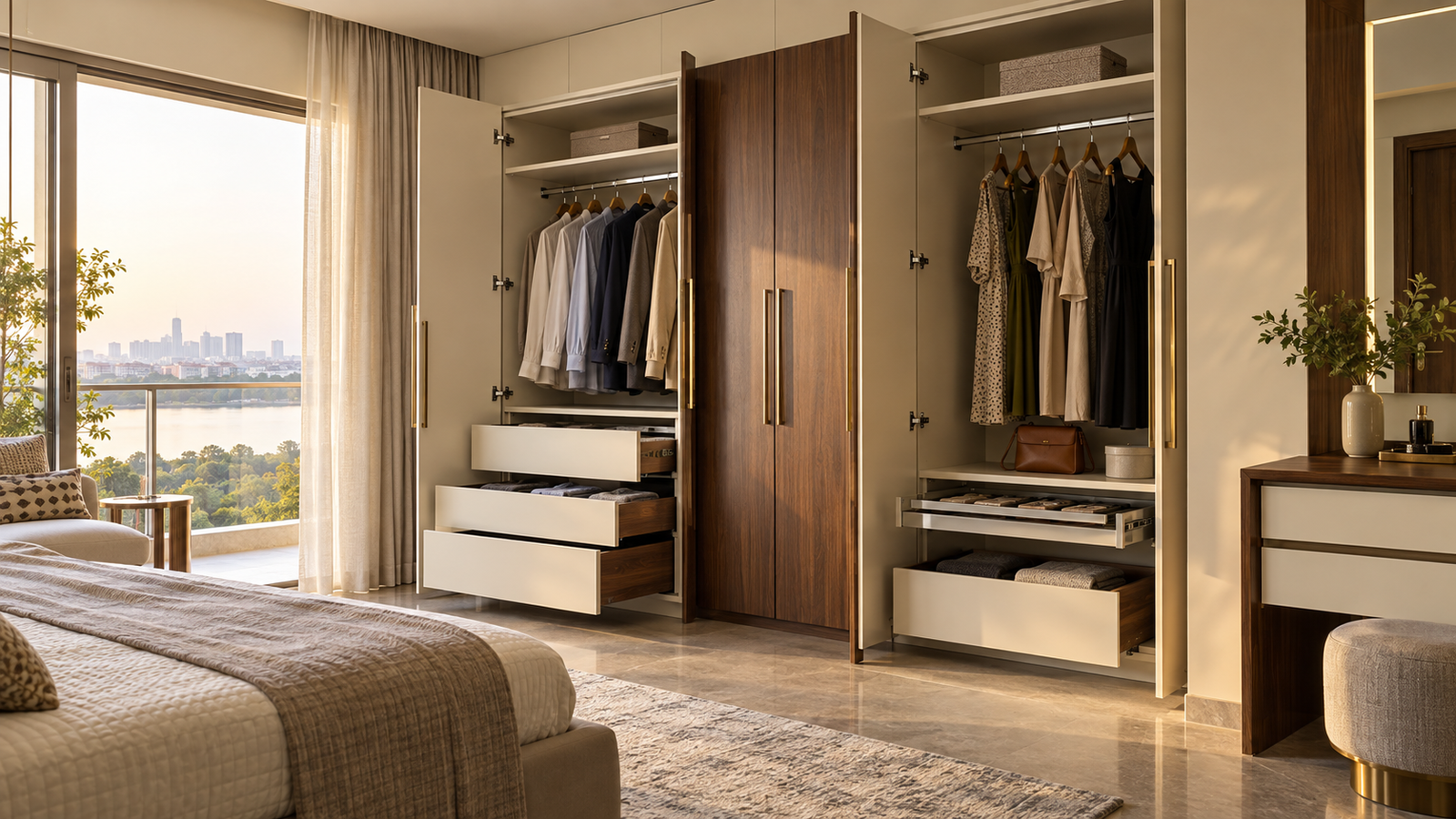
A wardrobe hardware and fittings guide should start with load and access, not with brand names. Hinges carry the shutter through thousands of opening cycles, drawer channels carry the weight of what is stored inside them, hanging rods hold the load of a full rail, and handles, lift-ups and baskets each solve one measured need. Specify every fitting by the job it performs, then confirm the brand or model only where it is genuinely included. Get an approximate custom metal wardrobe estimate in Hyderabad.
Most homeowners think about wardrobe hardware only after a door drops, a soft-close stops cushioning, a drawer starts to scrape or a handle works loose. By then the cabinet is fixed and the fault is awkward to reach. A short conversation at the planning stage about shutter weight, drawer load, rod span and service access prevents most of these complaints before the wardrobe is ever assembled.
This guide explains wardrobe hardware and fittings in practical terms for Hyderabad homes and their humidity. It treats hinges, channels, handles, hanging fittings, internal accessories and the fixing system as one connected package, using the same test throughout: decide the load, choose the fitting that carries it, and keep the fixing point serviceable. Metal & More Interiors designs and manufactures metal interiors in-house from its factory at B.N. Reddy, Charlapally, with its office at Jai Jawahar Nagar, Yapral Ammuguda Road, Secunderabad.
Wardrobe hardware fittings: quick answer
A wardrobe is a set of moving parts held inside a rigid frame. The hinge decides how the door swings and how long the fixing stays tight; the channel decides whether a drawer glides when it is full; the rod and its brackets decide whether a rail of heavy clothing stays level; the handle decides how much force the user applies every time. Get these four decisions right and the wardrobe feels solid for years. Get them wrong and no premium brand label will hide the fault.
Specify by numbers and by conditions. State the shutter height and material so the correct hinge count can be planned. State the drawer width and expected contents so the channel load rating is matched. State the rod span so a centre support can be added before the clothing goes on. Then record the fitting brand, series and model in the written schedule, because “good hardware” in a quotation means nothing once the shutters are on.
Understand wardrobe hardware before choosing
Hardware is often discussed as if it were a single upgrade you either buy or skip. In practice it is several unrelated mechanisms that happen to be sold together. A spring hinge, a telescopic channel, a lift-up stay and a trouser pull-out fail in different ways, and each has its own load limit. Treating them as one “hardware package” is how mismatches creep into a project.
Start with what the wardrobe is expected to hold. Two people sharing one wardrobe place very different demands on it than a guest room used a few nights a year. A children’s wardrobe sees lighter shutters and repeated, less careful handling; a master bedroom wardrobe may carry a full rail of formal clothing, folded stacks and heavy luggage boxes on the loft shelf. The fittings should follow the real household, not an average.
Humidity matters in Hyderabad, and it does not only attack board materials. Metal hardware can corrode when moisture sits on it, and a powder-coated or galvanised surface protects the cabinet while the moving parts still need appropriate finishes or coatings of their own. Ventilation, a small gap for air movement and prompt repair of any leak all extend the working life of hinges, channels and rods. A wardrobe pushed tight against a damp external wall and sealed with no airflow is a poor environment for any fitting.
The frame behind the fitting matters as much as the fitting. A hinge is only as stable as the panel it screws into. If the fixing is made into a thin skin, a hollow profile or an unreinforced edge, the screw can loosen after a season of use, and re-driving it into the same hole rarely restores the original hold. This is why the fastening system, covered later in this guide, is treated as core hardware rather than a detail.
How to evaluate wardrobe hardware fittings
Judging hardware starts with evidence, not appearance. Operate a finished sample: open and close a door, pull a loaded drawer, press the rod with a hand, work the lift-up, and listen. A door that sways when pushed, a drawer that needs a firm pull to start, a rod that dips under pressure or a handle that feels loose are all signals about the fixing and alignment behind the surface. A tidy elevation tells you nothing about any of them.
Ask specific questions rather than accepting a general description. The table below sets out the checks that separate a specified system from a hopeful one.
| Check | What to examine | Why it matters |
|---|---|---|
| Daily access | Place commonly worn clothing between knee and shoulder height, and keep out-of-season items higher. | Fewer awkward reaches and less chance of overloading the wrong shelf. |
| Shutter clearance | Measure the swing of every hinged door against the bed, side wall, curtains and adjacent handle. | Prevents collisions, chipped edges and blocked access in a tight room. |
| Shutter weight | Match hinge count and plate fixing to the door height and material. | A door that is under-hinged droops and stresses the box over time. |
| Drawer load | Check the channel rating against the width and the intended contents. | A short channel on a wide, full drawer sags and drags. |
| Rod support | Confirm the unsupported span against the weight of hanging clothes. | A long unsupported rail bows, and the bow is hard to fix later. |
| Fixing system | Inspect how hinges, channels and rods attach to the cabinet body. | Serviceable fixing points survive adjustment; a stripped hole does not. |
| Future change | Prefer adjustable shelves and documented fixing positions where practical. | Makes later reconfiguration of the layout simpler. |
Once the operating checks are done, ask the questions that decide long-term satisfaction: Which exact hinge and channel models are included? How are they fixed to the cabinet? Can a technician remove a single door or drawer without dismantling the whole wardrobe? What does the written warranty cover, and for how long? Clear answers on these points separate a build that can be maintained from one that must be replaced.
Hinges: the joint that carries every door
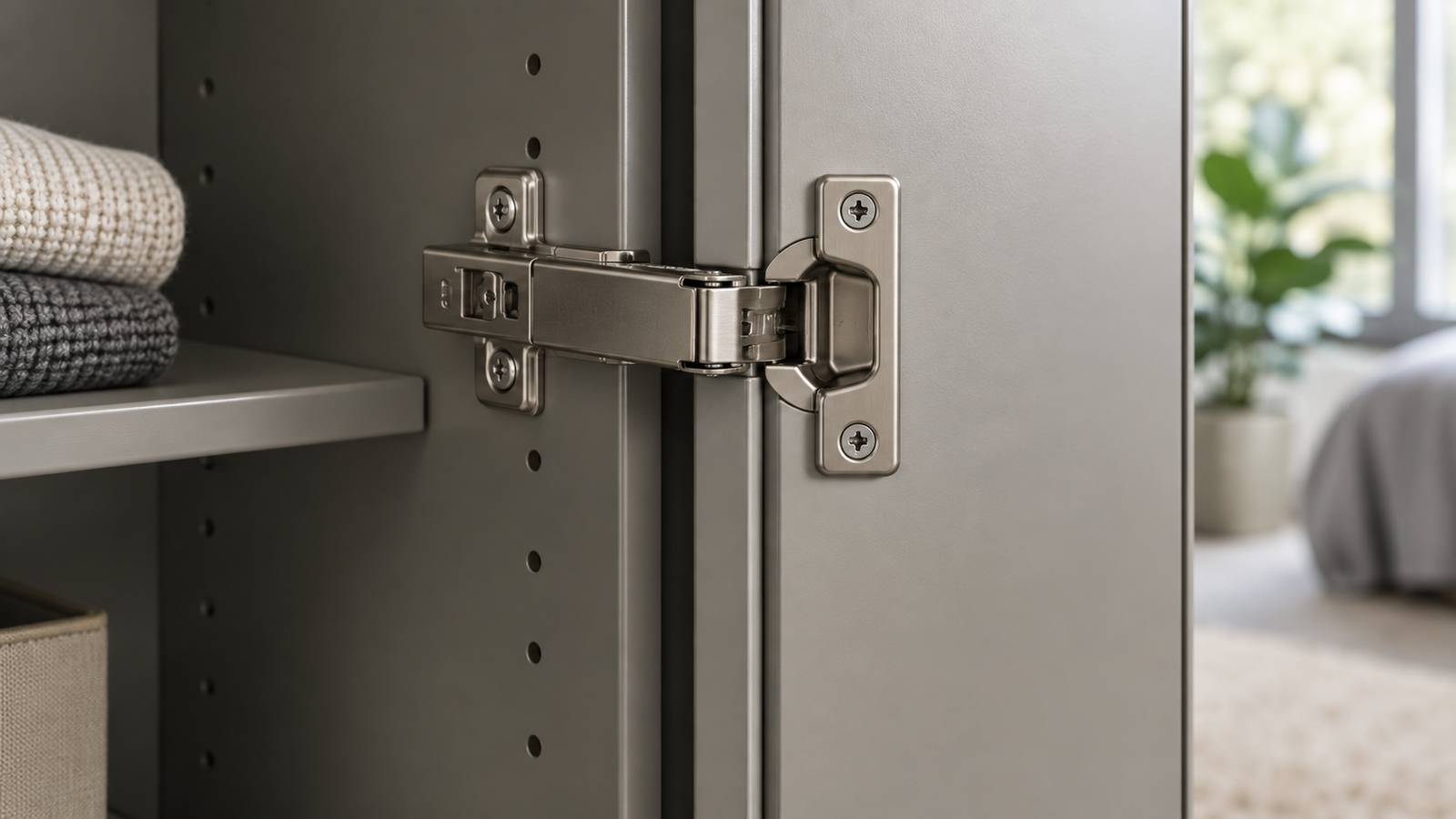
A concealed cup hinge is the default choice for a hinged wardrobe door. The metal cup sits in a bored recess in the door, the plate fixes to the cabinet side, and the two are joined by an adjustable arm. Three adjustments are normally available: side-to-side, which sets the gap between adjacent doors; height, which levels the door; and depth, which controls how firmly the door closes against the carcass. A door that should be easy to adjust but has no working adjustment has usually been installed without enough fixing support behind the plate.
Opening angle and door thickness
Hinges are made for different opening angles, commonly around 100 to 110 degrees for a standard wardrobe door, with wider options for doors that must clear a drawer or a corner. The angle must suit the room: a door that opens into a walkway needs enough swing to reach the rail comfortably, but not so much that it strikes a bed or a wall. Door thickness matters too, because the cup depth and the arm geometry are matched to a thickness range. Confirm both before the door is bored.
How many hinges per door
Hinge count follows door height and weight, not habit. A short overhead door may need two hinges; a full-height shutter carrying a heavy finish normally needs more, spaced to distribute the load down the cabinet side. Under-hinged doors are the most common cause of a dropped front, a strained cabinet side and a hinge that eventually pulls its plate free. The safe approach is to state door height, width, thickness and material, and let the count follow from the load.
Soft-close and damping
Soft-close mechanisms damp the last part of the door’s travel so it settles quietly instead of slamming. They reduce the shock that travels through the hinge plate into the cabinet, which matters on heavier doors, and they suit households with children or with a bedroom next to a quiet room. Damping is a convenience, not a substitute for correct alignment: a misaligned door will still rub even with soft-close fitted, and the mechanism can be overwhelmed if the door is far heavier than the hinge was chosen to carry.
If you are deciding between door styles, the two service pages for hinged-door wardrobes and sliding-door wardrobes explain how the door type changes the hardware load.
Channels and runners: moving drawer load
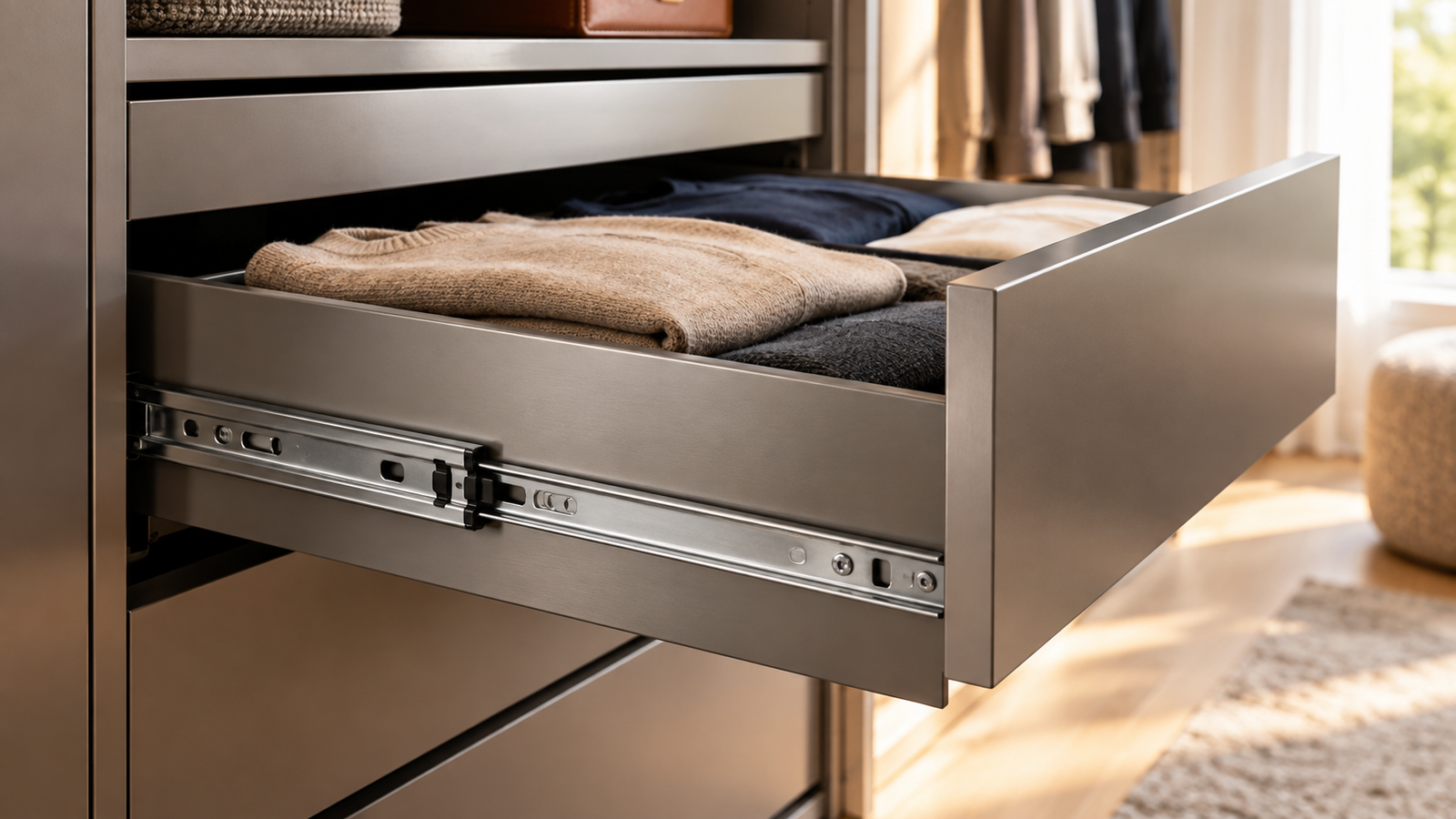
A drawer channel is a pair of rails that lets the drawer travel in and out of the cabinet. The common types are roller runners, which are simple and inexpensive and suit light drawers, and ball-bearing telescopic runners, which carry more weight, extend further and run more smoothly. The choice should follow the drawer’s width, its depth of travel and the weight it is expected to hold, because a channel rated for a light load will sag and drag if it is asked to carry a full drawer of folded clothing.
Load rating and extension
Channel load rating is quoted per pair under defined test conditions, and the usable capacity falls as the runner is made longer or the load is concentrated at the front of a wide drawer. A wide drawer is harder on a channel than a narrow one of the same weight, because the load sits further from the runner. For heavy or wide drawers, choose a runner with a higher rated load and, where the design allows, support the drawer bottom so the channel is not carrying all of the stress. Full-extension runners expose the whole drawer, which is genuinely useful near the back of a deep wardrobe.
Alignment and quiet running
Channels run quietly only when the cabinet is square and the two runners are level with each other. If the cabinet side is twisted, or the two runners are set at slightly different heights, the drawer will bind, rub on one side and wear faster. This is why the accuracy of the cabinet box matters before any premium runner is fitted: hardware follows the frame, it does not correct it. After a few years, a runner may need adjustment or a light service, and a removable drawer with a clear fixing point makes that quick.
Handles, hanging rods and lift-up fittings
Handles take the force of every opening, so their fixing matters more than their appearance. A long bar handle spreads the pull across two fixing points; a small knob concentrates the load on one, which is why knobs work loose sooner on heavy doors. Handle profile also affects how the door feels in the hand and how easily it is cleaned, and a slim profile can look lighter on a tall shutter. Match the handle’s fixing centres to the positions available on the door and make sure the screws seat into a sound zone rather than a thin skin.
Handleless designs move the grip to a routed profile or an integrated edge, removing the projecting handle from a tight room but placing new demands on the door edge and the closing mechanism. Whichever style is chosen, confirm that the fixing is engineered for the door weight. Beyond standard handles, Metal & More makes customised cabinet handles to suit a specific shutter design and grip preference.
The hanging rod looks simple and is frequently under-planned. A rod carries the weight of wet and dry clothing, coats and occasionally a heavy bag, and it bows when its unsupported span is too long for that load. A wardrobe rod should normally be supported by brackets at both ends, with a centre support added once the span grows past the point where the rail stays straight under a full load. The rod diameter and wall thickness, the bracket fixing and the cabinet side all share the duty. Choose the rod height so that the tallest garments clear the shelf above and the floor below, then confirm the clearance before the rail is fixed.
Lift-up fittings and stays hold an overhead door open while the upper shelf is being used, and they must be matched to the weight of that small door so it stays where it is put. A stay that is too weak lets the door fall; one that is too strong fights the user. As with every fitting here, the correct specification follows the load, not the label.
Internal fittings that earn their space
Drawer dividers, jewellery trays, trouser pull-outs, tie racks, shoe racks and pull-down rails each solve a specific storage problem, but every one of them takes up internal volume and adds moving parts that need clearance to operate. A pull-out needs empty space in front of it as well as beside it; a lift-down rail needs room to swing; a deep drawer with a divider holds fewer bulky items than an open one. It is easy to over-fit a wardrobe with mechanisms that look impressive in a showroom and then crowd the clothes in daily use.
The useful approach is to start from the clothes themselves. Count roughly how much long hanging, short hanging, folded and shoe storage the household actually needs, allocate shelf and rail space to each, and only then consider accessories for the categories that remain awkward, such as small jewellery, folded knitwear or a large collection of shoes. Where possible, choose adjustable shelves so the layout can follow changing wardrobes over the years. For a fuller walk-through of shelf heights, rail heights and drawer placement, see the wardrobe internal layout guide.
Accessory fittings also load the cabinet, even though they look light. A pull-out basket full of folded clothes, a loaded trouser rack or a shoe rack on sliding runners all transmit force into the cabinet sides. The fitting is only as reliable as the fixing behind it, so specify the accessory and the fixing together rather than treating the mechanism as a later add-on.
The Insert Nut Fastening System
The most common long-term hardware failure is not a broken hinge or a worn runner; it is a fixing point that will no longer hold. When a screw is driven directly into a panel edge, a thin skin or a hollow profile, it grips only as well as the material around it allows. Adjust the hinge a few times, load the drawer a little more, and the screw can enlarge its own hole until it turns freely and the fitting becomes loose.
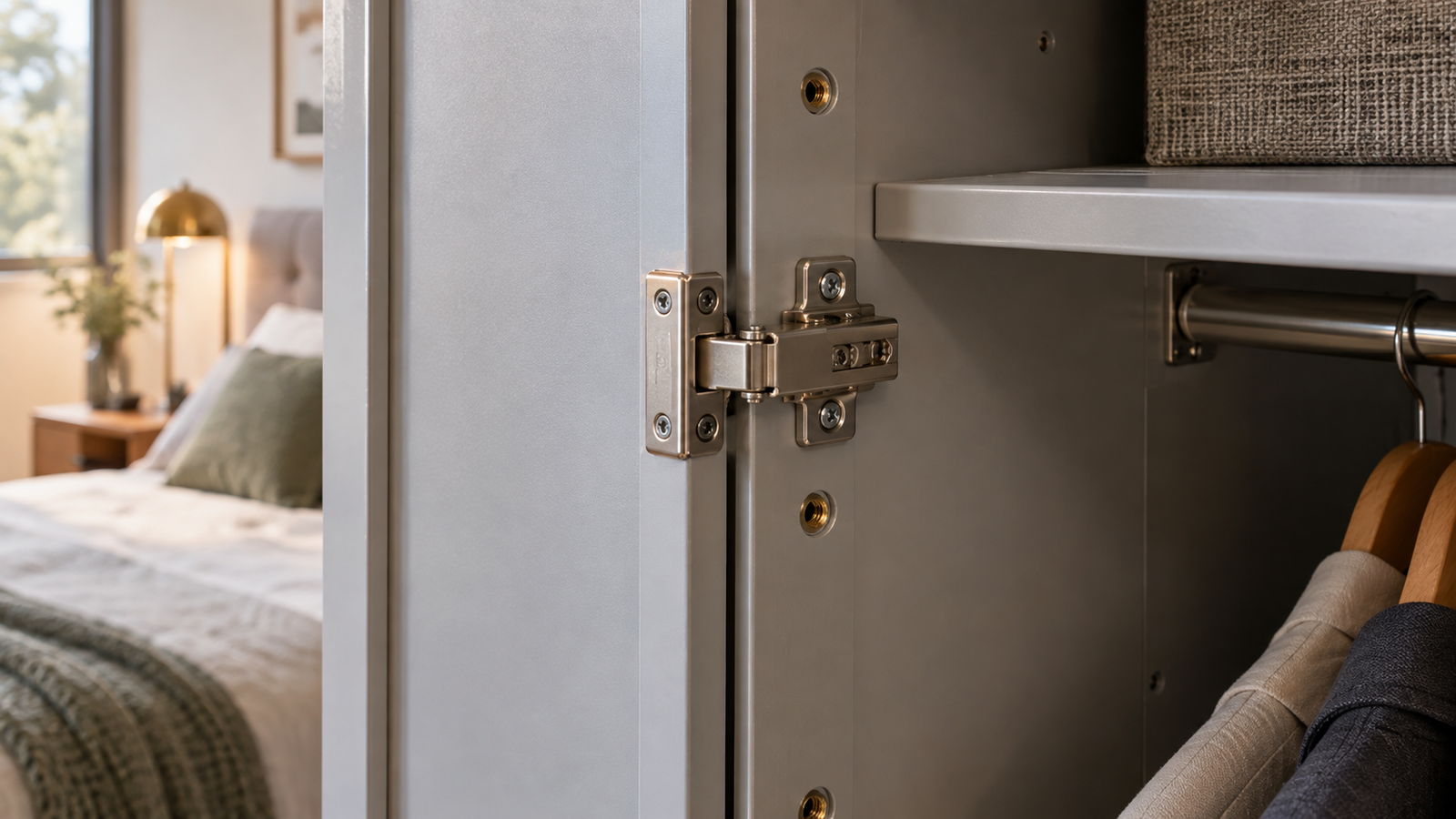
Metal & More Interiors uses an Insert Nut Fastening System in its metal wardrobe modules. A threaded insert is set into the fabricated metal construction to create a controlled fixing point, and a compatible machine fastener threads into it. Because the thread is formed in the insert rather than cut afresh into the substrate each time, a fitting can be removed and refitted during assembly or later service without enlarging the hole. This is the practical difference between a fixing that can be adjusted repeatedly and one that only works the first time.
The system supports repeatable assembly and service; it does not remove the need for accurate measurement, correct hole position, a square cabinet and hardware loaded within its rating. It is best understood as removing one common failure mode, so that the hinge, channel or rod performs as its manufacturer intended. When you inspect a wardrobe, look at how the hardware actually attaches: a visible, engineered fixing point is a better sign of build quality than a brand name on the moving part.
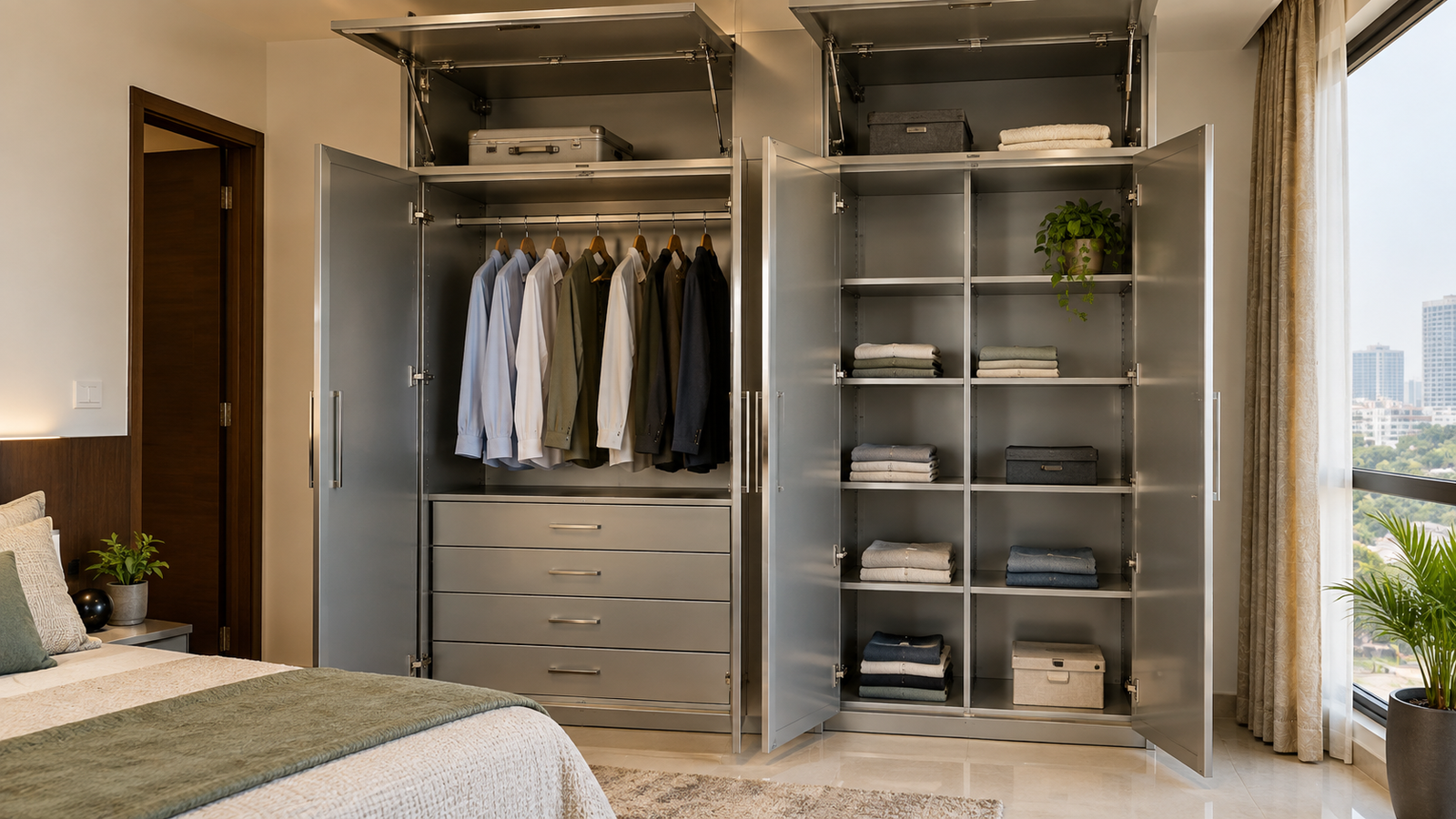
How Metal & More builds wardrobes differently
Metal & More Interiors designs and manufactures metal interiors in Hyderabad, with SS304 stainless steel, aluminium and GI cabinetry fabricated in-house. The practical value of in-house manufacturing is control from site measurement and shop drawings through fabrication, pre-assembly, quality checks and installation. Approved wardrobe modules are produced to a documented material schedule rather than assembled from parts chosen on site.
The selected carcass and shutters are metal: SS304 stainless steel, aluminium or galvanised steel according to the approved schedule, unless a customer deliberately chooses a documented mixed-metal or mixed-material configuration. Typical wardrobe depth is planned around 2 feet where applicable, then adjusted for the wall, doors, hanging clearance, shelves and room circulation. Because the cabinet body is fabricated metal, the sides that carry hinges, channels and rods can be detailed with planned reinforcement and insert-nut fixing points before production rather than after a problem appears.
Warranty is tied to the chosen material: lifetime on stainless steel and aluminium, and 15 years on GI, subject to the written project terms. Hettich hardware can be specified where it is selected for a project; it is not claimed automatically for every fitting, and the brand, series and model should appear in the written schedule wherever it is used. Metal is termite-proof as a material, non-absorbent and easy to clean, and the accurate safety description for the material is fire-resistant.
Choosing SS304, aluminium or GI
The metal used for the cabinet body affects how long a fitting stays reliable, because hinges, channels and rods all load the sides they are fixed to. The table below compares the three options as they relate to wardrobe hardware.
| Material | Where it suits a wardrobe | What it means for fittings |
|---|---|---|
| SS304 stainless steel | High-use and humidity-prone storage, and households that want the most corrosion-resistant body. | A rigid, non-absorbent side holds threaded insert-nut fixing points well; use appropriate cleaners and avoid chloride-rich products. |
| Aluminium | Light, corrosion-resistant wardrobes across bedrooms and utility storage. | Lightweight and easy to finish; profile design, alloy and reinforcement decide how firmly a fitting holds. |
| GI (galvanised steel) | General wardrobe storage with a finished surface, where the zinc-protected body is appropriate. | Coating continuity and fabricated edges should be checked; the 15-year warranty applies under the written project terms. |
None of the three is a single “better” choice for every room; the right one depends on the position of the wardrobe, the load it will carry and the finish you want. Explore the service pages for metal wardrobes in Hyderabad and stainless steel wardrobes before you settle on a material, and confirm the grade and the warranty wording in the written project terms.
Hardware specification checklist
Use this list to make a quotation comparable, so that two wardrobes of similar appearance can be judged on what is actually inside them.
- Record shutter height, width, thickness and material, then the resulting hinge count.
- Specify the hinge type, opening angle and whether soft-close is included.
- State each drawer’s width and expected contents, then the channel type and load rating.
- Confirm the hanging rod diameter, span and centre support, and the rod height clearances.
- Choose handle style and confirm the fixing seats into a sound zone on the door.
- List accessory fittings and check the clearance each one needs to operate.
- Confirm how hinges, channels and rods attach to the cabinet body.
- Ask for the brand, series and model of every fitting in writing.
- Confirm the warranty period and exclusions in writing.
- Operate a finished sample and inspect the inside construction, not just the shutter.
A clear schedule makes comparison easier, not harder. Two wardrobes can look alike in a rendering while using very different cabinet bodies, fixing methods and fitting grades. Ask for enough detail to understand how the wardrobe will behave after a few years of daily use, not only how it photographs on the day it is installed.
Frequently asked questions
Is soft-close hardware necessary?
It is not strictly necessary, but it is worthwhile on heavier doors and drawers. Soft-close damping absorbs the shock that would otherwise travel through the hinge plate into the cabinet, so it protects the fixing and reduces noise. It still needs correct alignment to work, and it cannot compensate for a door that is too heavy for its hinges, which is why wardrobe hardware and fittings should always be specified by load.
When does Metal & More use Hettich?
Hettich hardware can be supplied where it is specified in the approved project. It is not claimed automatically for every fitting, and the written schedule should record the exact brand, series and model wherever it is included, so that the quotation can be checked against what is installed.
Are more accessories always better?
No. Every mechanism uses internal volume and adds moving parts that need clearance. Choose fittings that match the household’s clothing habits and can be reached and operated comfortably, and keep enough open shelf and rail space for everyday use.
How does the Insert Nut Fastening System help?
A threaded insert set into the fabricated metal cabinet creates a fixed, load-bearing connection point. A compatible machine fastener threads into it, so a hinge, channel or rod can be removed and re-fitted during service without enlarging the hole, which is what happens when a screw is driven repeatedly into a soft or hollow substrate.
How many hinges does a wardrobe door need?
Hinge count follows door height, width, thickness and material rather than a fixed rule. A short overhead door may use two hinges, while a full-height shutter carrying a heavier finish normally needs more, spaced to spread the load down the cabinet side. State the door specification so the count can be planned from the load.
Do hanging rods need a centre support?
A rod should be supported at both ends, and a centre support is added once the unsupported span is long enough that the rail would bow under a full load of clothing. Confirm the rod diameter, wall thickness and bracket fixing together, because the span and the load decide whether the rail stays straight.
Final decision
Use this wardrobe hardware and fittings guide as a way to specify, not to shop by label. Decide what each fitting must carry, choose the hinge, channel, rod and handle that suit that load, and insist that the fixing behind them can be serviced. A wardrobe feels solid because its hardware and its cabinet body are matched, not because one part carries a well-known name.
Metal is especially relevant for a wardrobe when the priority is avoiding termite damage, board swelling and fixing points that loosen over time, but it still has to be measured, fabricated and installed correctly. Metal & More Interiors can measure the room, review the storage plan and recommend SS304, aluminium, GI or a documented mixed-metal configuration. The office is at Jai Jawahar Nagar, Yapral Ammuguda Road, Secunderabad, and manufacturing is at B.N. Reddy, Charlapally.