
Plywood kitchen cabinets swell when water reaches the veneers and unsealed edges faster than the panel can dry, so the wood fibres expand across the grain and the board thickens unevenly. Repeated wetting lifts laminate edges, softens cabinet bottoms and throws doors out of alignment. The leak has to be fixed before any cosmetic repair can hold.
Most people search for why plywood kitchen cabinets swell only after a cabinet has already failed, or while comparing quotations and trying to decide whether a “water-resistant” board is genuinely enough for a sink base. The helpful answer is not a single sentence about moisture. It comes from understanding how a sheet of plywood is built, where water actually reaches it, and how the finished cabinet handles sealing, ventilation and service.
This guide explains why plywood kitchen cabinets swell in practical terms for Hyderabad homes, where a long monsoon and humid summers test cabinetry every year. It separates the board from the build: the glue grade, the edge treatment, the cut-outs, the hardware and the plumbing inside the cabinet all decide the outcome. Metal & More Interiors designs and manufactures metal interiors in-house from its factory at B.N. Reddy, Charlapally, with its office at Jai Jawahar Nagar, Yapral Ammuguda Road, Secunderabad.
For many Hyderabad homeowners, this becomes a buying comparison between a plywood kitchen and a steel kitchen. People comparing modular-kitchen suppliers in Hyderabad or a stainless steel modular kitchen in Hyderabad should ask how the sink base, dishwasher bay and floor-level units handle leaks, ventilation and future service. A useful quotation names the material, sealing method, fixing system and warranty for each wet-zone module.
Quick answer
Plywood is made by gluing thin veneers together with the grain of each layer running at right angles to the one below it. Dry plywood is stable because the layers balance each other. Water breaks that balance. It is absorbed at unprotected edges, drilled holes and any point where the surface has been cut or damaged, and the wood fibres take on moisture and expand far more across the grain than along it.
Because the layers cannot all expand together, the panel thickens unevenly, the edges lift and the face can wave or separate from its core. Once that separation starts, the swelling rarely disappears on its own, even after the wood dries. The sequence is always the same: find and stop the water, judge how far the damage has travelled, then decide whether the affected unit can be repaired or should be replaced with a body that does not absorb water at all.
Why plywood kitchen cabinets swell: the moisture mechanism
Not sure whether the damaged unit can be repaired? Describe the leak and the affected edge before you approve a replacement.
Swelling starts at the wettest point and spreads inward. The veneer layers behave like a stack of thin planks glued face to face, so water that enters an exposed edge is drawn along the glue lines by capillary action before it ever shows on the outside face. A cabinet that looks dry from the front can already be swelled and soft along its rear edge or its base.
Two processes run together. The first is fibre expansion, where the wood itself takes on water and grows across the grain. The second is loss of bond, where repeated wetting and drying stress the adhesive between the layers until a veneer lifts. A brief splash is usually far less harmful than water that sits for days against an unsealed edge, because the time water stays in contact matters more than the amount.
Heat and humidity change the picture again. A Hyderabad kitchen can be humid for months, so a cabinet that never sees a visible leak can still take up moisture from the air and through small gaps. Condensation on a cold water pipe inside a sink base adds liquid water that nobody notices, and the warm damp air released by a dishwasher or washing machine creates the conditions that hasten swelling without any obvious flood.
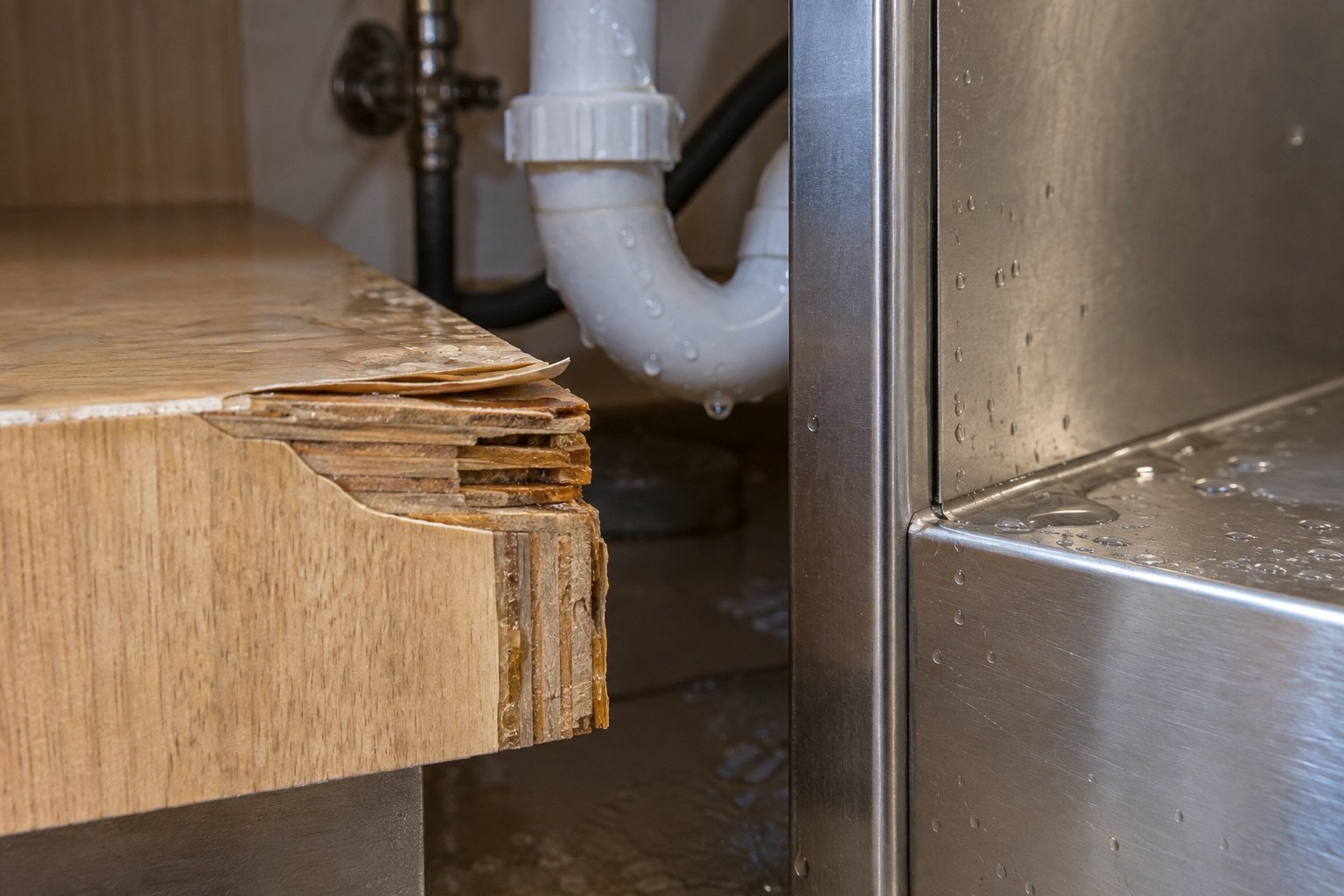
Edge quality decides most failures. A clean, properly sealed edge resists water far better than a raw or chipped one, because the seal blocks the path that water uses to reach the glue lines. The moment that path is opened by a cut-out, a screw or a chipped edge, the protection is only as good as the coating still in place around it.
BWP, BWR and MR plywood compared
Plywood is sold under a small set of water-resistance labels, and they are not interchangeable. The label describes how the board was bonded and how much water the glue can tolerate; it does not describe whether the finished cabinet is immune to water.
| Grade | Glue and usual claim | How it behaves in a kitchen |
|---|---|---|
| MR | Interior glue; resists normal indoor humidity. | Fine in dry cupboards, vulnerable at a sink base or beside any persistent leak. |
| BWR | More water-tolerant bond; sold for kitchen interiors. | Tolerates splashes and damp air better, but edges and cut-outs still need sealing. |
| BWP | Fully water-resistant bond; the highest common interior grade. | Best water tolerance of the three, yet no long-term protection against a running leak. |
| Marine | Void-free core with a marine-grade bond. | Strong and water-tolerant, but designed for boats and not the default kitchen answer. |
The comparison shows why “we used BWP” is not the whole answer. The glue can be excellent while the edge is left raw, the sink cut-out is sealed carelessly and the plinth traps water against the base. Many swollen cabinets are not failures of glue grade at all; they are failures of sealing, drainage and airflow around a board that was otherwise reasonable.
There is also a common myth to set aside. No plywood grade is permanently immune to swelling. A higher grade simply tolerates water for longer before the fibres and the bond give way, which buys time and reduces risk but never removes the need to stop a leak.
Where water reaches a kitchen cabinet
Water almost never arrives evenly. It concentrates at a handful of predictable points, and each one is worth checking before a quotation is approved or a repair is planned.
- The sink cut-out, where the counter is opened and the plumbing passes through.
- The joint between the countertop and the cabinet carcass, and the wall-to-counter seal behind it.
- Dishwasher, washing machine and water-purifier hose connections.
- The cabinet base and plinth, from wet mopping, floor seepage or a slow pipe drip.
- Drilled holes for hinges, channels, wires and handles, which open the core.
- Damaged laminate or edge banding that exposes raw board.
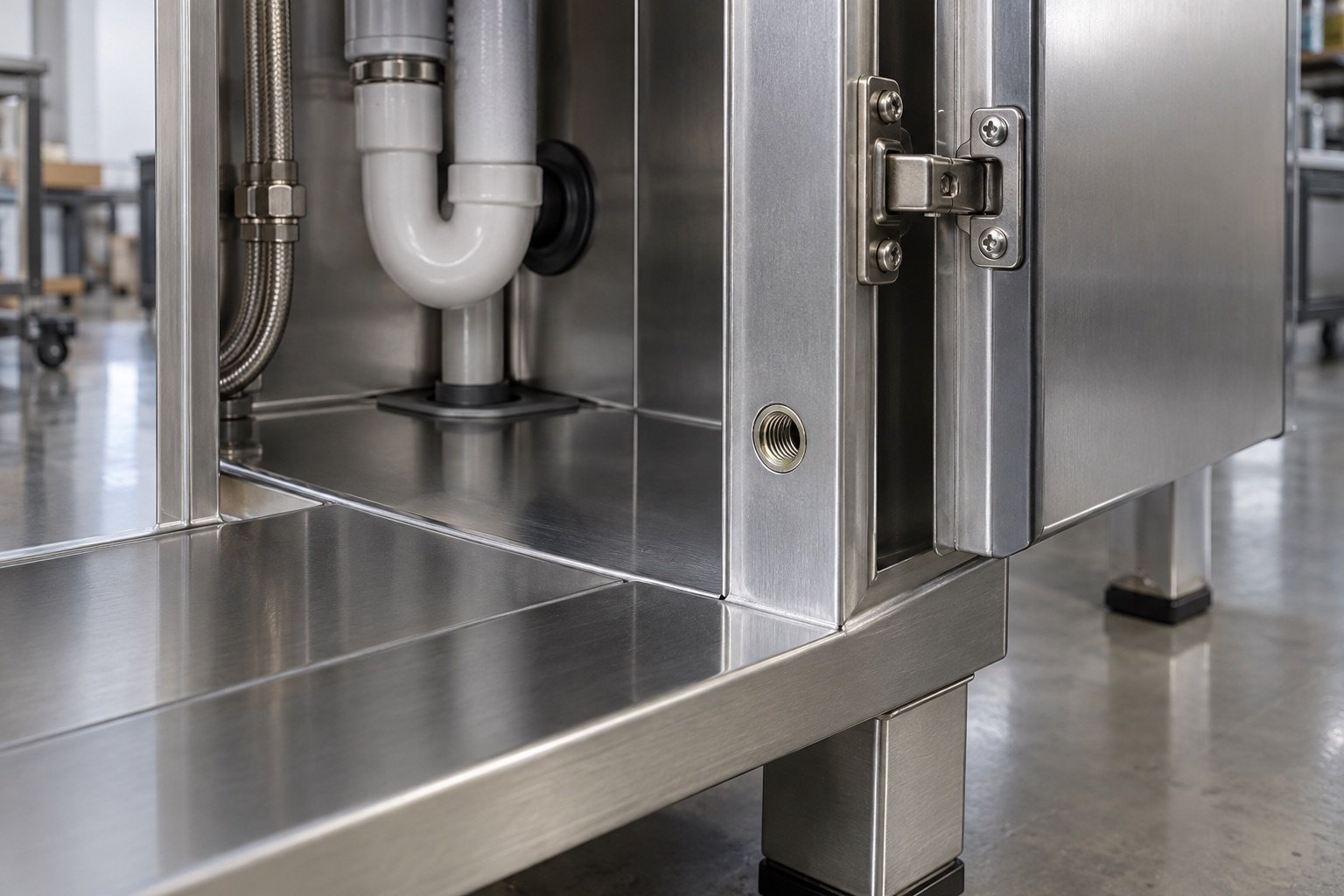
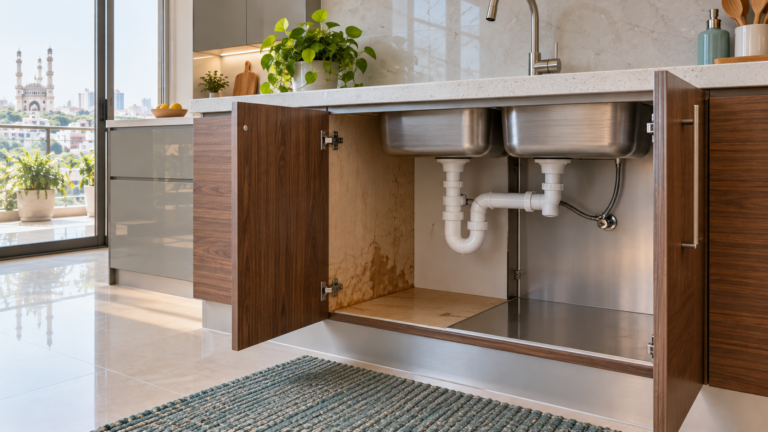
The under-sink base deserves the closest attention because it combines several of these risks in one small space. Plumbing, a drain trap, a purifier and often a dustbin share the same cabinet, and the space is dark and poorly ventilated. When you review a design, ask how the sink base will be sealed, how the plumbing will be reached for service and whether the base floor can be wiped dry. These same entry points recur across board-based kitchens, as the guides to kitchen cabinet water damage and under-sink cabinet failure explain.
Humidity-driven moisture is quieter but constant. A damp wall behind a cabinet, a wet utility corner or a poorly ventilated utility and laundry storage area can keep the air around a cabinet moist for weeks. Over time that is enough to feed the early stages of swelling and to encourage the surface growth described in the guide to mould and fungus inside kitchen cabinets.
Does swollen plywood return to normal?
Sometimes, and only partly. A panel that has taken on light surface moisture can dry out and settle back close to its original thickness once the air around it is dry again. This “swell and recover” behaviour is what leads people to believe a damp cabinet is harmless.
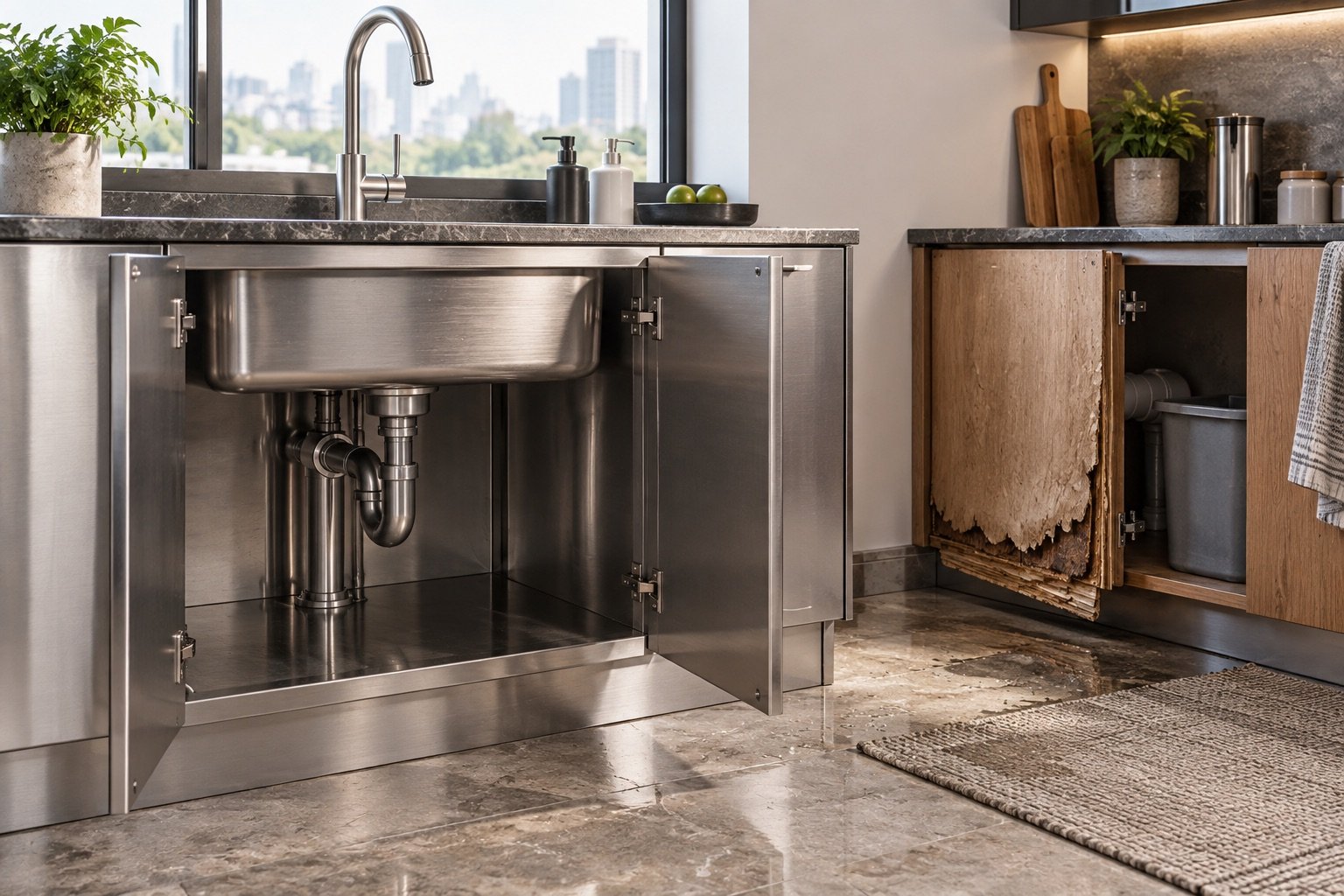
Edge swelling and delamination are different. Once the veneer layers have separated and the fibres at an edge have been compressed and dried, the board usually keeps a raised, wavy lip that no amount of drying removes. The change is permanent because the structure, not just the moisture content, has altered. A straight edge laid across the panel will show whether the surface is still flat, and tapping along an edge will reveal the hollow, separated feel where a bond has failed.
Even when a panel recovers its shape, it does not recover its strength. Cycles of wetting and drying leave the adhesive weaker, the wood more porous and the fixing points looser. A shelf or door that once felt solid may begin to sag or rub, and a hinge screwed into softened board will not hold the way it did when the cabinet was new. That is why a repair should always be judged on structure and hardware, not only on appearance.
How to assess a swollen cabinet
Work from evidence, not from the front face. Photograph the affected area, note when the problem first appeared and check the neighbouring units, because water travels along a base or a wall before it becomes visible. Then separate the visible symptom from the underlying cause.
| Check | What to examine | Why it matters |
|---|---|---|
| Affected edge | Lay a straight edge across the panel and look for a raised lip. | Shows whether the board has swelled at the edge, not merely dampened. |
| Delamination | Tap the face and listen for a hollow sound. | Confirms the bond between veneers has already failed. |
| Soft base | Press the cabinet floor near the sink. | A soft bottom means structural damage, not surface dampness. |
| Door alignment | Check gaps and whether doors rub after the monsoon. | Swelling changes the carcass, and the shutters follow. |
| Fixing points | Tighten a hinge or channel screw gently and watch for spin. | A loose thread shows the core has softened, not just loosened. |
| Odour and staining | Look for musty smells and water marks. | Points to a slow leak that has been running unseen. |
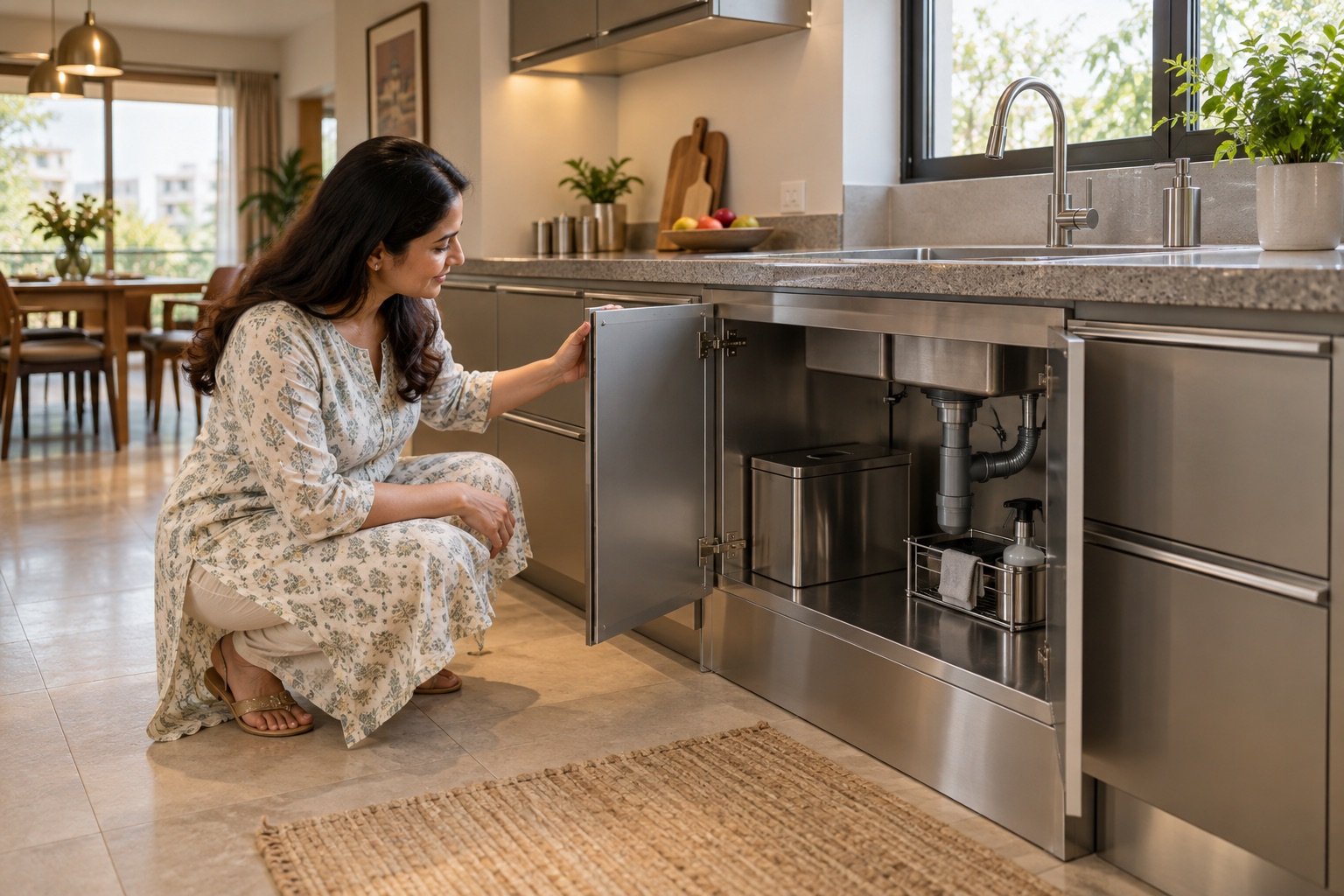
The decision that follows is repair or replace. A single swollen shelf in an otherwise sound cabinet can often be replaced on its own. Swelling along a base, a door line or a run of carcass panels usually signals that water has reached the structure, and patching the surface will not stop it recurring. If the source is a plumbing fault, fix that first, because any repair or replacement will otherwise meet the same water again.
How Metal & More Interiors builds differently
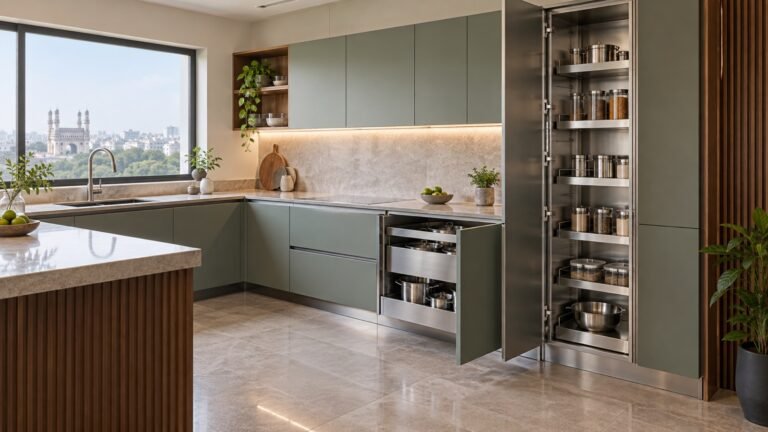
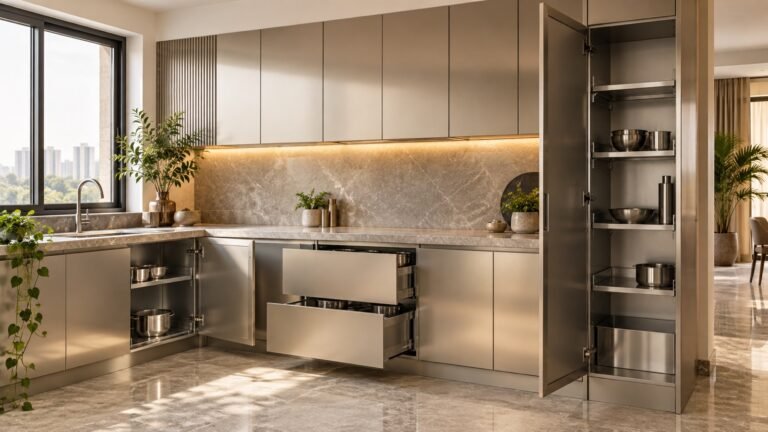
Metal & More Interiors designs and manufactures metal interiors in Hyderabad, with SS304 stainless steel, aluminium and GI cabinetry fabricated in-house. The practical difference is control: the same team measures the room, prepares shop drawings, fabricates the modules, pre-assembles them and installs them, so the finished cabinet matches the agreed specification rather than a decorative skin over an unnamed body.
The cabinet body and shutters are metal, so there is no wood fibre to absorb water and no veneer bond to fail. A spill or a slow drip still needs to be cleaned and repaired, but the cabinet itself cannot swell, delaminate or become a food source for termites. The material is non-absorbent and accurately described as fire-resistant, which removes the single most common cause of the failures described above.
Modules use an Insert Nut Fastening System: a threaded insert forms a controlled fixing point in the fabricated metal, so hardware can be loosened and re-fitted during service without stripping the panel. Kitchen and wardrobe depth is planned around 2 feet where applicable, then adjusted for the wall, appliances, services and circulation. Warranty follows the approved material schedule: lifetime on stainless steel and aluminium, and 15 years on GI, subject to the written project terms.
Choosing SS304, aluminium or GI
SS304 stainless steel
SS304 is the usual choice for a sink base and other demanding wet zones. Its non-porous, corrosion-resistant surface is hygienic and easy to wipe, and it does not absorb water. Confirm the grade and finish, and clean it with suitable products rather than harsh chloride-rich cleaners or steel wool that can mark the surface.
Aluminium
Aluminium is light, corrosion resistant and useful across kitchens, wardrobes and storage. It suits positions where weight and cost balance matters, provided the profile, reinforcement and hardware fixing are designed properly. It can carry warm, residential finishes instead of looking industrial.
GI
Galvanised steel adds a zinc protective layer and is normally paired with a painted or powder-coated finish. Coating continuity at fabricated edges and the care instructions should be clear. Metal & More Interiors provides a 15-year warranty on GI under the written project terms.
For a cabinet that has already swelled, the useful conclusion is not that one board outperforms another by a small margin, but that a metal body removes the mechanism entirely. Where the sink base or utility zone keeps getting wet, compare a stainless steel modular kitchen in Hyderabad against another absorbent board before you commit to replacing like with like.
Repair-or-replace planning checklist
Use the same set of questions whether you are repairing a damaged cabinet or specifying a new wet-zone unit.
- Confirm the exact board grade and where it is used, rather than one label for the whole kitchen.
- Record how every edge and cut-out will be sealed, including the sink opening.
- Check that plumbing and purifier connections stay reachable for service.
- Keep the base off standing water with a wipeable floor and a raised plinth.
- Plan ventilation so damp air can escape from under-sink and utility cabinets.
- Inspect a finished sample, including the inside, back and fixing points.
- Fix any active leak before authorising repair or replacement.
- Confirm the warranty period and its exclusions in writing.
| Situation | Reasonable first step | Why |
|---|---|---|
| One swollen shelf, rest dry | Replace the shelf and fix the leak. | Local damage can be isolated when the surrounding carcass is sound. |
| Swelling along the base or door line | Plan to replace the affected carcass. | Water has reached the structure, so a surface repair will recur. |
| Loose hinge or channel screws | Check the core before re-fixing. | A spinning screw shows the board has softened, not merely loosened. |
| Recurring damp under the sink | Change the material, not only the seal. | If water cannot be prevented, a non-absorbent body is the safer base. |
A clear quotation should make comparison easier. Two kitchens can look identical in a render while using different board grades, edge treatments and hardware. For a wet zone, the more useful question is not which board carries the best water label, but whether the cabinet body can be damaged by water at all.
Frequently asked questions
Can swollen plywood return to its original size?
Light surface dampness may dry out and the panel may relax close to its original thickness. Structural swelling and delamination at an edge usually do not reverse, because the fibres and the glue line have changed permanently. Stop the water source before deciding whether the panel can stay.
Does BWP plywood never swell?
BWP describes a fully water-resistant bond, not a guarantee against water. It tolerates moisture for longer than MR or BWR board, but raw edges, drilled holes, poor sealing or a persistent leak can still allow swelling. The grade and the quality of sealing both matter.
Why do plywood kitchen cabinets swell when the surface looks sealed?
The visible face is only one side of the board. Water most often enters through an unsealed edge, a cut-out or a hole, then travels along the glue lines behind the intact laminate. That is why a cabinet can look fine on the outside while its rear edge or base is already swollen.
Will a metal cabinet solve a plumbing leak?
No. A metal body removes the risk of the cabinet swelling, but a leak can still damage walls, hardware, stored items and finishes. Plumbing access and early detection remain essential whatever the carcass material.
Which cabinet zone needs the most attention?
The sink base, dishwasher bay, floor-level plinth and countertop joints combine hidden water with limited airflow, so they deserve the closest inspection and the most careful sealing.
Is marine plywood a good choice for a wet kitchen?
Marine plywood has a strong, void-free build, but it is designed for boat building rather than kitchen cabinetry. It is usually costlier and harder to source, and it still needs sealed edges. It is not automatically better than BWP for a sink base.
Final decision
Use why plywood kitchen cabinets swell as a decision framework rather than a contest between labels. Identify the room’s real exposure, inspect the hidden construction, and choose a system that can be maintained. Metal is especially relevant when the priority is avoiding water absorption, termite consumption and weak repeat fixing points, but it still has to be designed, fabricated and installed correctly.
Metal & More Interiors can measure the room, review the storage or failure point and recommend SS304, aluminium, GI or a documented mixed-metal configuration. The office is at Jai Jawahar Nagar, Yapral Ammuguda Road, Secunderabad, and manufacturing is at B.N. Reddy, Charlapally.